
Lot 18 清順治 五彩十八羅漢圖象腿瓶 | A RARE WUCAI 'EIGHTEEN LUOHANS' 'ELEPHANT-LEG' VASE
落槌价
预展中
成交价
预展中
| 拍卖公司 | 邦瀚斯 |
|---|---|
| 拍卖时间 | 2026年11月05日 |
拍品信息
拍品名称
清順治 五彩十八羅漢圖象腿瓶 | A RARE WUCAI 'EIGHTEEN LUOHANS' 'ELEPHANT-LEG' VASE
年代
Shunzhi
起拍价
GBP 60,000
估值区间
GBP 60000 - 80000
尺寸
未知
品相
未知
更多信息
Shunzhi
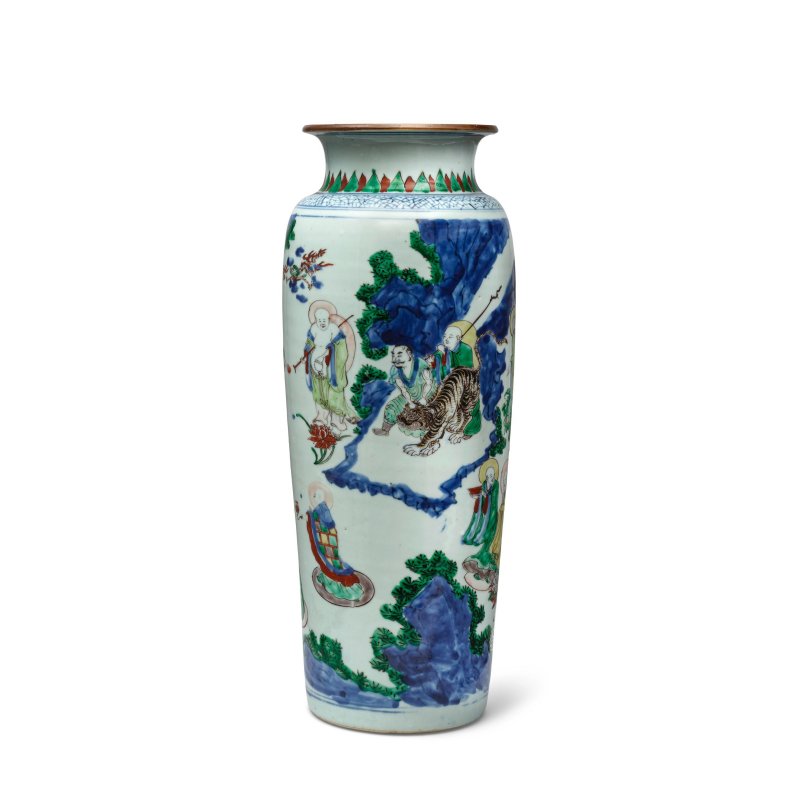
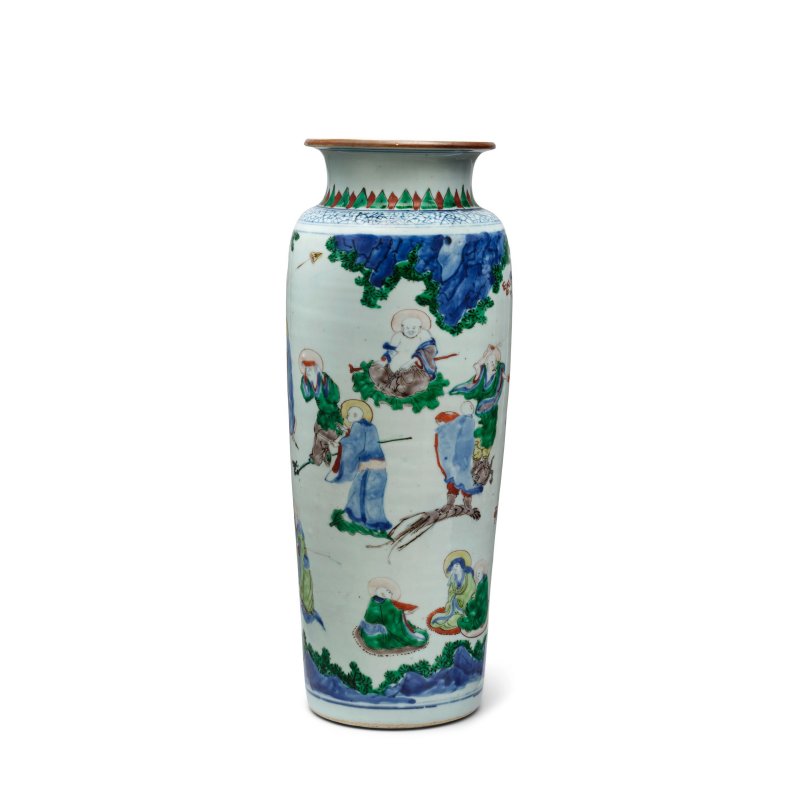
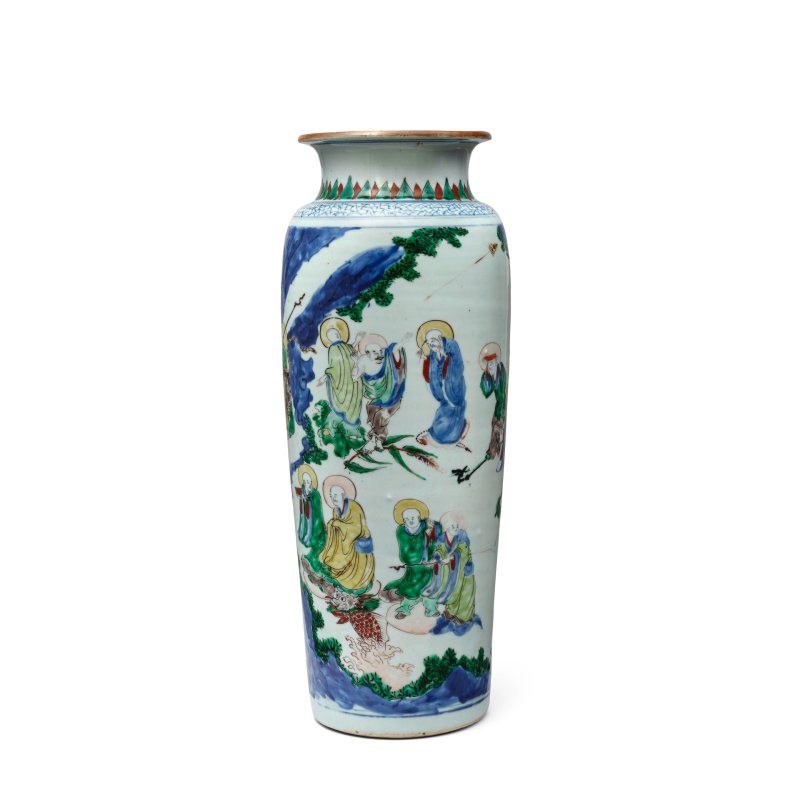
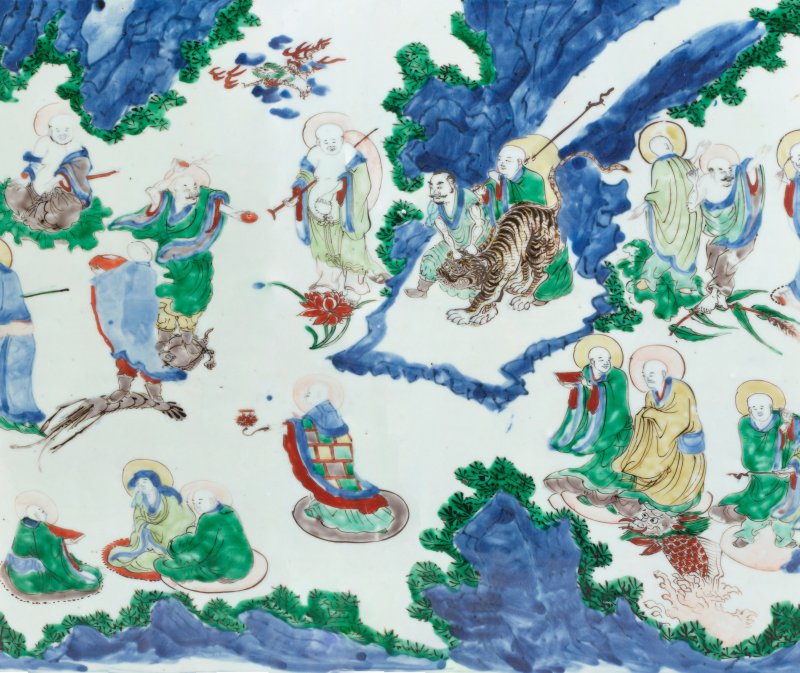
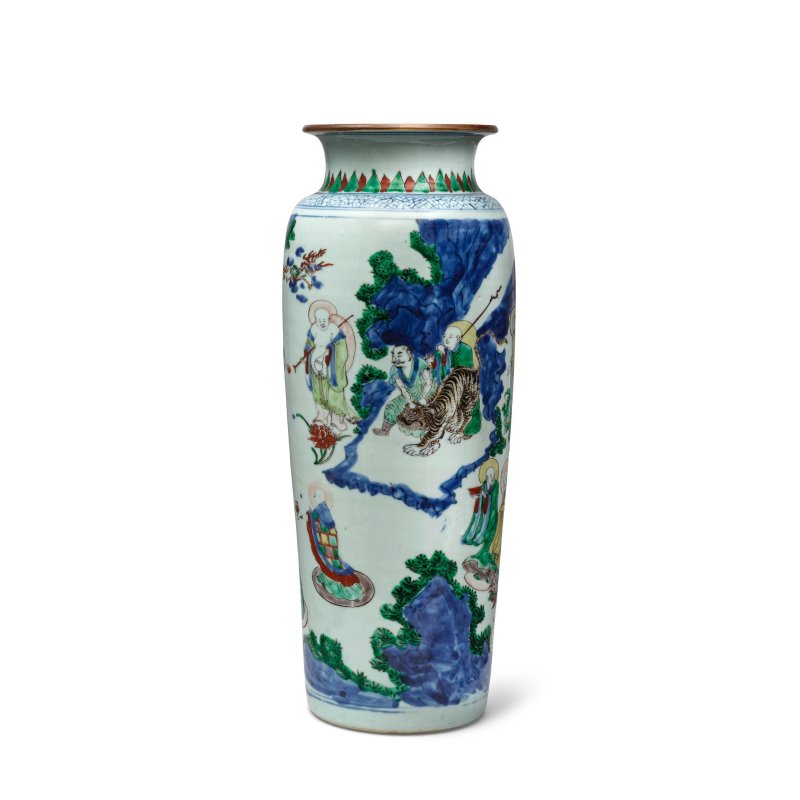
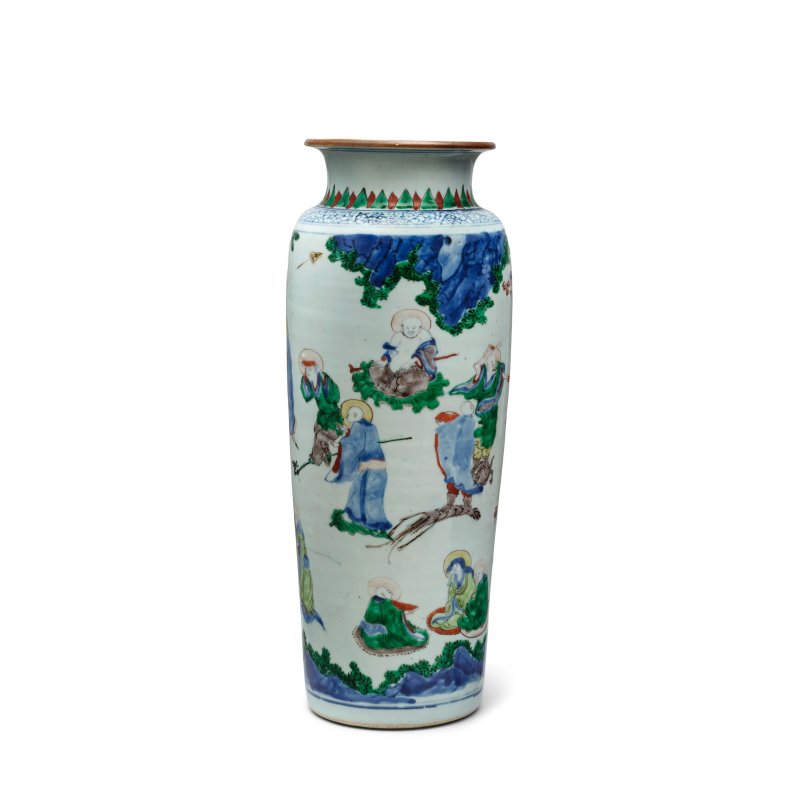
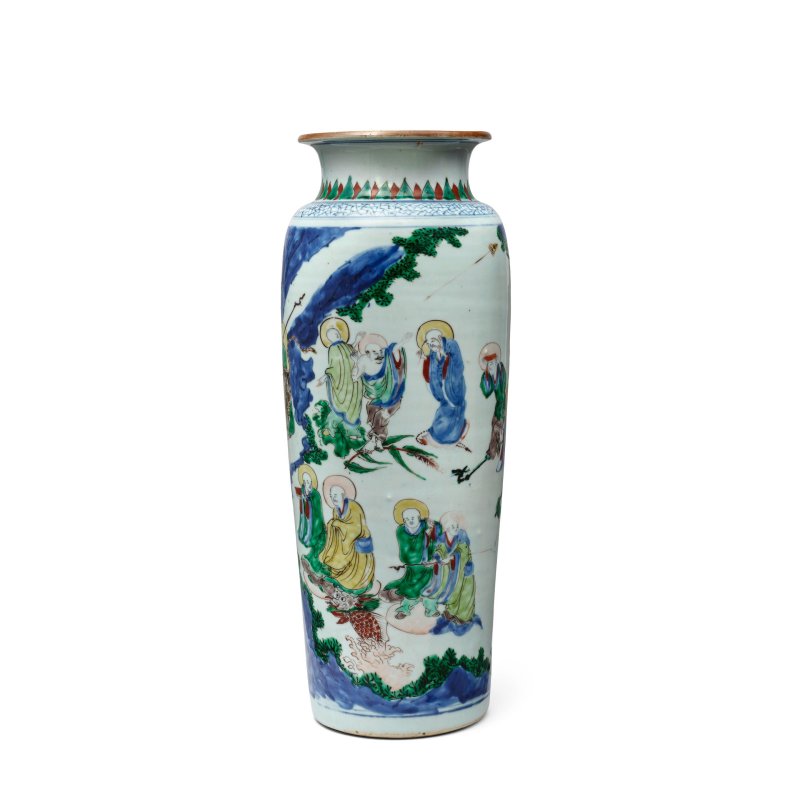
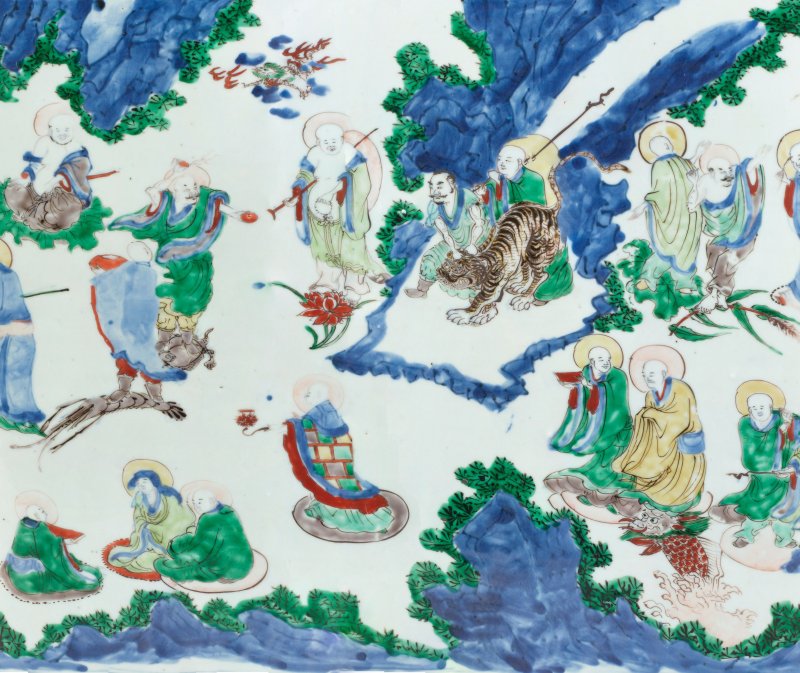
Well potted of cylindrical form with slightly curving walls surmounted by a short waisted neck and everted rim painted brown, the body finely decorated in a rich palette of underglaze cobalt-blue and overglaze green, red and yellow enamels, with a continuous scene of eighteen Luohans with various attributes, one beside a bristling tiger, while three others ride a leaf, turtle and crayfish, several others seated on mats or lotus leaves, one caressing his long eyebrows, a dragon in the sky beneath wispy flames, the shoulder with a band of underglaze blue cracked-ice beneath upright petals of alternating red and green enamels. 46.3cm (18 1/4in) high.
Footnotes
清順治 五彩十八羅漢圖象腿瓶
Provenance:
Priestley & Ferraro Chinese Art, London
Acquired from the above on 9 May 2013
來源:
倫敦古董商覺是軒
從上處獲得于2013年5月9日
Representations of the Eighteen Luohans became an increasingly popular subject in painting during the late Ming period, particularly among artists such as Wu Bin (active c.1590–1610) and Ding Yunpeng (1547–after 1629), whose highly imaginative interpretations emphasised the eccentric, supernatural, and otherworldly qualities of these enlightened disciples. A notable example is Wu Bin's of 1591, now in the Metropolitan Museum of Art, New York, illustrated in , Princeton, 1984, p.200, fig.166. The popularity of Luohan imagery during this period reflects both religious devotion and a broader cultural fascination with unusual and fantastical subjects. Such imagery, however, has much earlier origins, most famously in the celebrated Luohan paintings executed by Guanxiu in AD 891 for Shengyin Temple in Hangzhou, which were later admired, studied, and copied under the patronage of the Qianlong Emperor following his visit to the site in 1757.
The late sixteenth and seventeenth centuries witnessed significant developments within Chinese Buddhism. Chan Buddhism became increasingly integrated with Pure Land practice, combining meditative discipline with devotional worship. At the same time, intellectual and religious life was characterised by an openness to syncretism, often expressed through the concept of ('the unity of the Three Teachings'), which sought to harmonise the doctrines of Buddhism, Daoism, and Confucianism.
This climate of doctrinal flexibility together with the political chaos of the transitional period contributed to a growing appreciation of Buddhism among the scholar-gentry. As Buddhist ideas gained wider acceptance among educated elites, Buddhist themes became increasingly prevalent in painting, ceramics, and other decorative arts. Within this context, the Eighteen Luohans emerged as particularly compelling subjects, embodying spiritual attainment while also providing artists with opportunities to explore highly individualised and often unconventional forms.
The appeal of such imagery was further enhanced by the late Ming fascination with the extraordinary and the eccentric. During a period marked by both commercial prosperity and social change, artists and collectors developed a keen interest in the strange, marvellous, and uncanny. This fascination found expression across a range of cultural pursuits, from ghost stories and accounts of the supernatural to paintings depicting unusual landscapes, fantastic beings, and eccentric religious figures. On this subject, see K.P.Burnett, , Hong Kong, 2013, pp.142–163.
Influenced by both Neo-Confucian and Daoist thought, many intellectuals viewed the unusual and the sublime as vehicles for deeper philosophical reflection. Depictions of the Luohans therefore operated on several levels: they conveyed religious meaning, demonstrated artistic invention, and satisfied contemporary tastes for the remarkable and unexpected. As a result, images of the Eighteen Luohans enjoyed enduring popularity among both religious devotees and secular collectors throughout the late Ming and early Qing periods.
Compare with a related rouleau vase, decorated with a narrative scene beneath a cracked-ice border, c.1650–1660, in the Butler Family Collection, illustrated by M.Butler, M.Medley and S.Little, , Alexandria, 2002, p.206, no.64.
See also a very similar 'Eighteen Luohans' vase, Shunzhi, which was sold at Bonhams Hong Kong, 27 November 2024, lot 16.
Well potted of cylindrical form with slightly curving walls surmounted by a short waisted neck and everted rim painted brown, the body finely decorated in a rich palette of underglaze cobalt-blue and overglaze green, red and yellow enamels, with a continuous scene of eighteen Luohans with various attributes, one beside a bristling tiger, while three others ride a leaf, turtle and crayfish, several others seated on mats or lotus leaves, one caressing his long eyebrows, a dragon in the sky beneath wispy flames, the shoulder with a band of underglaze blue cracked-ice beneath upright petals of alternating red and green enamels. 46.3cm (18 1/4in) high.
Footnotes
清順治 五彩十八羅漢圖象腿瓶
Provenance:
Priestley & Ferraro Chinese Art, London
Acquired from the above on 9 May 2013
來源:
倫敦古董商覺是軒
從上處獲得于2013年5月9日
Representations of the Eighteen Luohans became an increasingly popular subject in painting during the late Ming period, particularly among artists such as Wu Bin (active c.1590–1610) and Ding Yunpeng (1547–after 1629), whose highly imaginative interpretations emphasised the eccentric, supernatural, and otherworldly qualities of these enlightened disciples. A notable example is Wu Bin's of 1591, now in the Metropolitan Museum of Art, New York, illustrated in , Princeton, 1984, p.200, fig.166. The popularity of Luohan imagery during this period reflects both religious devotion and a broader cultural fascination with unusual and fantastical subjects. Such imagery, however, has much earlier origins, most famously in the celebrated Luohan paintings executed by Guanxiu in AD 891 for Shengyin Temple in Hangzhou, which were later admired, studied, and copied under the patronage of the Qianlong Emperor following his visit to the site in 1757.
The late sixteenth and seventeenth centuries witnessed significant developments within Chinese Buddhism. Chan Buddhism became increasingly integrated with Pure Land practice, combining meditative discipline with devotional worship. At the same time, intellectual and religious life was characterised by an openness to syncretism, often expressed through the concept of ('the unity of the Three Teachings'), which sought to harmonise the doctrines of Buddhism, Daoism, and Confucianism.
This climate of doctrinal flexibility together with the political chaos of the transitional period contributed to a growing appreciation of Buddhism among the scholar-gentry. As Buddhist ideas gained wider acceptance among educated elites, Buddhist themes became increasingly prevalent in painting, ceramics, and other decorative arts. Within this context, the Eighteen Luohans emerged as particularly compelling subjects, embodying spiritual attainment while also providing artists with opportunities to explore highly individualised and often unconventional forms.
The appeal of such imagery was further enhanced by the late Ming fascination with the extraordinary and the eccentric. During a period marked by both commercial prosperity and social change, artists and collectors developed a keen interest in the strange, marvellous, and uncanny. This fascination found expression across a range of cultural pursuits, from ghost stories and accounts of the supernatural to paintings depicting unusual landscapes, fantastic beings, and eccentric religious figures. On this subject, see K.P.Burnett, , Hong Kong, 2013, pp.142–163.
Influenced by both Neo-Confucian and Daoist thought, many intellectuals viewed the unusual and the sublime as vehicles for deeper philosophical reflection. Depictions of the Luohans therefore operated on several levels: they conveyed religious meaning, demonstrated artistic invention, and satisfied contemporary tastes for the remarkable and unexpected. As a result, images of the Eighteen Luohans enjoyed enduring popularity among both religious devotees and secular collectors throughout the late Ming and early Qing periods.
Compare with a related rouleau vase, decorated with a narrative scene beneath a cracked-ice border, c.1650–1660, in the Butler Family Collection, illustrated by M.Butler, M.Medley and S.Little, , Alexandria, 2002, p.206, no.64.
See also a very similar 'Eighteen Luohans' vase, Shunzhi, which was sold at Bonhams Hong Kong, 27 November 2024, lot 16.
常见问题
这件清順治 五彩十八羅漢圖象腿瓶 | A RARE WUCAI 'EIGHTEEN LUOHANS' 'ELEPHANT-LEG' VASE的成交价是多少?
落槌价为 预展中。 成交价为 预展中。