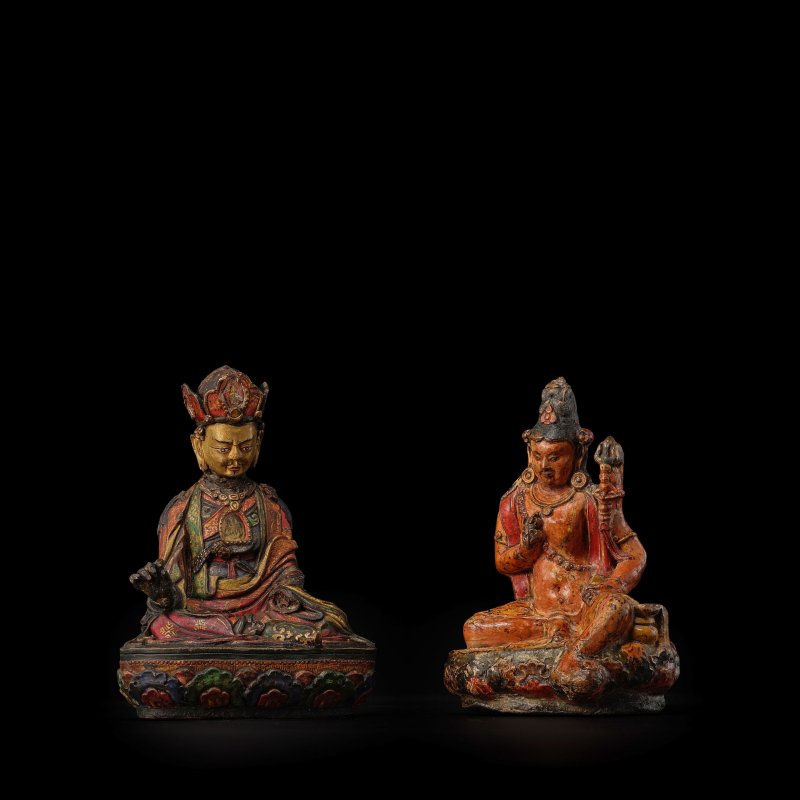
Lot 28 不丹 十八/十九世紀 彩繪蓮花生大士與藏紐赫魯嘎像 | TWO POLYCHROMED CLAY FIGURES OF PADMASAMBAVA AND TSANGNYON HERUKA
落槌价
****
成交价
****
拍品信息
拍品名称
不丹 十八/十九世紀 彩繪蓮花生大士與藏紐赫魯嘎像 | TWO POLYCHROMED CLAY FIGURES OF PADMASAMBAVA AND TSANGNYON HERUKA
年代
BHUTAN, 18TH/19TH CENTURY
起拍价
HKD 26,000
估值区间
未知
尺寸
未知
品相
未知
更多信息
BHUTAN, 18TH/19TH CENTURY
Himalayan Art Resources item no. 207038
Left: 13.5 cm (5 1/4 in.) high
Right: 13 cm (5 1/8 in.) high
Footnotes
不丹 十八/十九世紀 彩繪蓮花生大士與藏紐赫魯嘎像
Provenance
The Mahasiddha, since 1990s
The Guru Rinpoche, since 2010s
John and Karina Stewart Collection
Padmasambhava, known as the "Lotus-Born", is credited with introducing tantric Buddhism to Bhutan during the eighth century. Revered as the Second Buddha by the Nyingma school, he is associated with the transmission of Buddhist teachings and the concealment of spiritual treasures (terma). Tsangnyon Heruka (1452–1507), an influential master of the Kagyu tradition, is celebrated for his biography of Milarepa, a foundational work of Tibetan religious literature.
Padmasambhava is depicted wearing his distinctive lotus hat and layered robes, with an ornamental pendant at his chest and his right hand extended. Tsangnyon Heruka is represented with his hair arranged in a high chignon, large circular earrings, and a ritual staff, reflecting the iconographic traditions of the Indian mahasiddhas.
Both figures are distinguished by their expressive facial features, deeply modeled garments, and lotus bases with three-lobed petals characteristic of Bhutanese sculpture. Comparable lotus bases appear on a figure of Padmasambhava illustrated in Bartholomew and Johnston (eds.), , Chicago, 2008, pp. 274–75, no. 57, and another sold at Christie's, New York, 21 September 2021, lot 411.