
拍品信息
拍品名称
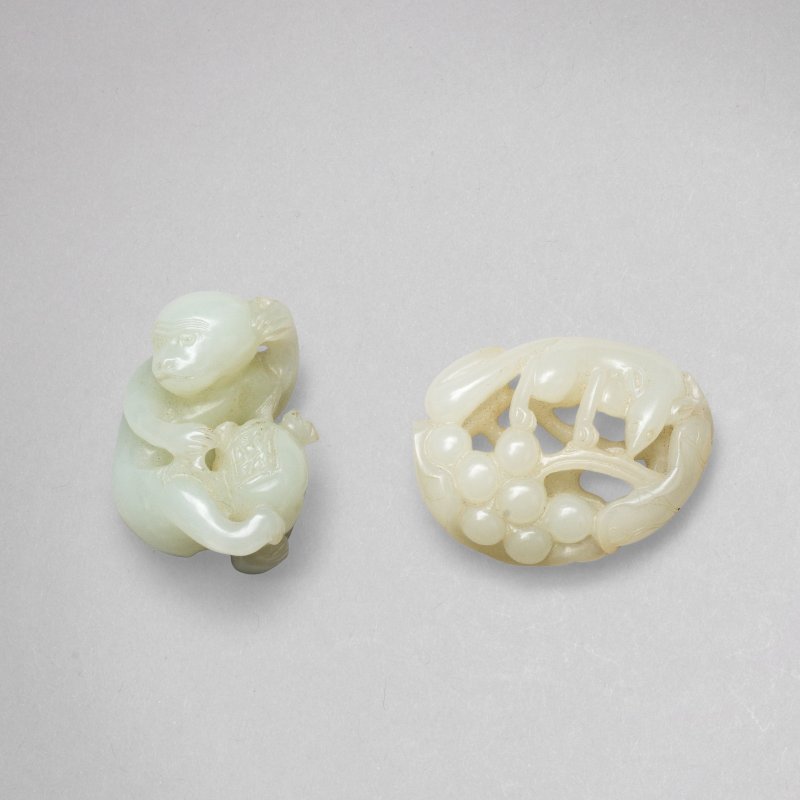
清 白玉靈猴及松鼠葡萄把件 一組兩件 | A WHITE JADE 'MONKEY' CARVING AND A WHITE JADE 'SQUIRREL AND GRAPE' CARVING
年代
Qing Dynasty
起拍价
GBP 3,500
估值区间
GBP 3500 - 5500
尺寸
未知
品相
未知
更多信息
Qing Dynasty
Comprising: a jade carving of a monkey, seated with its left hand scratching the ear and the right hand clutching a sprig of pomegranate, the stone of an even white tone, 4.5cm (1 3/4in) high; and a jade carving pierced and carved with a squirrel with a long bushy tail, biting and clasping a leafy sprig of grapes, the stone of an even white tone, 5cm (2in) long. (2).
Footnotes
清 白玉靈猴及松鼠葡萄把件 一組兩件
Provenance: a Norwegian private collection, acquired while working at the Royal Norwegian Embassy in Beijing in the 1960s–1970s, and thence by descent
來源:挪威私人收藏,於1960至1970年代在北京挪威皇家大使館任職期間獲得,後由家族傳承迄今
The 'squirrel and grapes' motif carries rich auspicious symbolism in Chinese art, representing themes of abundance and prosperity. Grapes, with their bountiful clusters of fruit, symbolise fertility and the desire for numerous descendants. Squirrels, celebrated for their vitality and agility, complement this imagery by embodying resourcefulness and vigour. Together, the motif conveys blessings for a flourishing family and a prosperous life. See a related jade pendant in the shape of squirrels and grapes, Qing dynasty, in the collection of the Capital Museum, illustrated in (中國傳世玉器全集), vol.6, Beijing, 2010, p.206. See a related white and russet jade 'squirrel and grapes' pendant, 18th/19th century, which was sold at Bonhams Hong Kong, 5 May 2025, lot 43.
Compare the jade monkey carving with a related jade 'monkey and peach' carving, Qing dynasty, in the collection of Kaifeng Museum, illustrated in (中國傳世玉器全集), vol.6, Beijing, 2010, p.112. See also a related white jade 'monkey and peach' group, Qing dynasty, which was sold at Sotheby's London, 10 May 2017, lot 93.
Comprising: a jade carving of a monkey, seated with its left hand scratching the ear and the right hand clutching a sprig of pomegranate, the stone of an even white tone, 4.5cm (1 3/4in) high; and a jade carving pierced and carved with a squirrel with a long bushy tail, biting and clasping a leafy sprig of grapes, the stone of an even white tone, 5cm (2in) long. (2).
Footnotes
清 白玉靈猴及松鼠葡萄把件 一組兩件
Provenance: a Norwegian private collection, acquired while working at the Royal Norwegian Embassy in Beijing in the 1960s–1970s, and thence by descent
來源:挪威私人收藏,於1960至1970年代在北京挪威皇家大使館任職期間獲得,後由家族傳承迄今
The 'squirrel and grapes' motif carries rich auspicious symbolism in Chinese art, representing themes of abundance and prosperity. Grapes, with their bountiful clusters of fruit, symbolise fertility and the desire for numerous descendants. Squirrels, celebrated for their vitality and agility, complement this imagery by embodying resourcefulness and vigour. Together, the motif conveys blessings for a flourishing family and a prosperous life. See a related jade pendant in the shape of squirrels and grapes, Qing dynasty, in the collection of the Capital Museum, illustrated in (中國傳世玉器全集), vol.6, Beijing, 2010, p.206. See a related white and russet jade 'squirrel and grapes' pendant, 18th/19th century, which was sold at Bonhams Hong Kong, 5 May 2025, lot 43.
Compare the jade monkey carving with a related jade 'monkey and peach' carving, Qing dynasty, in the collection of Kaifeng Museum, illustrated in (中國傳世玉器全集), vol.6, Beijing, 2010, p.112. See also a related white jade 'monkey and peach' group, Qing dynasty, which was sold at Sotheby's London, 10 May 2017, lot 93.
常见问题
这件清 白玉靈猴及松鼠葡萄把件 一組兩件 | A WHITE JADE 'MONKEY' CARVING AND A WHITE JADE 'SQUIRREL AND GRAPE' CARVING的成交价是多少?
落槌价为 预展中。 成交价为 预展中。


