
拍品信息
拍品名称
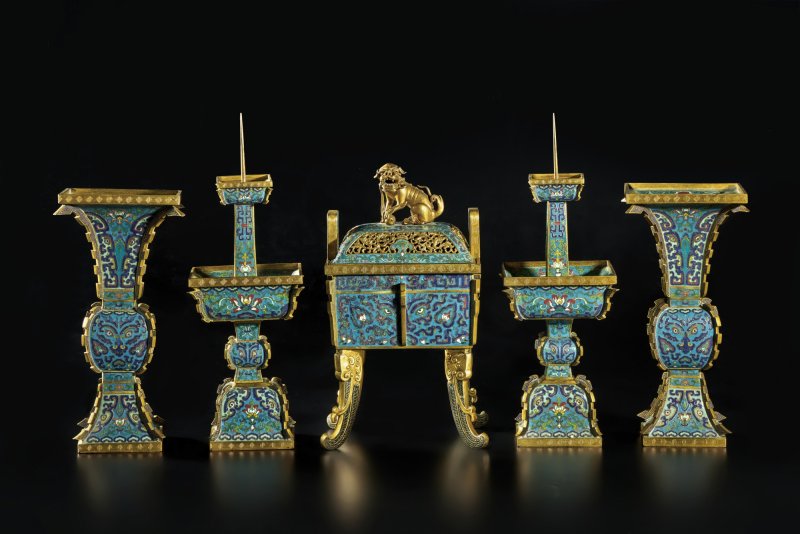
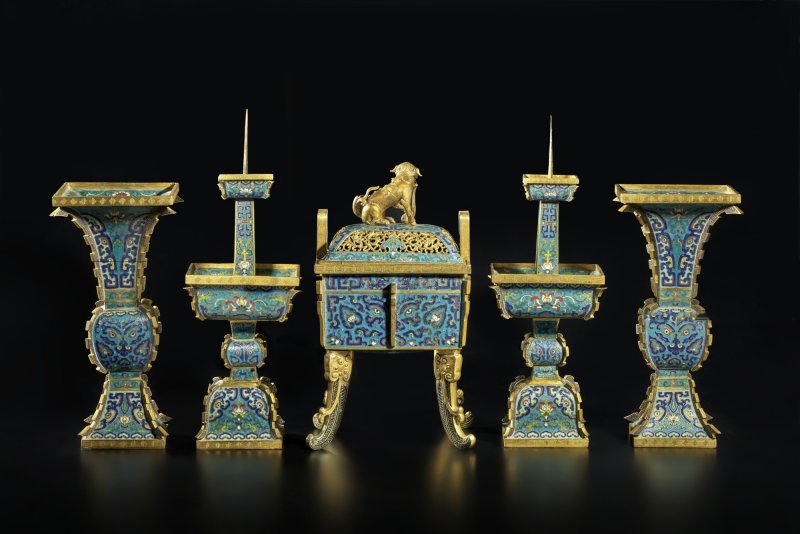
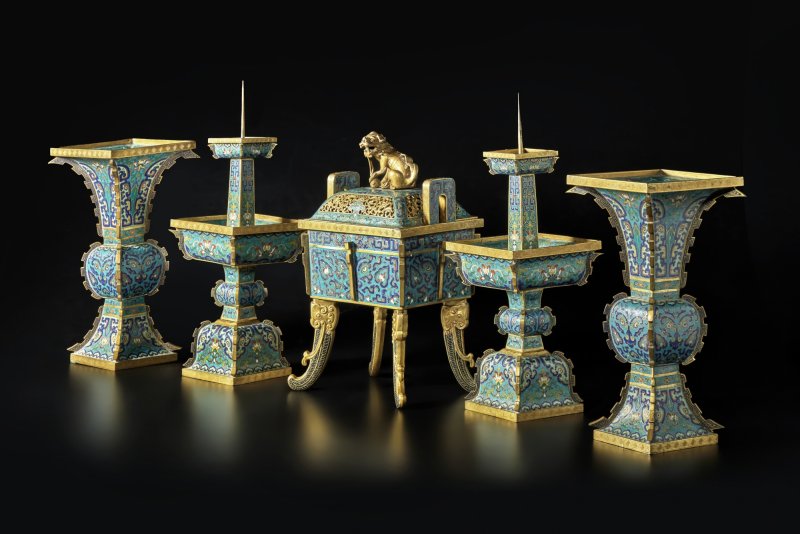
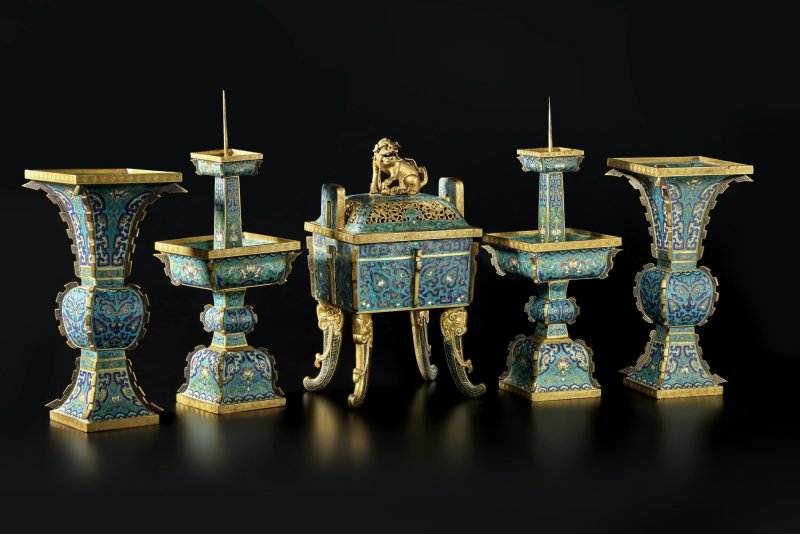
清乾隆 掐絲琺瑯纏枝蓮紋五供一套
起拍价
USD 80,000
估值区间
80,000 - 120,000 USD
尺寸
未知
品相
如欲了解本拍品狀況的更多資訊,請聯絡 Drew.Lerner@sothebys.com
更多信息
(6)
Height of candlestick 17 in., 43.2 cm
来源:紐約蘇富比2005年3月31日,編號240
图录
说明:Inspired by the designs of antiquity but replete with eighteenth century grandeur, the present lot is a fine and rare example of a complete garniture from the height of cloisonné enamel production. Adorned with taotie masks and composed of forms inspired by the fanggu and fangding vessels of the Shang and Western Zhou dynasties, the present garniture pays homage to China’s ancient past. Its bright gilded surfaces, rococoesque lotus designs and characterful Buddhist lion finial, however, hold this antiquity in tension, and speak to the continuity of Chinese history; not simply hearkening back to a forgotten age but bringing its spirit into the contemporary grandeur of the Qing court.
While many individual altar vessels from this zenith of production survive today, complete surviving five-piece garnitures of matching design are exceedingly rare, even in the imperial collection preserved in the Palace Museum, Beijing. Compare two garnitures of Qianlong marks and period of rounded forms and lotus designs in Compendium of Collections in the Palace Museum, Enamels, vol. 3, Cloisonné in the Qing Dynasty, Beijing, 2011, pls 6 and 7; and three others of similar rounded forms and floral designs: one from the collection of Samuel P. Avery (1847–1920), sold in these rooms from the the Caramoor Center for Music and the Arts, 15th March 2016, lot 128; another from the Lizzadro Collection sold at Christie’s New York, 21st March 2013, lot 906; and the other from the collection of the Springfield Museums, sold at Christie’s Hong Kong, 28th May 2021, lot 2902.
This garniture is particularly notable in the prominence of its bronze-inspired taotie design and square archaistic forms, which root the assemblage in antiquity. Only three other closely comparable garnitures of archaistic design and rectilinear form appear to be published: the first in the Uldry Collection at the Museum Rietberg included in Helmut Brinker and Albert Lutz, Chinese Cloisonné Enamel: The Pierre Uldry Collection, Asia Society, New York, 1989, cat. no. 267; the second of a more rudimentary design attributed to the first half of the 17th century in Gunhild Gabbert Avitabile, Die Ware aus dem Teufelsland. Chinesische und japanische Cloisonné- und Champlevé-Arbeiten von 1400 bis 1900, Museum für Kunsthandwerk, Frankfurt, 1981, cat. no. 51; and the other sold at Christie’s New York, 19th September 2006, lot 97.
Also compare two cloisonné fangding censers of closely related form, archaistic design and lion finial to the present in the Qing Court Collection in Compendium of Collections, op. cit., pls 225 and 226; another sold at Christie’s Hong Kong, 2nd December 2015, lot 3250; and another in Chinese Cloisonné. The Clague Collection, Phoenix Art Museum, 1980, cat. no. 41.
Height of candlestick 17 in., 43.2 cm
来源:紐約蘇富比2005年3月31日,編號240
图录
说明:Inspired by the designs of antiquity but replete with eighteenth century grandeur, the present lot is a fine and rare example of a complete garniture from the height of cloisonné enamel production. Adorned with taotie masks and composed of forms inspired by the fanggu and fangding vessels of the Shang and Western Zhou dynasties, the present garniture pays homage to China’s ancient past. Its bright gilded surfaces, rococoesque lotus designs and characterful Buddhist lion finial, however, hold this antiquity in tension, and speak to the continuity of Chinese history; not simply hearkening back to a forgotten age but bringing its spirit into the contemporary grandeur of the Qing court.
While many individual altar vessels from this zenith of production survive today, complete surviving five-piece garnitures of matching design are exceedingly rare, even in the imperial collection preserved in the Palace Museum, Beijing. Compare two garnitures of Qianlong marks and period of rounded forms and lotus designs in Compendium of Collections in the Palace Museum, Enamels, vol. 3, Cloisonné in the Qing Dynasty, Beijing, 2011, pls 6 and 7; and three others of similar rounded forms and floral designs: one from the collection of Samuel P. Avery (1847–1920), sold in these rooms from the the Caramoor Center for Music and the Arts, 15th March 2016, lot 128; another from the Lizzadro Collection sold at Christie’s New York, 21st March 2013, lot 906; and the other from the collection of the Springfield Museums, sold at Christie’s Hong Kong, 28th May 2021, lot 2902.
This garniture is particularly notable in the prominence of its bronze-inspired taotie design and square archaistic forms, which root the assemblage in antiquity. Only three other closely comparable garnitures of archaistic design and rectilinear form appear to be published: the first in the Uldry Collection at the Museum Rietberg included in Helmut Brinker and Albert Lutz, Chinese Cloisonné Enamel: The Pierre Uldry Collection, Asia Society, New York, 1989, cat. no. 267; the second of a more rudimentary design attributed to the first half of the 17th century in Gunhild Gabbert Avitabile, Die Ware aus dem Teufelsland. Chinesische und japanische Cloisonné- und Champlevé-Arbeiten von 1400 bis 1900, Museum für Kunsthandwerk, Frankfurt, 1981, cat. no. 51; and the other sold at Christie’s New York, 19th September 2006, lot 97.
Also compare two cloisonné fangding censers of closely related form, archaistic design and lion finial to the present in the Qing Court Collection in Compendium of Collections, op. cit., pls 225 and 226; another sold at Christie’s Hong Kong, 2nd December 2015, lot 3250; and another in Chinese Cloisonné. The Clague Collection, Phoenix Art Museum, 1980, cat. no. 41.
常见问题
拍品的品相状况如何?
如欲了解本拍品狀況的更多資訊,請聯絡 Drew.Lerner@sothebys.com
这件拍品的流传来源是什么?
紐約蘇富比2005年3月31日,編號240
图录
图录