
拍品信息
拍品名称
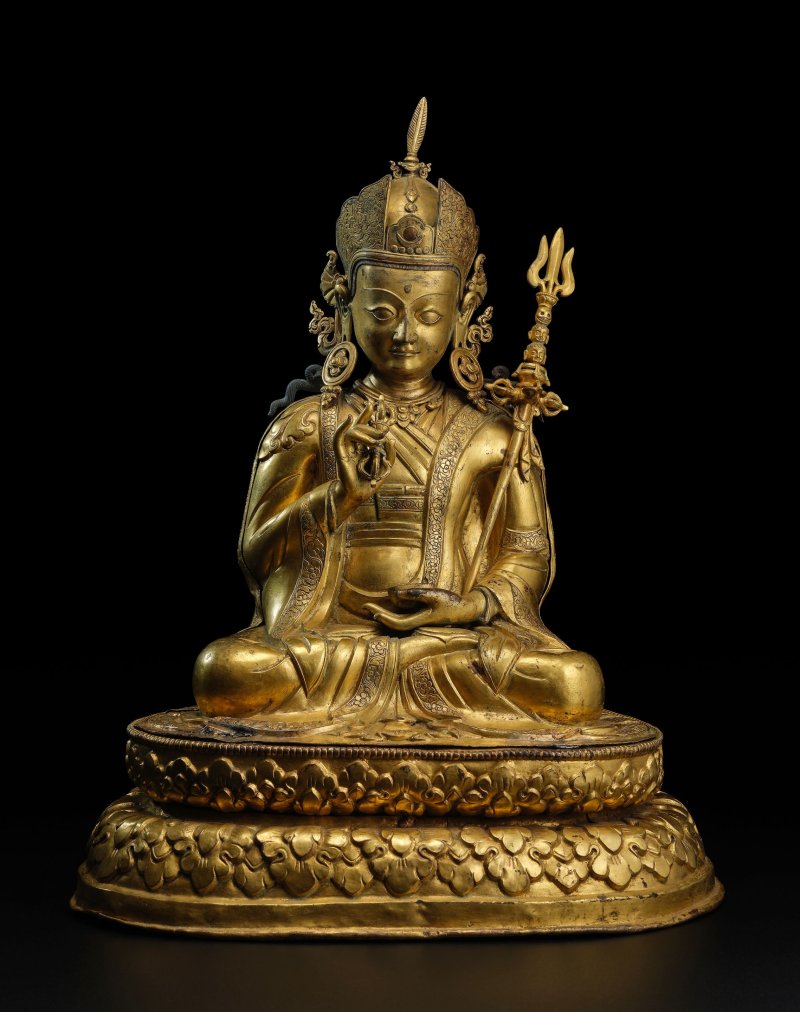
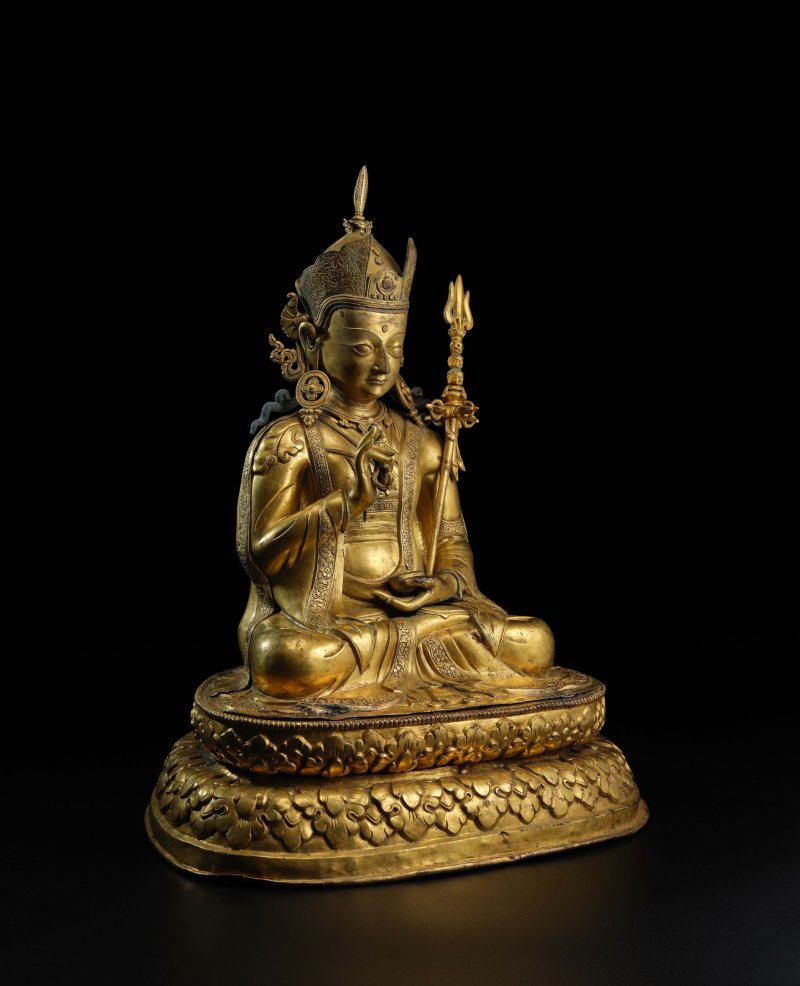
西藏或不丹 十八世紀 銅鎏金及錘揲蓮花生大士像 | A GILT COPPER ALLOY REPOUSSE FIGURE OF PADMASAMBHAVA
年代
TIBET OR BHUTAN, 18TH CENTURY
起拍价
HKD 300,000
估值区间
HKD 300000 - 500000
尺寸
未知
品相
未知
更多信息
TIBET OR BHUTAN, 18TH CENTURY
Himalayan Art Resources item no. 207027
50 cm (19 3/4 in.) high
Footnotes
西藏或不丹 十八世紀 銅鎏金及錘揲蓮花生大士像
Provenance
Ex Private German Collection
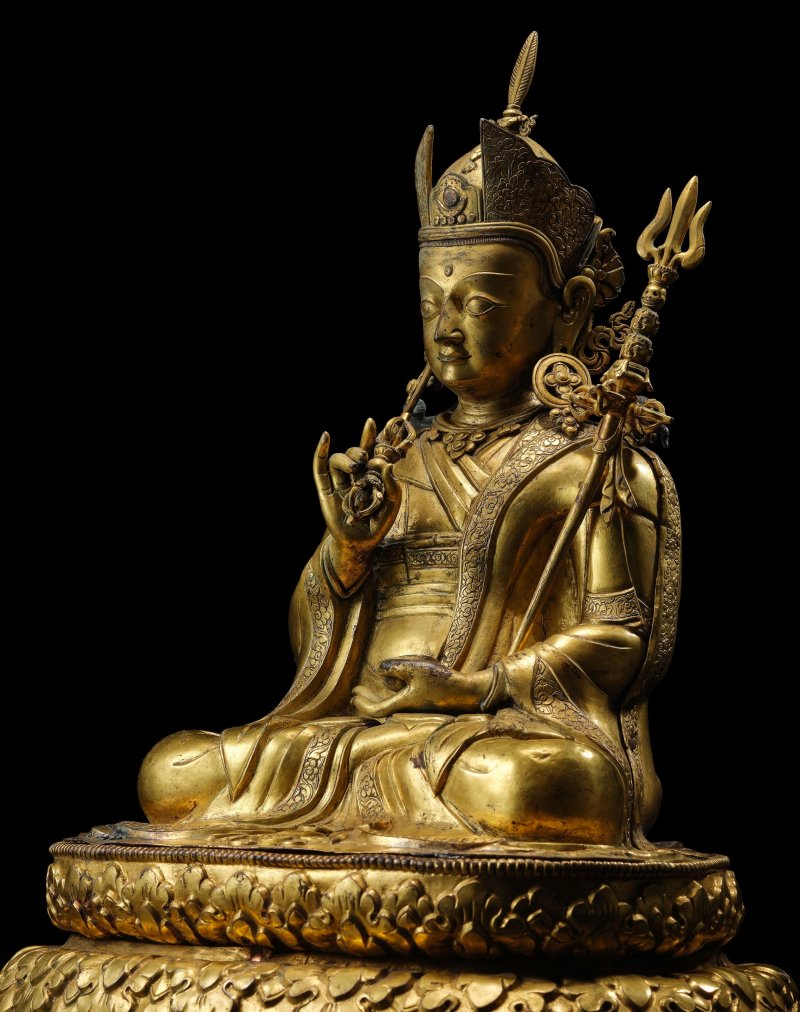
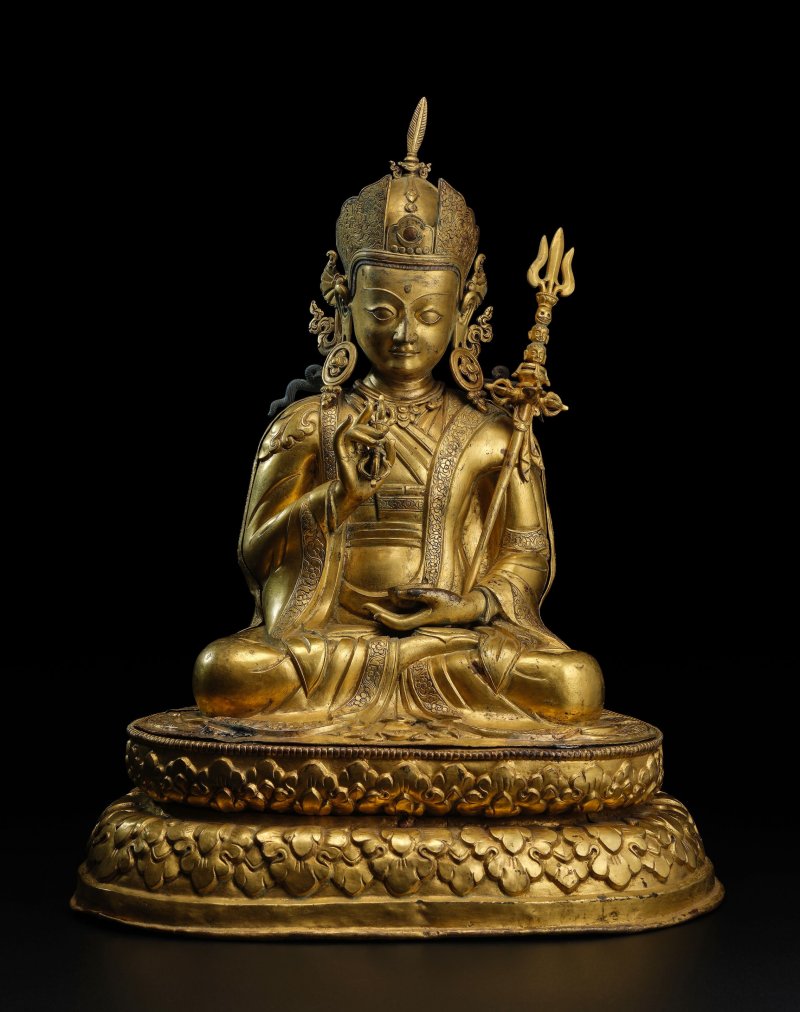
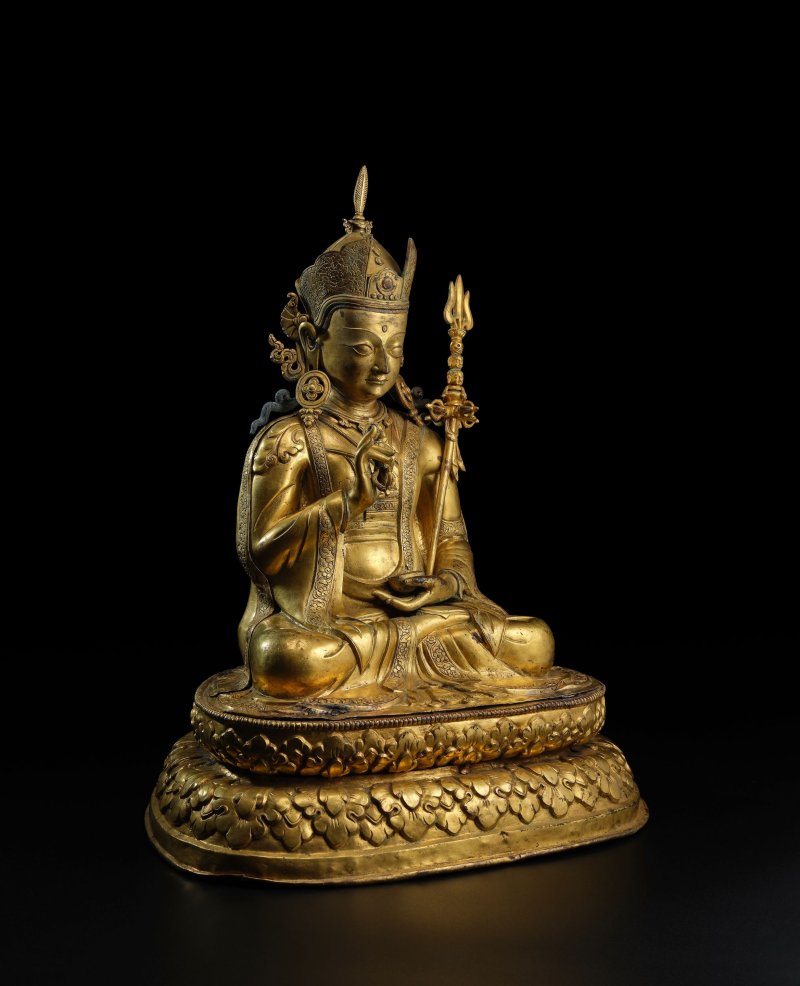
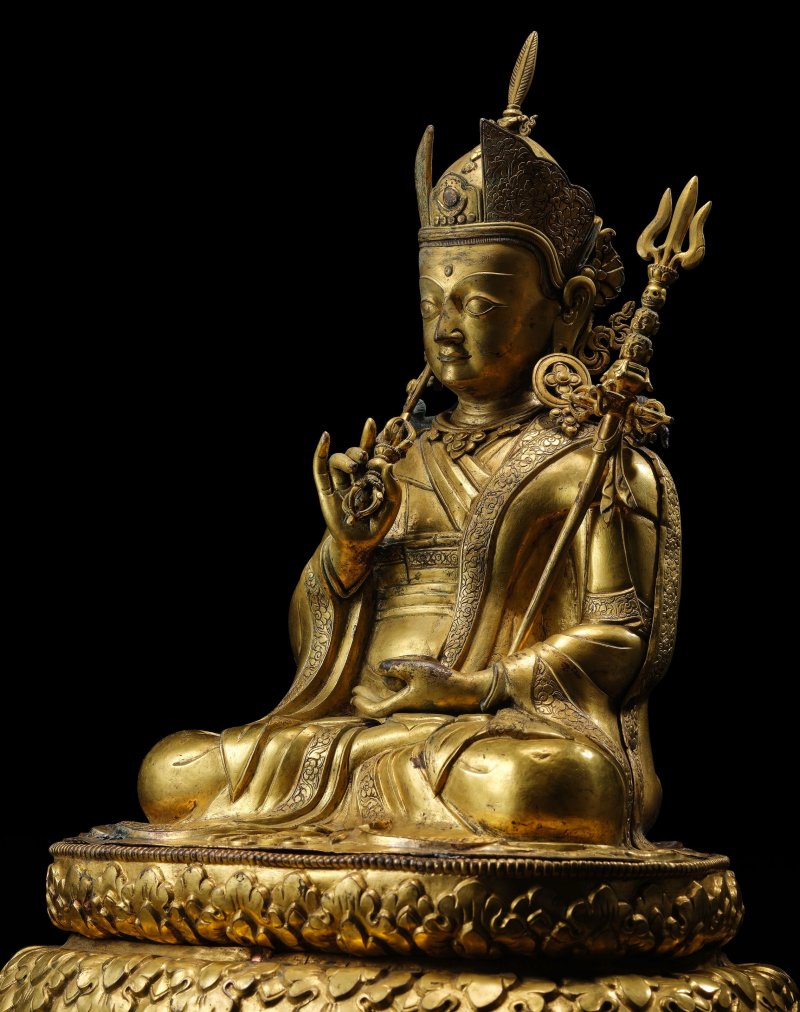
Seated in vajraparyankasana on a double lotus pedestal of exuberantly curling petals, Guru Rinpoche holds the vajra in his right hand and the kapala in his left, with the khatvanga cradled in the crook of his arm. He wears layered, voluminous robes gathered beneath a cloud collar, and the lotus cap with upturned lappets, sun and moon emblem and feather finial. His dress and attributes follow the Guru's principal form, but the face is that of a youth.
Padmasambhava is ordinarily portrayed as a mature master, with moustache and goatee, furrowed brow and piercing gaze. A gilt copper repousse figure of almost identical scale and date in the National Museum of Asian Art, Smithsonian Institution (Central Tibet, first half of the 18th century, 51.5 cm; S2014.18a–b), shows this conventional face. Here, by contrast, the brow is smooth, the gaze calm and inward, and the full cheeks and gently smiling lips are free of facial hair. These are the four features by which Himalayan Art Resources defines the youthful Padmasambhava, an uncommon variant found more often in painting than in sculpture (HAR set no. 6873; see the 19th-century painting in the Rubin Museum of Art, C2006.51.1). The present work is thus a rare sculptural statement of the type. Youth lies at the heart of the Guru's legend. He is said to have appeared as an eight-year-old child upon a lotus in Lake Dhanakosha and to have been raised by King Indrabhuti as crown prince of Oddiyana, hence his names Padmasambhava, the Lotus-Born, and Tsokye Dorje, the Lake-Born Vajra. By giving the Guru the face of that miraculous prince, the sculptor recalls his origin even as the robes and emblems proclaim the master he became.
The surface is lavished with finely chased ornament. Scrolling tendrils animate the panels of the cap, a band of blossoms runs along the hems of the robes, and a dense foliate pattern spreads across the shoulders, contrasting with the smooth, softly modelled planes of the face. The idealised facial contours and the assured handling of the repousse point to Newar craftsmen, whose mastery of the technique was prized throughout the Himalayas. The boldly curling petals of the pedestal find parallels in Bhutanese sculpture (see Bartholomew and Johnston, (eds.), , 2008, pp. 254-5, pl. 50).
Himalayan Art Resources item no. 207027
50 cm (19 3/4 in.) high
Footnotes
西藏或不丹 十八世紀 銅鎏金及錘揲蓮花生大士像
Provenance
Ex Private German Collection
Seated in vajraparyankasana on a double lotus pedestal of exuberantly curling petals, Guru Rinpoche holds the vajra in his right hand and the kapala in his left, with the khatvanga cradled in the crook of his arm. He wears layered, voluminous robes gathered beneath a cloud collar, and the lotus cap with upturned lappets, sun and moon emblem and feather finial. His dress and attributes follow the Guru's principal form, but the face is that of a youth.
Padmasambhava is ordinarily portrayed as a mature master, with moustache and goatee, furrowed brow and piercing gaze. A gilt copper repousse figure of almost identical scale and date in the National Museum of Asian Art, Smithsonian Institution (Central Tibet, first half of the 18th century, 51.5 cm; S2014.18a–b), shows this conventional face. Here, by contrast, the brow is smooth, the gaze calm and inward, and the full cheeks and gently smiling lips are free of facial hair. These are the four features by which Himalayan Art Resources defines the youthful Padmasambhava, an uncommon variant found more often in painting than in sculpture (HAR set no. 6873; see the 19th-century painting in the Rubin Museum of Art, C2006.51.1). The present work is thus a rare sculptural statement of the type. Youth lies at the heart of the Guru's legend. He is said to have appeared as an eight-year-old child upon a lotus in Lake Dhanakosha and to have been raised by King Indrabhuti as crown prince of Oddiyana, hence his names Padmasambhava, the Lotus-Born, and Tsokye Dorje, the Lake-Born Vajra. By giving the Guru the face of that miraculous prince, the sculptor recalls his origin even as the robes and emblems proclaim the master he became.
The surface is lavished with finely chased ornament. Scrolling tendrils animate the panels of the cap, a band of blossoms runs along the hems of the robes, and a dense foliate pattern spreads across the shoulders, contrasting with the smooth, softly modelled planes of the face. The idealised facial contours and the assured handling of the repousse point to Newar craftsmen, whose mastery of the technique was prized throughout the Himalayas. The boldly curling petals of the pedestal find parallels in Bhutanese sculpture (see Bartholomew and Johnston, (eds.), , 2008, pp. 254-5, pl. 50).
常见问题
这件西藏或不丹 十八世紀 銅鎏金及錘揲蓮花生大士像 | A GILT COPPER ALLOY REPOUSSE FIGURE OF PADMASAMBHAVA的成交价是多少?
落槌价为 预展中。 成交价为 预展中。