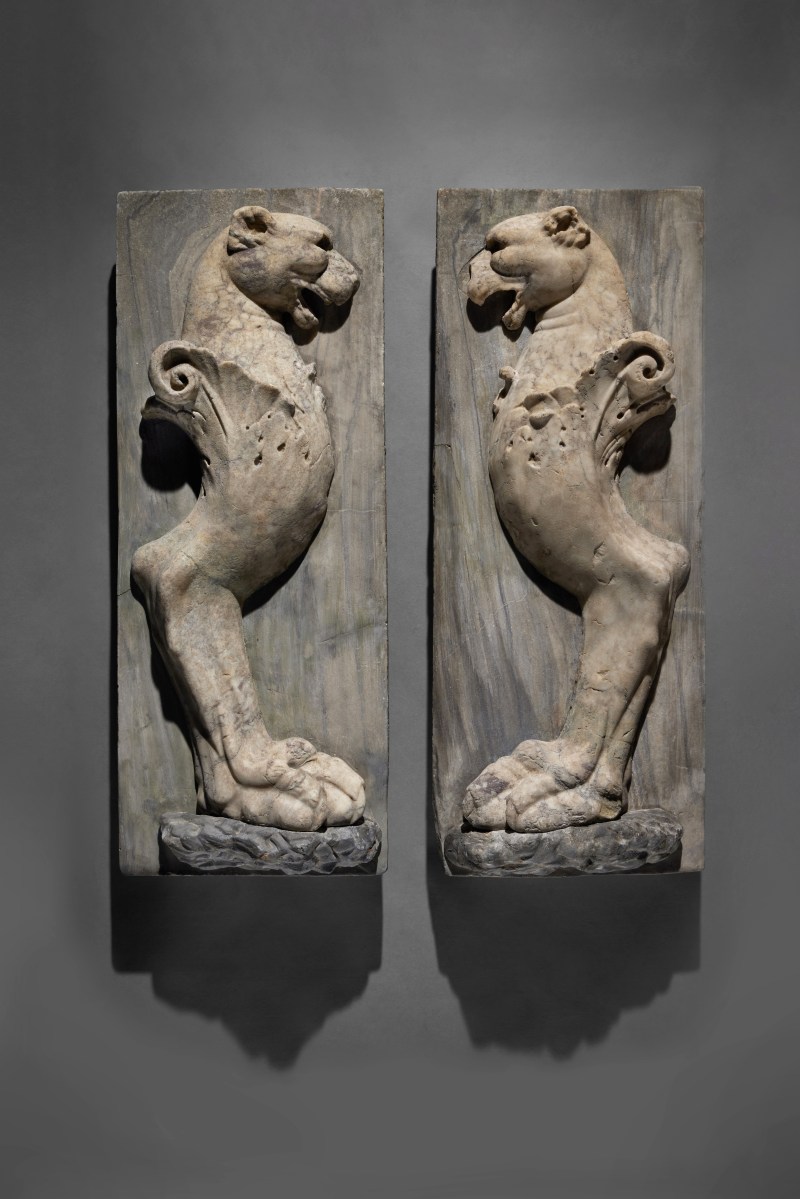

Lot 102 A Roman Marble Table Leg, circa 2nd Century A.D.
落槌价
预展中
成交价
预展中
| 拍卖公司 | 苏富比 |
|---|---|
| 拍卖时间 | 2026年10月22日 |
拍品信息
拍品名称
A Roman Marble Table Leg, circa 2nd Century A.D.
起拍价
USD 30,000
估值区间
30,000 - 50,000 USD
尺寸
未知
品相
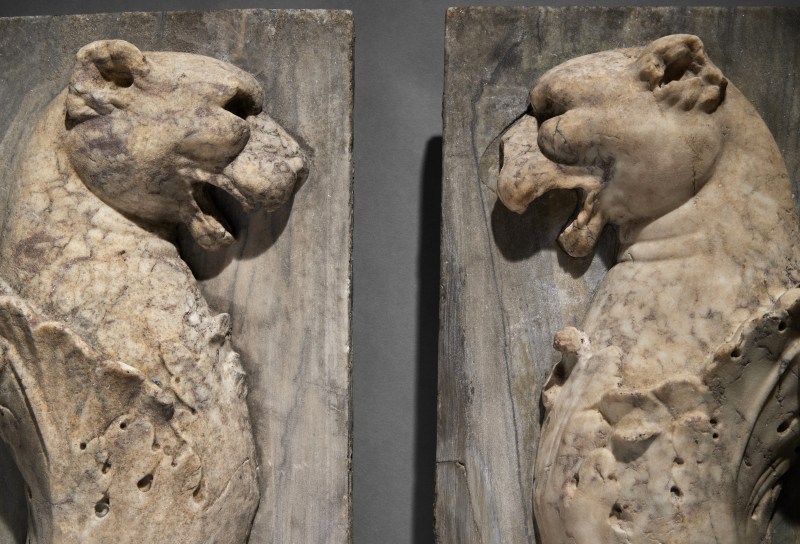
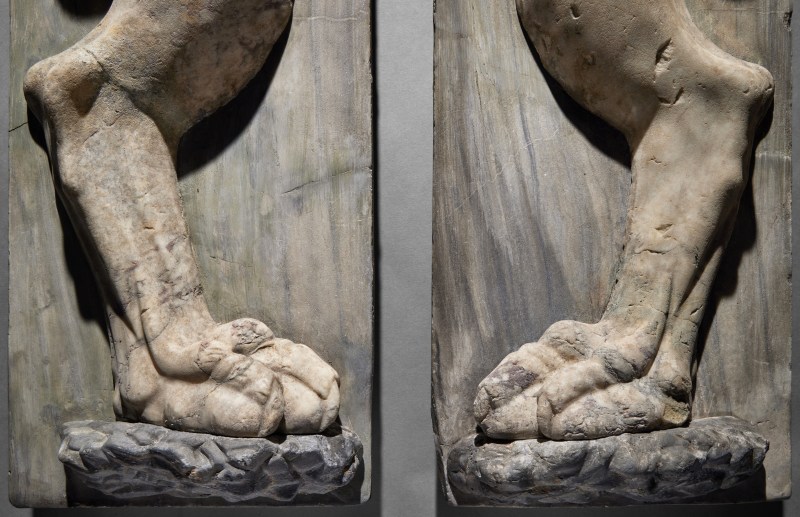
Left facing: In good and stable condition. A loss to the snout and the edge of the ear, with the teeth now worn away. Another loss to the tip of the curling acanthus leaf beneath the scrolling curl. Broken and repaired along the ankle, with fill visible along the break. Shallow surface cracks, knicks, chips and abrasions throughout, with the surface well worn as visible in the illustration. Mounted on a modern stone panel which seems to be broken and repaired, with a “footrest” created for the paw to rest on, as visible in the illustration.
Right facing: In good and stable condition, with the lower teeth well worn and a loss to the tip of one of the acanthus leaves on the flank before the scroll. A surface fissure on the knee join with some possible fill along the crack. Shallow surface cracks, knicks, chips and abrasions throughout, with the surface well worn as visible in the illustration. Mounted on a modern stone panel with some surface cracking, with a “footrest” created for the paw to rest on, as visible in the illustration.
If a condition report is provided to assist you with assessing the condition of the lot, it is for guidance purposes only. Such condition report may not refer to all faults, restoration, alterations, or adaptations because Sotheby's is not a professional conservator or restorer but rather a condition report is a statement of subjective, qualified opinion genuinely held by Sotheby's. For these reasons, any such condition report is not an alternative to taking your own professional advice regarding the condition of the lot. Prospective buyers should also refer to the Guide for Buyers at Auction which includes important notices concerning the type of property in this sale.
Right facing: In good and stable condition, with the lower teeth well worn and a loss to the tip of one of the acanthus leaves on the flank before the scroll. A surface fissure on the knee join with some possible fill along the crack. Shallow surface cracks, knicks, chips and abrasions throughout, with the surface well worn as visible in the illustration. Mounted on a modern stone panel with some surface cracking, with a “footrest” created for the paw to rest on, as visible in the illustration.
If a condition report is provided to assist you with assessing the condition of the lot, it is for guidance purposes only. Such condition report may not refer to all faults, restoration, alterations, or adaptations because Sotheby's is not a professional conservator or restorer but rather a condition report is a statement of subjective, qualified opinion genuinely held by Sotheby's. For these reasons, any such condition report is not an alternative to taking your own professional advice regarding the condition of the lot. Prospective buyers should also refer to the Guide for Buyers at Auction which includes important notices concerning the type of property in this sale.
更多信息
A Roman Marble Table Leg, circa 2nd Century A.D.
In the form of a feline hind leg terminating in a panther's head emerging from a calyx of acanthus leaves; sawn in two halves, each one mounted onto a cipollino marble panel for wall display.
marble
height of each half 29½ in.
75 cm
来源:William, 2nd Earl of Shelburne and 1st Marquess of Lansdowne (1737-1805);
Thence by descent at Lansdowne House, Berkeley Square and Bowood, Wiltshire;
Proposed by the 3rd Marquess of Lansdowne (1780-1863) to have them removed from Lansdowne House 'so that they can be placed about the house and gardens at Bowood';
Removed from Bowood, Wiltshire, prior to the demolition of the main portion of the house in 1955;
Property of a Nobleman (Christie's, Wrotham Park, Hertfordshire, June 13th, 1995, lot 2208, illus.);
Christie's, London, May 2nd, 2013, lot 128, illus.;
Where acquired by the present collector.
著录:A Catalogue of the Lansdowne Marbles, Statues, Busts, Bas- Reliefs, and other Distinguished Monuments of Ancient Sculpture, Principally collected in Italy, by the Most Noble William, Marquis of Lansdowne, and Constituting the Celebrated Collection of Lansdowne House in Berkeley Square, Bulmer & Co., London, 1810, nos. 97 and 98, p. 14
图录
说明:Of the Lansdowne Collection of ancient marble sculpture, which he visited on Berkeley Square when it was still intact, Adolf Michaelis writes in his Ancient Marbles in Great Britain (1882, pp. 103-104):
"High above all these collections of the second and third rank stands the magnificent museum formed in the last decade of the [18th] century by William, second Earl of Shelburne, afterwards first Marquis of Lansdowne (A.D. 1737-1805). Though deeply involved in the politics of his time, Lord Shelburne showed the liveliest interest in nature, art, and science. He gave proofs of this by his gardens at Bowood, the building of Shelburne House, his art collections, and the founding of his library. In the year 1771, after the death of his first wife, and in a breathing-space in his public activity, he visited Italy. The fact of his not afterwards joining the Dilettanti Society is fully explained by the preponderance of other political parties in that body. At Rome, Lord Shelburne, who at that time was planning the building of his new palace, entered into close relations with Gavin Hamilton, by whom he had a plan sketched for the arrangement and decoration of a sculpture gallery. A small number of antiques were purchased by him personally, others were procured for him by Hamilton in the following years; these were partly the choicest specimens from Hamilton's own excavations, partly the result of purchases elsewhere. Shelburne had done well to turn to a man of honour like Hamilton, instead of to Jenkins. Considering the number of competitors, among whom the Vatican Museum stood in the first rank, it is surprising to see how fine a selection of excellent works was brought together. It is true that the purchases were continued for a long time, into the last decade of the century, but the majority of the most remarkable marbles are the result of Hamilton's earlier excavations in the years 1770-1780; e.g.: the so-called Jason, the Hermes, the Amazon, and the Discobolus, which last has been badly disfigured by mistaken restoration. The Herakles, however, did not come to light till later. Among the heads there are not a few of conspicious merit; the Hermes, with the petasus, has become a general favourite. Finally, we have a few excellent reliefs."
For a recent reassessment and catalogue of the collection see E. Angelicoussis et al., Reconstructing the Lansdowne Collection of Ancient Marbles, Munich, 2017.
In the form of a feline hind leg terminating in a panther's head emerging from a calyx of acanthus leaves; sawn in two halves, each one mounted onto a cipollino marble panel for wall display.
marble
height of each half 29½ in.
75 cm
来源:William, 2nd Earl of Shelburne and 1st Marquess of Lansdowne (1737-1805);
Thence by descent at Lansdowne House, Berkeley Square and Bowood, Wiltshire;
Proposed by the 3rd Marquess of Lansdowne (1780-1863) to have them removed from Lansdowne House 'so that they can be placed about the house and gardens at Bowood';
Removed from Bowood, Wiltshire, prior to the demolition of the main portion of the house in 1955;
Property of a Nobleman (Christie's, Wrotham Park, Hertfordshire, June 13th, 1995, lot 2208, illus.);
Christie's, London, May 2nd, 2013, lot 128, illus.;
Where acquired by the present collector.
著录:A Catalogue of the Lansdowne Marbles, Statues, Busts, Bas- Reliefs, and other Distinguished Monuments of Ancient Sculpture, Principally collected in Italy, by the Most Noble William, Marquis of Lansdowne, and Constituting the Celebrated Collection of Lansdowne House in Berkeley Square, Bulmer & Co., London, 1810, nos. 97 and 98, p. 14
图录
说明:Of the Lansdowne Collection of ancient marble sculpture, which he visited on Berkeley Square when it was still intact, Adolf Michaelis writes in his Ancient Marbles in Great Britain (1882, pp. 103-104):
"High above all these collections of the second and third rank stands the magnificent museum formed in the last decade of the [18th] century by William, second Earl of Shelburne, afterwards first Marquis of Lansdowne (A.D. 1737-1805). Though deeply involved in the politics of his time, Lord Shelburne showed the liveliest interest in nature, art, and science. He gave proofs of this by his gardens at Bowood, the building of Shelburne House, his art collections, and the founding of his library. In the year 1771, after the death of his first wife, and in a breathing-space in his public activity, he visited Italy. The fact of his not afterwards joining the Dilettanti Society is fully explained by the preponderance of other political parties in that body. At Rome, Lord Shelburne, who at that time was planning the building of his new palace, entered into close relations with Gavin Hamilton, by whom he had a plan sketched for the arrangement and decoration of a sculpture gallery. A small number of antiques were purchased by him personally, others were procured for him by Hamilton in the following years; these were partly the choicest specimens from Hamilton's own excavations, partly the result of purchases elsewhere. Shelburne had done well to turn to a man of honour like Hamilton, instead of to Jenkins. Considering the number of competitors, among whom the Vatican Museum stood in the first rank, it is surprising to see how fine a selection of excellent works was brought together. It is true that the purchases were continued for a long time, into the last decade of the century, but the majority of the most remarkable marbles are the result of Hamilton's earlier excavations in the years 1770-1780; e.g.: the so-called Jason, the Hermes, the Amazon, and the Discobolus, which last has been badly disfigured by mistaken restoration. The Herakles, however, did not come to light till later. Among the heads there are not a few of conspicious merit; the Hermes, with the petasus, has become a general favourite. Finally, we have a few excellent reliefs."
For a recent reassessment and catalogue of the collection see E. Angelicoussis et al., Reconstructing the Lansdowne Collection of Ancient Marbles, Munich, 2017.
常见问题
这件A Roman Marble Table Leg, circa 2nd Century A.D.的成交价是多少?
落槌价为 预展中。 成交价为 预展中。
拍品的品相状况如何?
Left facing: In good and stable condition. A loss to the snout and the edge of the ear, with the teeth now worn away. Another loss to the tip of the curling acanthus leaf beneath the scrolling curl. Broken and repaired along the ankle, with fill visible along the break. Shallow surface cracks, knicks, chips and abrasions throughout, with the surface well worn as visible in the illustration. Mounted on a modern stone panel which seems to be broken and repaired, with a “footrest” created for the paw to rest on, as visible in the illustration.
Right facing: In good and stable condition, with the lower teeth well worn and a loss to the tip of one of the acanthus leaves on the flank before the scroll. A surface fissure on the knee join with some possible fill along the crack. Shallow surface cracks, knicks, chips and abrasions throughout, with the surface well worn as visible in the illustration. Mounted on a modern stone panel with some surface cracking, with a “footrest” created for the paw to rest on, as visible in the illustration.
If a condition report is provided to assist you with assessing the condition of the lot, it is for guidance purposes only. Such condition report may not refer to all faults, restoration, alterations, or adaptations because Sotheby's is not a professional conservator or restorer but rather a condition report is a statement of subjective, qualified opinion genuinely held by Sotheby's. For these reasons, any such condition report is not an alternative to taking your own professional advice regarding the condition of the lot. Prospective buyers should also refer to the Guide for Buyers at Auction which includes important notices concerning the type of property in this sale.
Right facing: In good and stable condition, with the lower teeth well worn and a loss to the tip of one of the acanthus leaves on the flank before the scroll. A surface fissure on the knee join with some possible fill along the crack. Shallow surface cracks, knicks, chips and abrasions throughout, with the surface well worn as visible in the illustration. Mounted on a modern stone panel with some surface cracking, with a “footrest” created for the paw to rest on, as visible in the illustration.
If a condition report is provided to assist you with assessing the condition of the lot, it is for guidance purposes only. Such condition report may not refer to all faults, restoration, alterations, or adaptations because Sotheby's is not a professional conservator or restorer but rather a condition report is a statement of subjective, qualified opinion genuinely held by Sotheby's. For these reasons, any such condition report is not an alternative to taking your own professional advice regarding the condition of the lot. Prospective buyers should also refer to the Guide for Buyers at Auction which includes important notices concerning the type of property in this sale.
这件拍品的流传来源是什么?
William, 2nd Earl of Shelburne and 1st Marquess of Lansdowne (1737-1805);
Thence by descent at Lansdowne House, Berkeley Square and Bowood, Wiltshire;
Proposed by the 3rd Marquess of Lansdowne (1780-1863) to have them removed from Lansdowne House 'so that they can be placed about the house and gardens at Bowood';
Removed from Bowood, Wiltshire, prior to the demolition of the main portion of the house in 1955;
Property of a Nobleman (Christie's, Wrotham Park, Hertfordshire, June 13th, 1995, lot 2208, illus.);
Christie's, London, May 2nd, 2013, lot 128, illus.;
Where acquired by the present collector.
Thence by descent at Lansdowne House, Berkeley Square and Bowood, Wiltshire;
Proposed by the 3rd Marquess of Lansdowne (1780-1863) to have them removed from Lansdowne House 'so that they can be placed about the house and gardens at Bowood';
Removed from Bowood, Wiltshire, prior to the demolition of the main portion of the house in 1955;
Property of a Nobleman (Christie's, Wrotham Park, Hertfordshire, June 13th, 1995, lot 2208, illus.);
Christie's, London, May 2nd, 2013, lot 128, illus.;
Where acquired by the present collector.
这件拍品被哪些著录书籍记载?
A Catalogue of the Lansdowne Marbles, Statues, Busts, Bas- Reliefs, and other Distinguished Monuments of Ancient Sculpture, Principally collected in Italy, by the Most Noble William, Marquis of Lansdowne, and Constituting the Celebrated Collection of Lansdowne House in Berkeley Square, Bulmer & Co., London, 1810, nos. 97 and 98, p. 14
图录
图录