
拍品信息
拍品名称
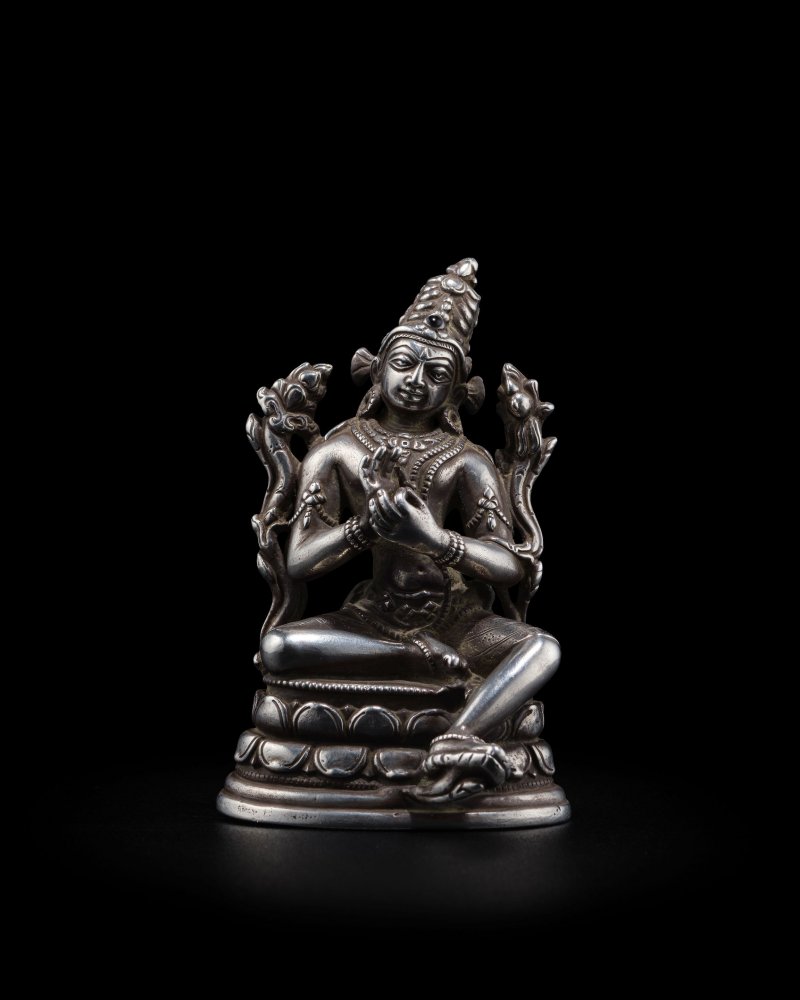
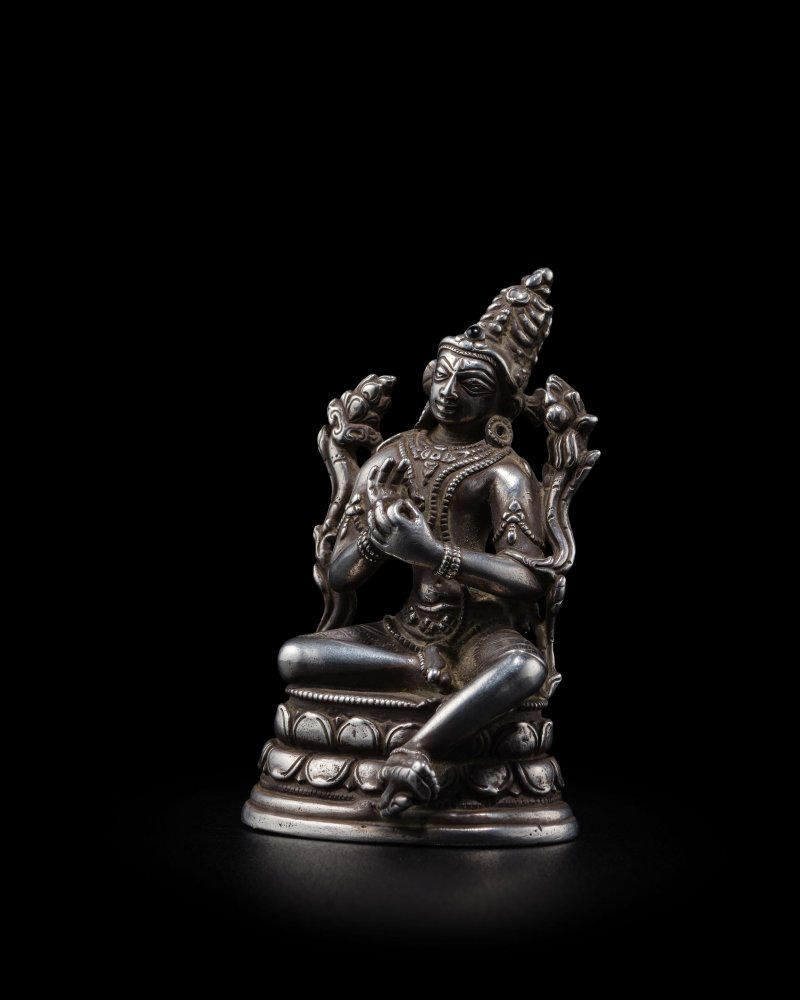
印度東北部 帕拉時期 十二世紀 彌勒銀像 | A SILVER FIGURE OF MAITREYA
年代
NORTHEASTERN INDIA, PALA PERIOD, 12TH CENTURY
起拍价
HKD 300,000
估值区间
HKD 300000 - 500000
尺寸
未知
品相
未知
更多信息
NORTHEASTERN INDIA, PALA PERIOD, 12TH CENTURY
Himalayan Art Resources item no. 207047
8 cm (3 1/8 in.) high
Footnotes
印度東北部 帕拉時期 十二世紀 彌勒銀像
Provenance
Benny Rustenburg, Amsterdam
King's Collection, acquired from the above in 1990s
Seated in the posture of royal ease (lalitasana) upon a rounded lotus pedestal, this exquisite silver figure captures Maitreya, the Buddha of the Future, with his hands held in dharmachakramudra. The sculpture embodies a harmonious synthesis of grace and plastic volume; the torso sways in a subtle curve, complemented by the naturalistic fullness of the shoulders and gently rounded abdomen.
A quiet, introspective calm pervades the face. The downcast gaze, framed by arching brows, directs attention to classic Pala facial modelling. Flanking the bodhisattva, one of his identifying attributes, the , rises from a lotus at his left shoulder, while another lotus at his right balances the composition. Adorned with a high-tiered chignon, fluttering crown ribbons, and delicate drapes, the work stands as a refined testament to the artistic heights of 11th–12th century Pala Northeastern India. The modeling of the lotus base, high chignon, and shoulder-slung finds a close stylistic counterpart in a 12th-century Maitreya from the Nyingjei Lam Collection (HAR 68420). Furthermore, the facial features and treatment of the lotus throne closely align with a Pala period sculpture of Manjushri in the British Museum (HAR 34430). Very similar jewellery and adornments appear on a c. 12th-century Manjushri sold at Christie's, New York, 20 March 2002, lot 52.
Himalayan Art Resources item no. 207047
8 cm (3 1/8 in.) high
Footnotes
印度東北部 帕拉時期 十二世紀 彌勒銀像
Provenance
Benny Rustenburg, Amsterdam
King's Collection, acquired from the above in 1990s
Seated in the posture of royal ease (lalitasana) upon a rounded lotus pedestal, this exquisite silver figure captures Maitreya, the Buddha of the Future, with his hands held in dharmachakramudra. The sculpture embodies a harmonious synthesis of grace and plastic volume; the torso sways in a subtle curve, complemented by the naturalistic fullness of the shoulders and gently rounded abdomen.
A quiet, introspective calm pervades the face. The downcast gaze, framed by arching brows, directs attention to classic Pala facial modelling. Flanking the bodhisattva, one of his identifying attributes, the , rises from a lotus at his left shoulder, while another lotus at his right balances the composition. Adorned with a high-tiered chignon, fluttering crown ribbons, and delicate drapes, the work stands as a refined testament to the artistic heights of 11th–12th century Pala Northeastern India. The modeling of the lotus base, high chignon, and shoulder-slung finds a close stylistic counterpart in a 12th-century Maitreya from the Nyingjei Lam Collection (HAR 68420). Furthermore, the facial features and treatment of the lotus throne closely align with a Pala period sculpture of Manjushri in the British Museum (HAR 34430). Very similar jewellery and adornments appear on a c. 12th-century Manjushri sold at Christie's, New York, 20 March 2002, lot 52.
常见问题
这件印度東北部 帕拉時期 十二世紀 彌勒銀像 | A SILVER FIGURE OF MAITREYA的成交价是多少?
落槌价为 预展中。 成交价为 预展中。