
拍品信息
拍品名称
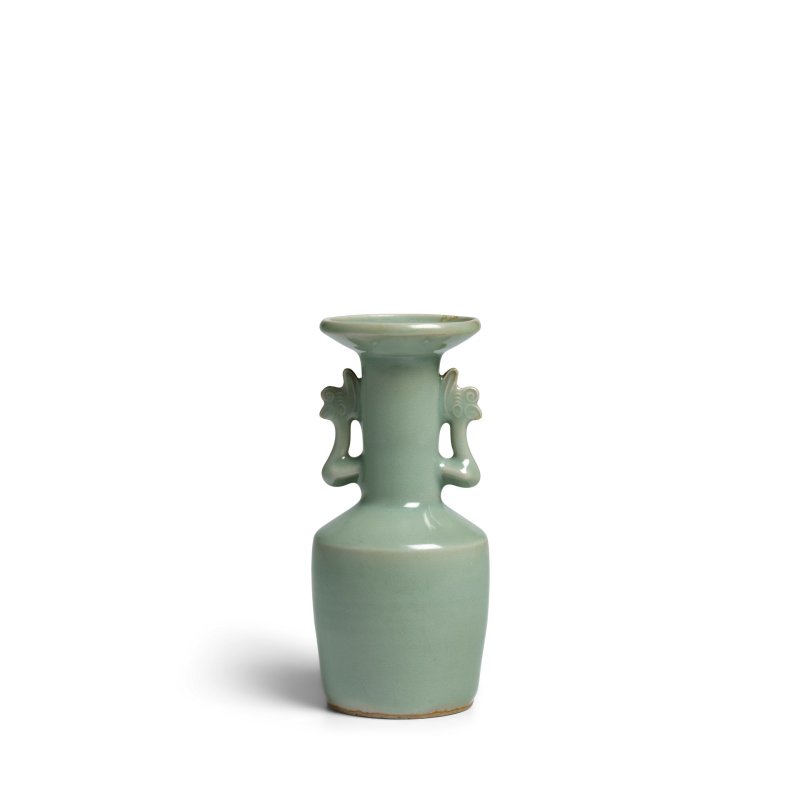
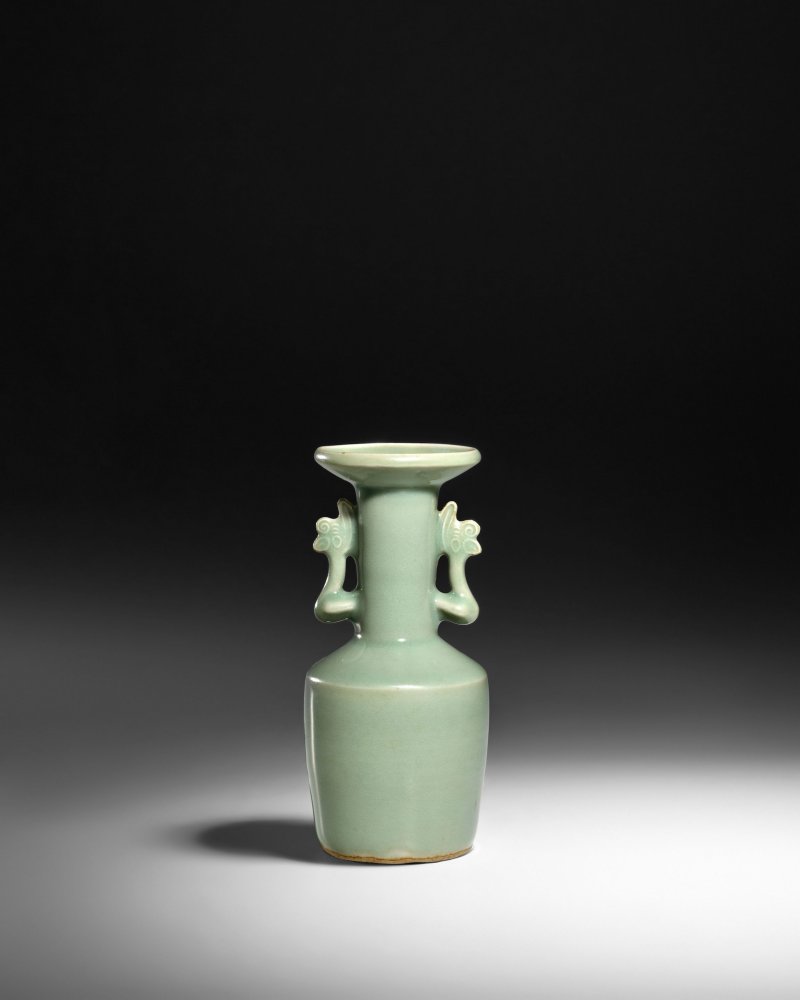
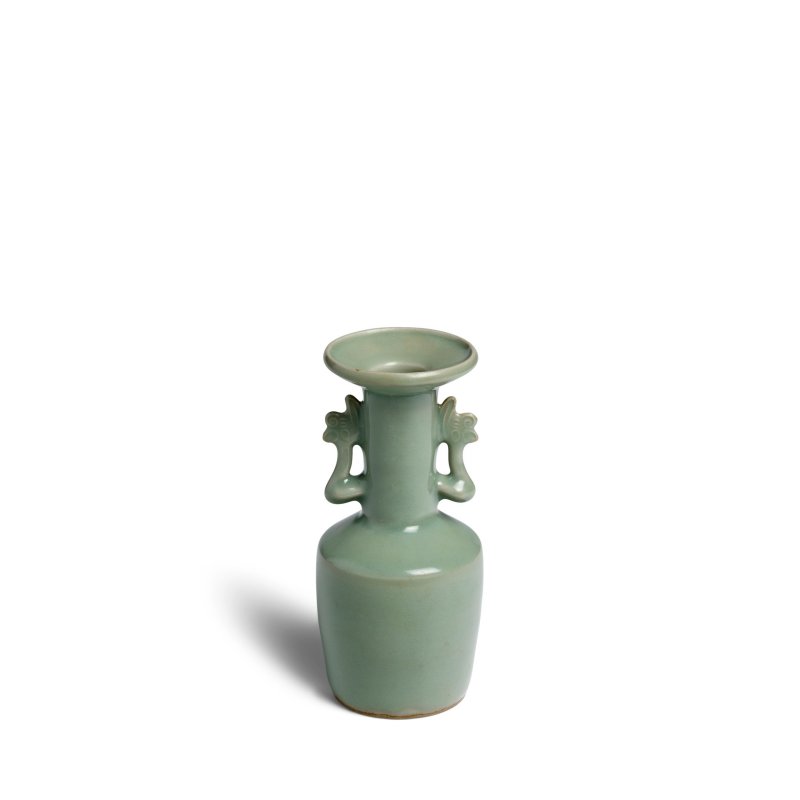
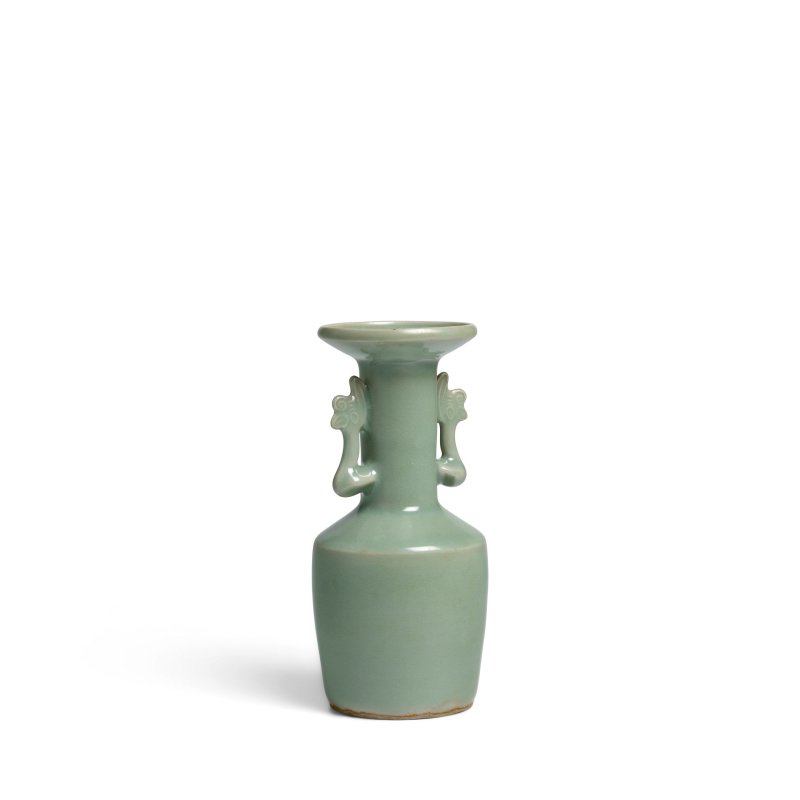
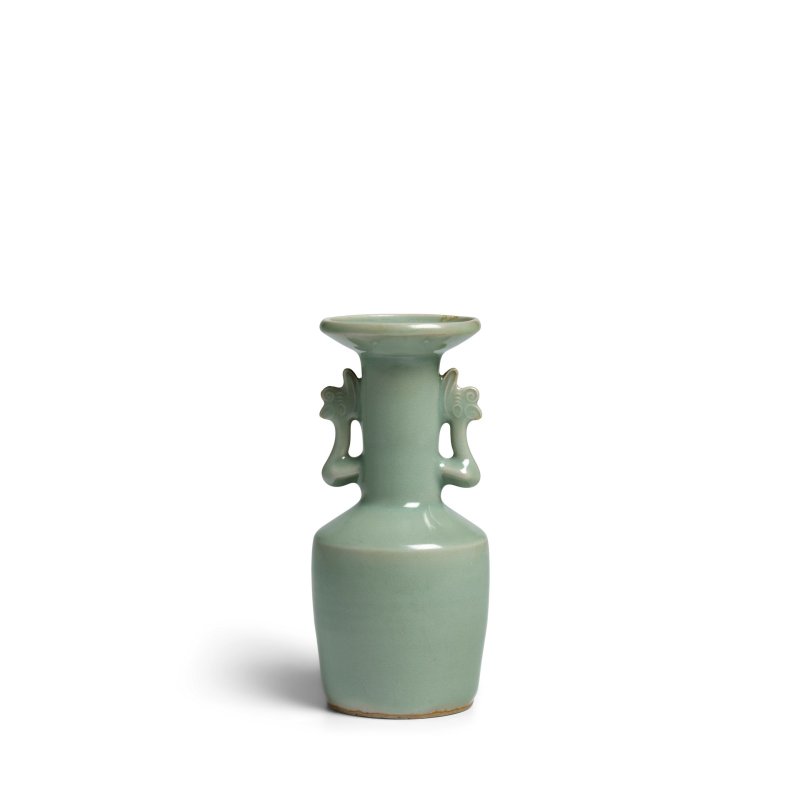
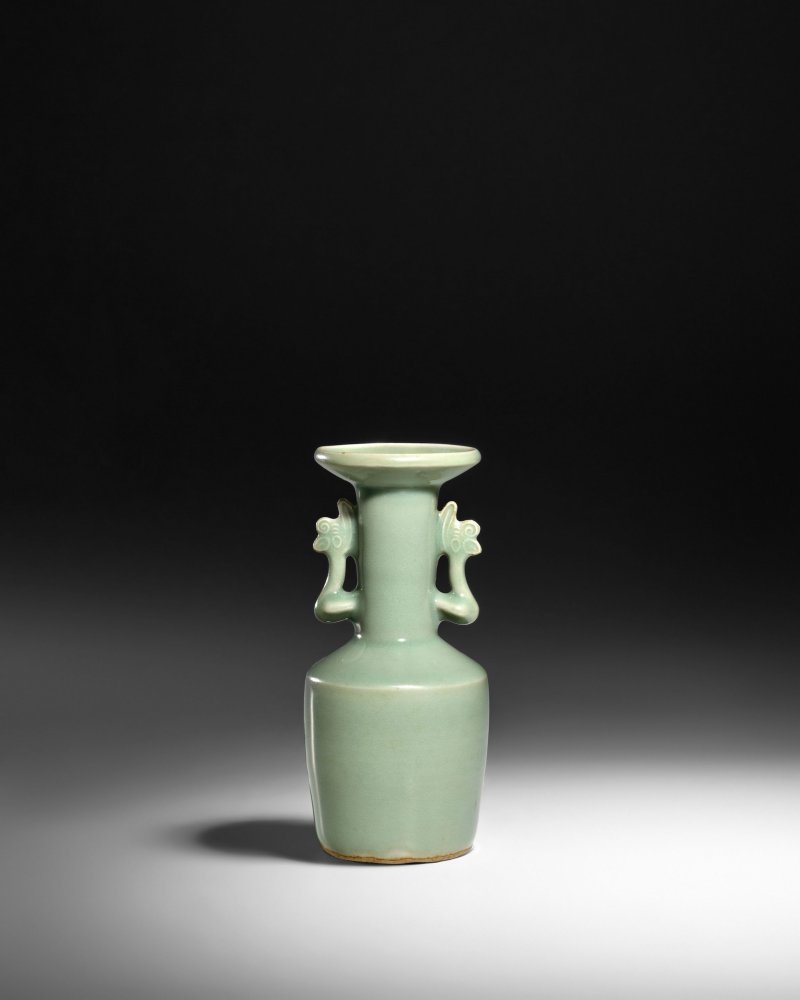
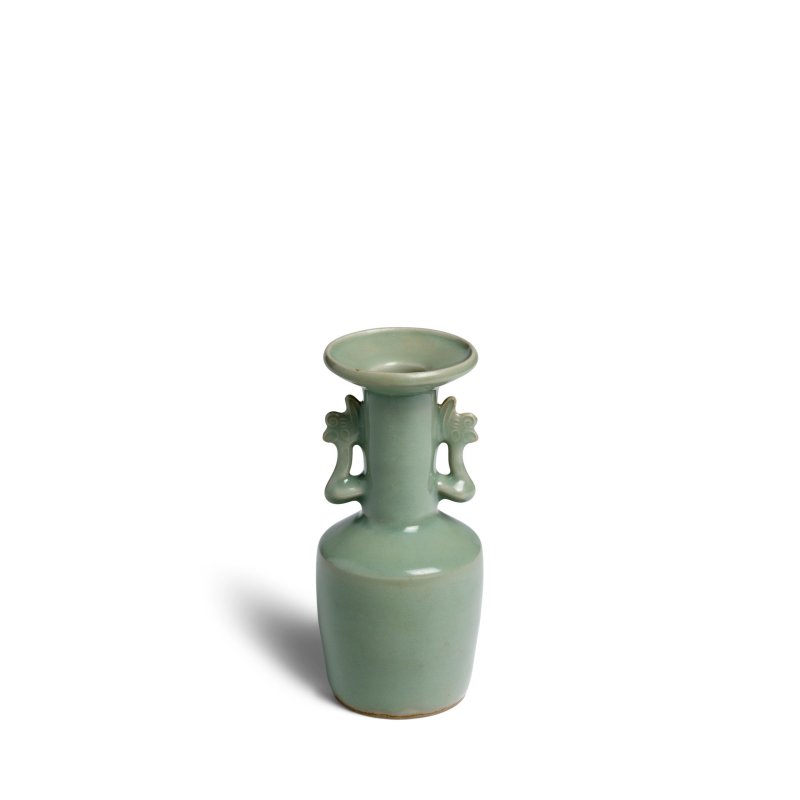
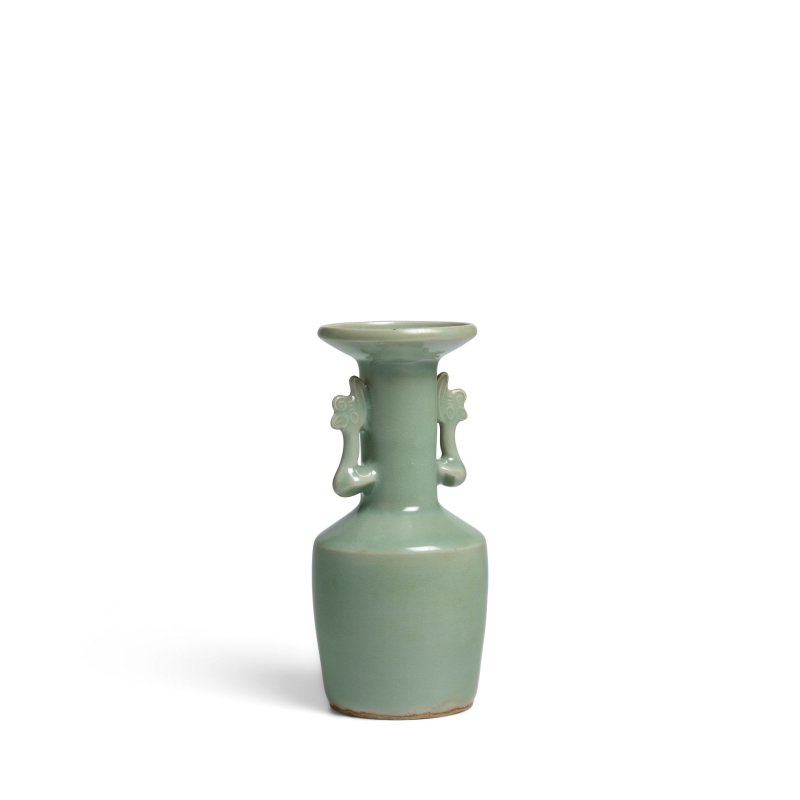
南宋 龍泉窯粉青釉鳳耳盤口紙錘瓶 | A LONGQUAN CELADON PHOENIX-HANDLED MALLET VASE
年代
Southern Song Dynasty
起拍价
USD 40,000
估值区间
未知
尺寸
未知
品相
未知
更多信息
Southern Song Dynasty
The cylindrical body slightly tapering down to an indented foot, the sloping shoulders surmounting a slender neck flanked by a pair of handles molded in the form of long-neck mythical birds, the dish-form flared mouth with galleried rim, covered inside and out with a translucent sea-green glaze, the foot rim unglazed and showing the light-gray porcelaneous body burnt orange-brown in the firing.
6 7/8in (17.4cm) high
(brocade fitted box).
Footnotes
南宋 龍泉窯粉青釉鳳耳盤口紙錘瓶
Provenance:
From a North American Scholarly Collection, acquired in the early 1990s, by repute
來源:
北美學者珍藏,據傳購於 1990 年代早期
Longquan celadon is renowned for its thick, translucent glaze and rich, jade-like surface. The present vase displays the highly prized bluish-green tone characteristic of the finest Longquan wares, a color notoriously difficult for potters to achieve consistently and one that became particularly esteemed in Japan. Mallet-form vases of this type are known in Japan as , literally 'mallet', a name derived from their distinctive shape. Imported into Japan from China during the Southern Song and Yuan dynasties, these vessels became closely associated with the soft bluish-green glaze that Japanese connoisseurs came to prize above other Longquan celadons. A similar Longquan celadon mallet vase (17.5cm high), with phoenix-shaped handles and of closely similar proportions, is in the Qing Court Collection, illustrated in , Hong Kong, 1996, p. 110, no. 98.
The origins of the mallet form itself remain the subject of scholarly discussion. Although its shape may appear to derive naturally from the wooden or paper mallet, it has also been suggested that the form may ultimately have been inspired by glass vessels introduced into China from the Islamic West, possibly Persia. An Islamic glass bottle vase, probably from Nishapur in north-eastern Iran, was among the objects recovered from the tomb of the Princess of Chen, a Liao dynasty burial dated no later than 1018, and is illustrated in , Taipei, 2007, no. 25, fig. 2. The presence of such a vessel in an elite Chinese tomb provides an intriguing indication of the circulation of luxury objects between the Islamic world and China at a period when the mallet form was emerging.
The form is characteristically found with a pair of applied handles, most commonly modelled as phoenixes, dragons, or fish. See a large Southern Song dynasty Longquan mallet-form vase with phoenix handles (25.5cm high) in the collection of the Palace Museum, Taipei, illustrated by Maxwell K. Hearn in , The Metropolitan Museum of Art, New York, 1996, p. 51, no. 34. For a further example of comparable size, see the Gordon Collection vase (17.5cm high), sold by J.J. Lally & Co., , New York, March 2009, no. 21, with a less brilliant glaze.
Another Longquan celadon mallet-form vase with phoenix handles of slightly smaller size (16.5cm high), formerly in J.J. Lally & Co., was sold at Christie's New York, 23 March 2023, lot 889.
The cylindrical body slightly tapering down to an indented foot, the sloping shoulders surmounting a slender neck flanked by a pair of handles molded in the form of long-neck mythical birds, the dish-form flared mouth with galleried rim, covered inside and out with a translucent sea-green glaze, the foot rim unglazed and showing the light-gray porcelaneous body burnt orange-brown in the firing.
6 7/8in (17.4cm) high
(brocade fitted box).
Footnotes
南宋 龍泉窯粉青釉鳳耳盤口紙錘瓶
Provenance:
From a North American Scholarly Collection, acquired in the early 1990s, by repute
來源:
北美學者珍藏,據傳購於 1990 年代早期
Longquan celadon is renowned for its thick, translucent glaze and rich, jade-like surface. The present vase displays the highly prized bluish-green tone characteristic of the finest Longquan wares, a color notoriously difficult for potters to achieve consistently and one that became particularly esteemed in Japan. Mallet-form vases of this type are known in Japan as , literally 'mallet', a name derived from their distinctive shape. Imported into Japan from China during the Southern Song and Yuan dynasties, these vessels became closely associated with the soft bluish-green glaze that Japanese connoisseurs came to prize above other Longquan celadons. A similar Longquan celadon mallet vase (17.5cm high), with phoenix-shaped handles and of closely similar proportions, is in the Qing Court Collection, illustrated in , Hong Kong, 1996, p. 110, no. 98.
The origins of the mallet form itself remain the subject of scholarly discussion. Although its shape may appear to derive naturally from the wooden or paper mallet, it has also been suggested that the form may ultimately have been inspired by glass vessels introduced into China from the Islamic West, possibly Persia. An Islamic glass bottle vase, probably from Nishapur in north-eastern Iran, was among the objects recovered from the tomb of the Princess of Chen, a Liao dynasty burial dated no later than 1018, and is illustrated in , Taipei, 2007, no. 25, fig. 2. The presence of such a vessel in an elite Chinese tomb provides an intriguing indication of the circulation of luxury objects between the Islamic world and China at a period when the mallet form was emerging.
The form is characteristically found with a pair of applied handles, most commonly modelled as phoenixes, dragons, or fish. See a large Southern Song dynasty Longquan mallet-form vase with phoenix handles (25.5cm high) in the collection of the Palace Museum, Taipei, illustrated by Maxwell K. Hearn in , The Metropolitan Museum of Art, New York, 1996, p. 51, no. 34. For a further example of comparable size, see the Gordon Collection vase (17.5cm high), sold by J.J. Lally & Co., , New York, March 2009, no. 21, with a less brilliant glaze.
Another Longquan celadon mallet-form vase with phoenix handles of slightly smaller size (16.5cm high), formerly in J.J. Lally & Co., was sold at Christie's New York, 23 March 2023, lot 889.