
拍品信息
拍品名称
十八世紀 銅鎏金吉祥天母及眷屬像 | A RARE AND LARGE GILT-BRONZE SHRI DEVI AND ATTENDANTS GROUP
年代
18th century
起拍价
HKD 600,000
估值区间
HKD 600000 - 800000
尺寸
未知
品相
未知
更多信息
18th century
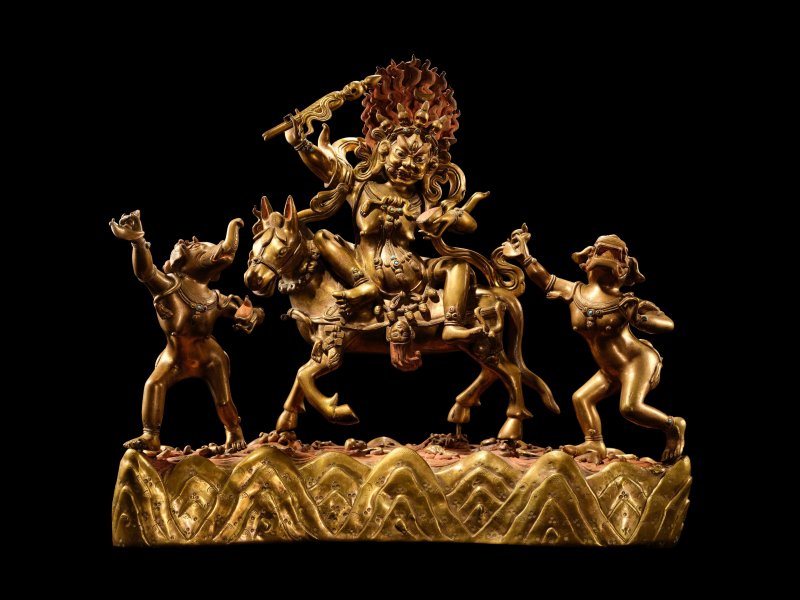
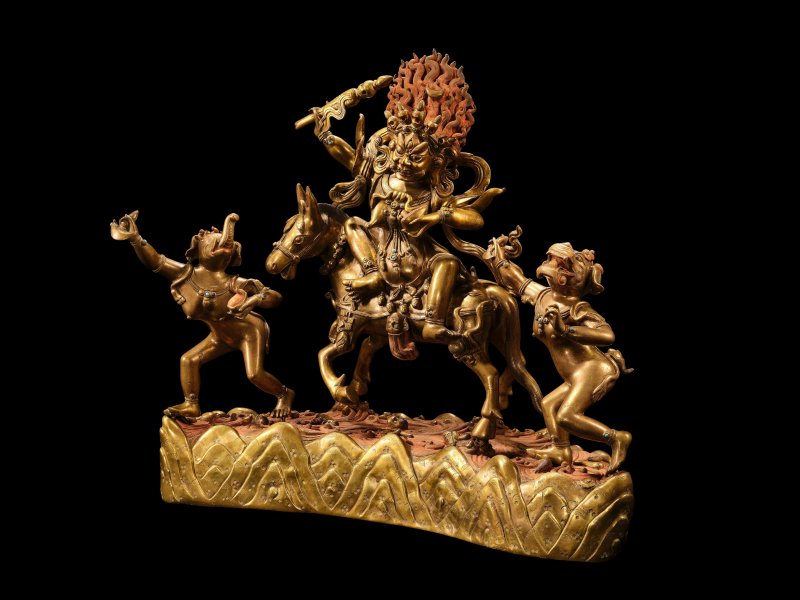
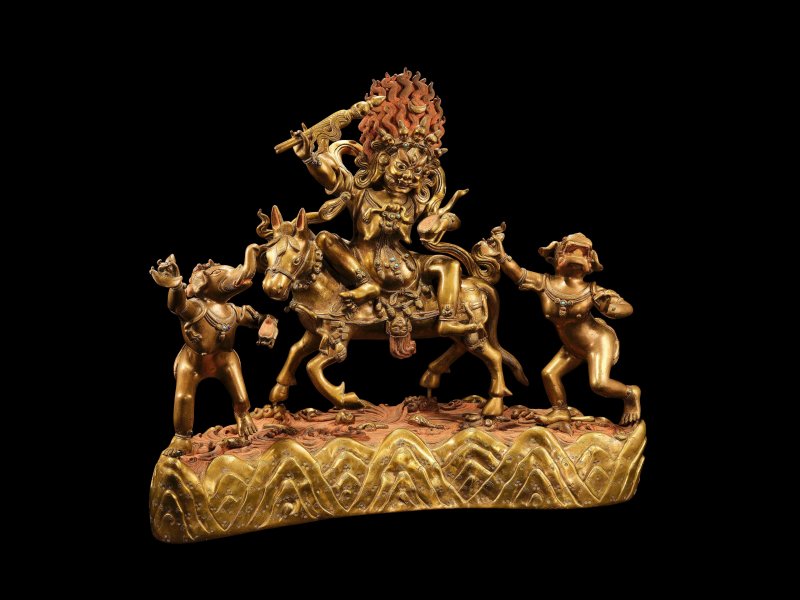
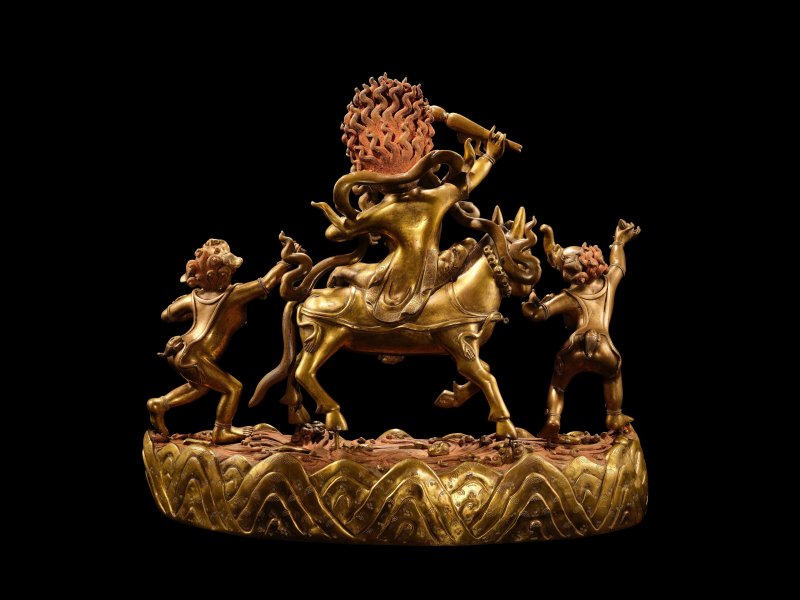
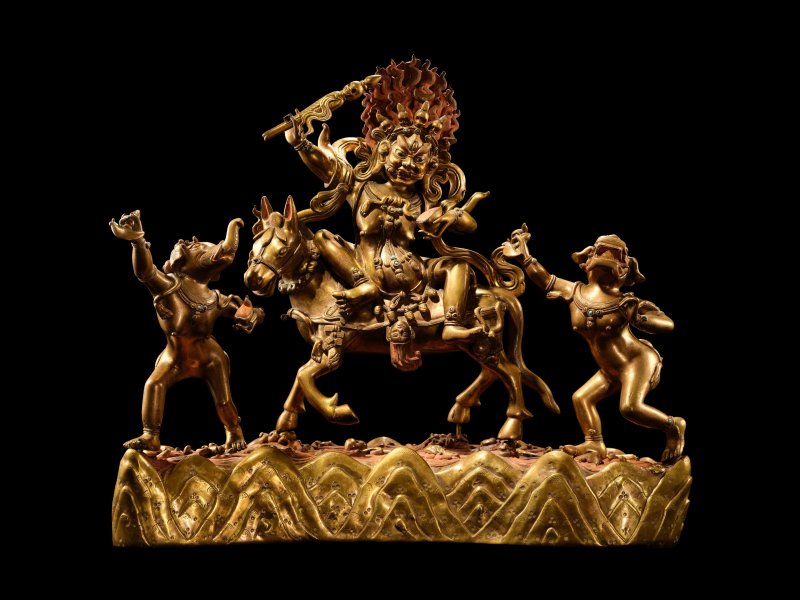
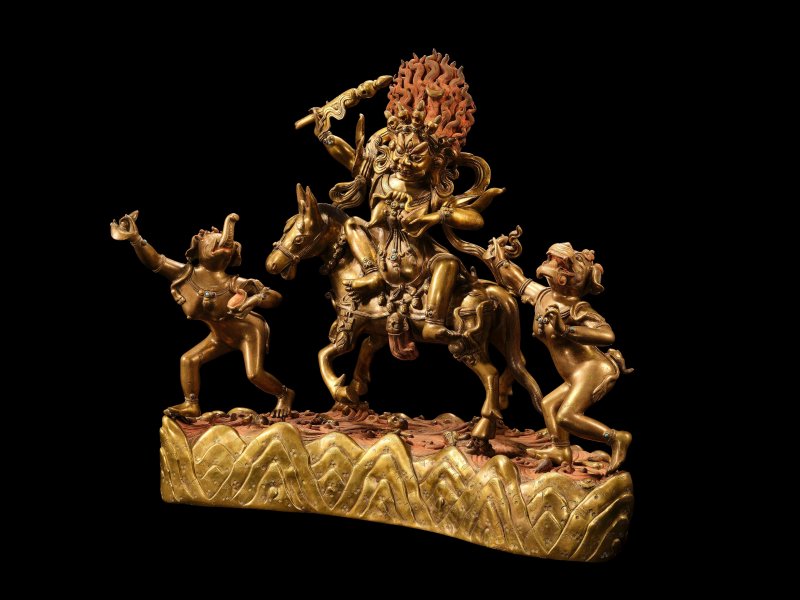
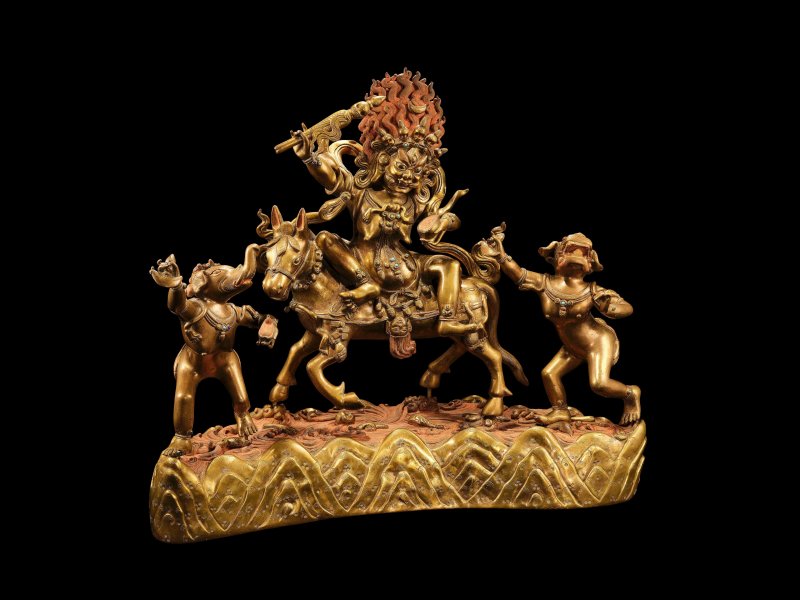
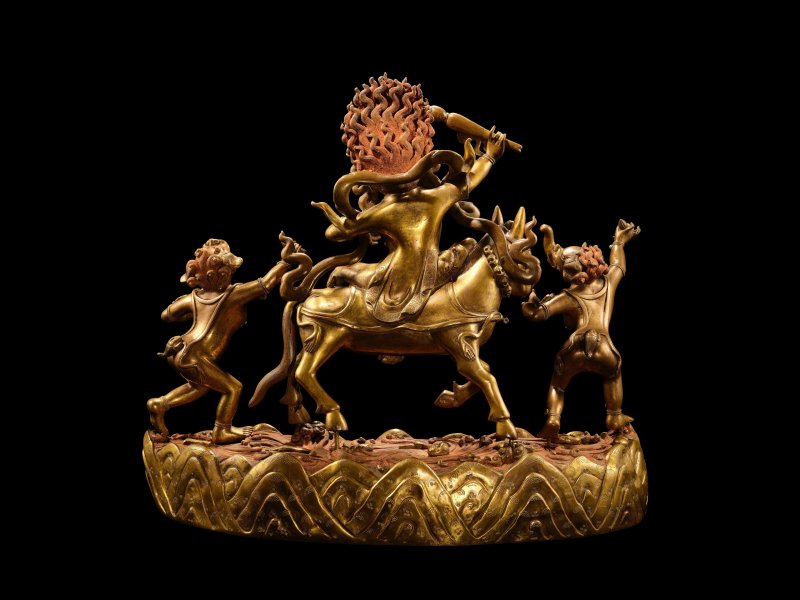
The deity seated on a mule with the skin of her son as the saddle, holding a skull cup, her right arm aloft, the flaming hair fronted by a tiara of skulls above the wrathful face, the body encircled by a garland of human heads around her waist, the mount galloping across a sea of red blood with floating human remains, flanked by an elephant-headed attendant and a lion-headed attendant at the rear, all enclosed within a border of stylised mountains.
48.4cm (19in) wide. (5).
Footnotes
十八世紀 銅鎏金吉祥天母及眷屬像
Provenance:
A South American private collection
來源:
南美私人收藏
Shri Devi, known in Tibet as Palden Lhamo, is the principal female Dharma-protector of Tibetan Buddhism and the only woman among the Eight Guardians of the Dharma (dharmapala). She is regarded as a wrathful manifestation of the peaceful goddess Sarasvatī (Yangchenma) and is especially associated with the Gelug tradition, where she serves as the protector of Lhasa and the Dalai Lama. Canonical descriptions, including those in the and other standard ritual sources, depict her riding a mule across a sea of blood, dark blue in colour, and holding the skull cup, trident, and flayed skin. Her iconography is consistent across the major Tibetan schools and is well documented in both textual and visual traditions.
In the widely attested origin narrative of Magzor Gyalmo, the best-known form of Palden Lhamo, the flayed skin she carries is that of her own son. According to standard protector-deity texts, her husband, often identified as the cannibal Yaksha King, intended to oppose the Dharma, and their son was being raised for the same purpose. After repeated attempts to dissuade them, Shri Devi vowed to stop the boy before he caused further harm. She killed him and flayed his skin, using it as a banner and saddlecloth as she rode away. In Tibetan Buddhist interpretation, this narrative expresses her absolute commitment to protecting the Dharma: the flayed skin symbolises the destruction of ignorance at its root, even when it arises closest to oneself. The motif became a fixed element of her iconography and appears consistently across the ritual manuals and thangka traditions of the Magzor Gyalmo cycle.
In many thangkas and sculptural groupings, Palden Lhamo is flanked by two female wrathful attendants. One is lion-headed, corresponding to the dakini form Sengdongma or Siṃhamukha ('Lion-Faced Lady'), a subsidiary protector. The other commonly bears the head of an elephant, or in some traditions a makara, reflecting established variations within the wider Shri Devi cycle. These attendants appear in recognised iconographic programmes, including those of Magzor Gyalmo ('Queen who Repels Armies'), and their presence is attested in standard protector-deity lineages and ritual manuals. Together they accompany and reinforce Shri Devi's protective activity, forming a triad frequently represented in Tibetan Buddhist art.
A similar set of gilt-bronze figure of Palden Lhamo and attendant is housed in the , illustrated in , Beijing, 2001, p.112. See a few more gilt-bronze figures of Palden Lhamo in comparable style, including one dated 17th century, Tibet, illustrated in , Shanghai, 2003, p.197, no.188; another dated 19th century is in the Crow Collection of Asian Art (Himalayan Art Resources, item no.58808).
吉祥天母,為藏傳佛教無上瑜伽密的唯一女護法,是辯才天女之忿怒相,為格魯派所重,是拉薩與達賴喇嘛之守護神。依據儀軌,包括《Rinjung Lhantab》等,吉祥天母膚色藍,騎騾行於血海,手持顱缽、三叉戟,身披人皮。形象頗為恐怖兇殘,然則能報一方平安,綏靖瘟疫與邪崇。此形相歷代流傳,見於各派文本與圖像記錄。
吉祥天母之著名化身為退敵佛母,根據退敵佛母相關記載,其所披人皮出自親生子,其夫為食人羅剎王,誓與佛法為敵,兒子亦受父親影響。吉祥天母屢勸不果,終為護法而殺子剝皮,以其皮為幡幟及鞍韉,乘騾而去。此傳説寓意其護法之絕對忠誠,剝皮象徵摧毀無明之根。此母題遂成其固定特徵,常見於退敵母相關之唐卡及儀軌文本。
在許多唐卡與造像中,吉祥天母兩側常伴兩位女性忿怒眷屬:其一為獅面空行母,即獅面護法;另一常見象首或摩羯首,各派傳承略有不同,然皆屬吉祥天母眷屬體系。北京雍和宮藏一組形制相近之銅鎏金吉祥天母及眷屬像,見《雍和宮佛像寶典》,北京,2001年,頁112。另可比對數件風格相若之銅鎏金吉祥天母像,包括一件西藏十七世紀例子,錄於《故宮博物院藏文物珍品全集:藏傳佛教造像》,上海,2003年,頁197,編號188;及克洛亞洲藝術舊藏一件十九世紀吉祥天母(喜馬拉雅藝術資源,編號58808)。
The deity seated on a mule with the skin of her son as the saddle, holding a skull cup, her right arm aloft, the flaming hair fronted by a tiara of skulls above the wrathful face, the body encircled by a garland of human heads around her waist, the mount galloping across a sea of red blood with floating human remains, flanked by an elephant-headed attendant and a lion-headed attendant at the rear, all enclosed within a border of stylised mountains.
48.4cm (19in) wide. (5).
Footnotes
十八世紀 銅鎏金吉祥天母及眷屬像
Provenance:
A South American private collection
來源:
南美私人收藏
Shri Devi, known in Tibet as Palden Lhamo, is the principal female Dharma-protector of Tibetan Buddhism and the only woman among the Eight Guardians of the Dharma (dharmapala). She is regarded as a wrathful manifestation of the peaceful goddess Sarasvatī (Yangchenma) and is especially associated with the Gelug tradition, where she serves as the protector of Lhasa and the Dalai Lama. Canonical descriptions, including those in the and other standard ritual sources, depict her riding a mule across a sea of blood, dark blue in colour, and holding the skull cup, trident, and flayed skin. Her iconography is consistent across the major Tibetan schools and is well documented in both textual and visual traditions.
In the widely attested origin narrative of Magzor Gyalmo, the best-known form of Palden Lhamo, the flayed skin she carries is that of her own son. According to standard protector-deity texts, her husband, often identified as the cannibal Yaksha King, intended to oppose the Dharma, and their son was being raised for the same purpose. After repeated attempts to dissuade them, Shri Devi vowed to stop the boy before he caused further harm. She killed him and flayed his skin, using it as a banner and saddlecloth as she rode away. In Tibetan Buddhist interpretation, this narrative expresses her absolute commitment to protecting the Dharma: the flayed skin symbolises the destruction of ignorance at its root, even when it arises closest to oneself. The motif became a fixed element of her iconography and appears consistently across the ritual manuals and thangka traditions of the Magzor Gyalmo cycle.
In many thangkas and sculptural groupings, Palden Lhamo is flanked by two female wrathful attendants. One is lion-headed, corresponding to the dakini form Sengdongma or Siṃhamukha ('Lion-Faced Lady'), a subsidiary protector. The other commonly bears the head of an elephant, or in some traditions a makara, reflecting established variations within the wider Shri Devi cycle. These attendants appear in recognised iconographic programmes, including those of Magzor Gyalmo ('Queen who Repels Armies'), and their presence is attested in standard protector-deity lineages and ritual manuals. Together they accompany and reinforce Shri Devi's protective activity, forming a triad frequently represented in Tibetan Buddhist art.
A similar set of gilt-bronze figure of Palden Lhamo and attendant is housed in the , illustrated in , Beijing, 2001, p.112. See a few more gilt-bronze figures of Palden Lhamo in comparable style, including one dated 17th century, Tibet, illustrated in , Shanghai, 2003, p.197, no.188; another dated 19th century is in the Crow Collection of Asian Art (Himalayan Art Resources, item no.58808).
吉祥天母,為藏傳佛教無上瑜伽密的唯一女護法,是辯才天女之忿怒相,為格魯派所重,是拉薩與達賴喇嘛之守護神。依據儀軌,包括《Rinjung Lhantab》等,吉祥天母膚色藍,騎騾行於血海,手持顱缽、三叉戟,身披人皮。形象頗為恐怖兇殘,然則能報一方平安,綏靖瘟疫與邪崇。此形相歷代流傳,見於各派文本與圖像記錄。
吉祥天母之著名化身為退敵佛母,根據退敵佛母相關記載,其所披人皮出自親生子,其夫為食人羅剎王,誓與佛法為敵,兒子亦受父親影響。吉祥天母屢勸不果,終為護法而殺子剝皮,以其皮為幡幟及鞍韉,乘騾而去。此傳説寓意其護法之絕對忠誠,剝皮象徵摧毀無明之根。此母題遂成其固定特徵,常見於退敵母相關之唐卡及儀軌文本。
在許多唐卡與造像中,吉祥天母兩側常伴兩位女性忿怒眷屬:其一為獅面空行母,即獅面護法;另一常見象首或摩羯首,各派傳承略有不同,然皆屬吉祥天母眷屬體系。北京雍和宮藏一組形制相近之銅鎏金吉祥天母及眷屬像,見《雍和宮佛像寶典》,北京,2001年,頁112。另可比對數件風格相若之銅鎏金吉祥天母像,包括一件西藏十七世紀例子,錄於《故宮博物院藏文物珍品全集:藏傳佛教造像》,上海,2003年,頁197,編號188;及克洛亞洲藝術舊藏一件十九世紀吉祥天母(喜馬拉雅藝術資源,編號58808)。
常见问题
这件十八世紀 銅鎏金吉祥天母及眷屬像 | A RARE AND LARGE GILT-BRONZE SHRI DEVI AND ATTENDANTS GROUP的成交价是多少?
落槌价为 预展中。 成交价为 预展中。