
拍品信息
拍品名称
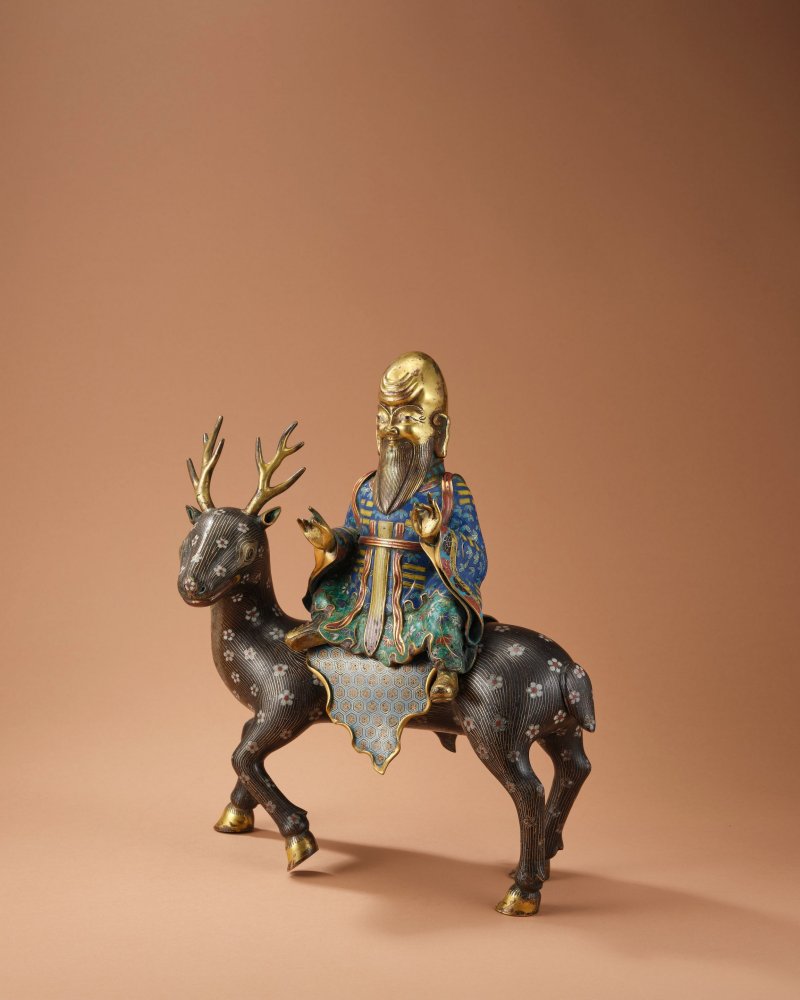
清乾隆 掐絲琺瑯「壽老乘鹿」香爐 | A RARE CLOISONNÉ-ENAMEL AND GILT-BRONZE 'SHOULAO AND DEER' INCENSE BURNER AND COVER
年代
Qianlong
起拍价
HKD 150,000
估值区间
HKD 150000 - 200000
尺寸
未知
品相
未知
更多信息
Qianlong
Deftly cast and enamelled, the God of Longevity shown with an enlarged domed forehead and long pendulous ears, his jovial face framed by a flowing beard, clad in a long robe decorated with trigrams and bordered by floral hems, seated upon a saddle cloth patterned with a honeycomb design, the stag rendered with gilt linear fur markings against a black enamel ground scattered with floral motifs, its long gilt-bronze antlers rising prominently as the head turns sharply to the left.
33.6cm (13 1/4in) high. (3).
Footnotes
清乾隆 掐絲琺瑯「壽老乘鹿」香爐
The figure depicts Shoulao, the Daoist deity and Star God of Longevity, recognisable by his characteristic enlarged, domed cranium and long flowing beard. The image of Shoulao riding a deer is particularly rich in auspicious associations. The deer (lu 鹿), is a homophone for lu 祿, meaning emolument or official salary, and consequently became closely associated with Luxing, the Star God of Rank and Emolument. The deer therefore conveys not only longevity, through its association with Shoulao, but also wishes for rank, status and material prosperity.
The association between the deer and longevity is further reinforced by its traditional connection with 靈芝, the fungus of immortality. Deer were believed to seek out and consume , and consequently came to be regarded as creatures endowed with exceptional longevity. They thus became natural companions to Daoist deities associated with long life, most notably Shoulao and Magu, the Goddess of Longevity. The present figure consequently brings together several layers of auspicious symbolism: Shoulao himself embodies longevity, while the deer simultaneously evokes long life, official emolument and worldly prosperity.
The iconography of Shoulao riding a deer was well established by the Ming dynasty and continued to be popular throughout the Qing period. Compare a pair of mid-Qing cloisonné enamel figures of Shoulao riding a deer in the Qing Court Collection, illustrated in , Beijing, 2011, p.131, no.83. See also a bronze finial cast in the form of 'Shoulao riding a deer' in the Palace Museum, Taipei (acc.no.故銅002630N000000000), and a bronze group of Shoulao riding a stag, late Ming dynasty, formerly in the collection of Edward T. Chow and subsequently sold at Sotheby's Hong Kong, 19 May 1981, lot 622.
Compare the figure of Shoulao to a related cloisonné enamel and gilt-bronze figure of a lady, one of a pair, Qianlong, in the Metropolitan Museum of Art, New York (acc.no.54.154.2a, b). See also a very similar cloisonné enamel incense burner and cover in the form of Shoulao riding a deer, 18th century, which was sold at Christie's London, 5 April 2000, lot 134, and subsequently at Christie's New York, 17 March 2017, lot 1055.
壽老源自中國道教神仙信仰,形象上常被塑造成額頭突出、長鬚飄逸的模樣。座下花鹿與「祿」諧音,既象徵祿星,亦為長壽之徵。相傳鹿為唯一能尋得靈芝仙草之獸,故常與壽老、麻姑等長壽仙真相伴。
「壽老乘鹿」圖樣盛行於明清兩代。比較北京故宮博物院藏一對清中期掐絲琺瑯鹿馱寶瓶,見《故宮博物院藏品大系:琺瑯器編4:清掐絲琺瑯》,北京,2011年,頁131,編號83;及台北故宮博物院藏一件明代銅薰爐(館藏編號:故銅002630N000000000),帶壽星乘鹿鈕蓋;另見仇焱之舊藏一件明晚期銅壽老騎鹿像,後售於香港蘇富比,1981年5月19日,拍品編號622。
紐約大都會藝術博物館藏一件乾隆朝銅鎏金掐絲琺瑯仕女坐像(館藏編號54.154.2a, b),其一之風格與本拍品之壽老相類。另見一件極為相似之十八世紀掐絲琺瑯壽老乘鹿蓋爐,曾先後售於倫敦佳士得,2000年4月5日,拍品編號134及紐約佳士得,2017年3月17日,拍品編號1055。
Deftly cast and enamelled, the God of Longevity shown with an enlarged domed forehead and long pendulous ears, his jovial face framed by a flowing beard, clad in a long robe decorated with trigrams and bordered by floral hems, seated upon a saddle cloth patterned with a honeycomb design, the stag rendered with gilt linear fur markings against a black enamel ground scattered with floral motifs, its long gilt-bronze antlers rising prominently as the head turns sharply to the left.
33.6cm (13 1/4in) high. (3).
Footnotes
清乾隆 掐絲琺瑯「壽老乘鹿」香爐
The figure depicts Shoulao, the Daoist deity and Star God of Longevity, recognisable by his characteristic enlarged, domed cranium and long flowing beard. The image of Shoulao riding a deer is particularly rich in auspicious associations. The deer (lu 鹿), is a homophone for lu 祿, meaning emolument or official salary, and consequently became closely associated with Luxing, the Star God of Rank and Emolument. The deer therefore conveys not only longevity, through its association with Shoulao, but also wishes for rank, status and material prosperity.
The association between the deer and longevity is further reinforced by its traditional connection with 靈芝, the fungus of immortality. Deer were believed to seek out and consume , and consequently came to be regarded as creatures endowed with exceptional longevity. They thus became natural companions to Daoist deities associated with long life, most notably Shoulao and Magu, the Goddess of Longevity. The present figure consequently brings together several layers of auspicious symbolism: Shoulao himself embodies longevity, while the deer simultaneously evokes long life, official emolument and worldly prosperity.
The iconography of Shoulao riding a deer was well established by the Ming dynasty and continued to be popular throughout the Qing period. Compare a pair of mid-Qing cloisonné enamel figures of Shoulao riding a deer in the Qing Court Collection, illustrated in , Beijing, 2011, p.131, no.83. See also a bronze finial cast in the form of 'Shoulao riding a deer' in the Palace Museum, Taipei (acc.no.故銅002630N000000000), and a bronze group of Shoulao riding a stag, late Ming dynasty, formerly in the collection of Edward T. Chow and subsequently sold at Sotheby's Hong Kong, 19 May 1981, lot 622.
Compare the figure of Shoulao to a related cloisonné enamel and gilt-bronze figure of a lady, one of a pair, Qianlong, in the Metropolitan Museum of Art, New York (acc.no.54.154.2a, b). See also a very similar cloisonné enamel incense burner and cover in the form of Shoulao riding a deer, 18th century, which was sold at Christie's London, 5 April 2000, lot 134, and subsequently at Christie's New York, 17 March 2017, lot 1055.
壽老源自中國道教神仙信仰,形象上常被塑造成額頭突出、長鬚飄逸的模樣。座下花鹿與「祿」諧音,既象徵祿星,亦為長壽之徵。相傳鹿為唯一能尋得靈芝仙草之獸,故常與壽老、麻姑等長壽仙真相伴。
「壽老乘鹿」圖樣盛行於明清兩代。比較北京故宮博物院藏一對清中期掐絲琺瑯鹿馱寶瓶,見《故宮博物院藏品大系:琺瑯器編4:清掐絲琺瑯》,北京,2011年,頁131,編號83;及台北故宮博物院藏一件明代銅薰爐(館藏編號:故銅002630N000000000),帶壽星乘鹿鈕蓋;另見仇焱之舊藏一件明晚期銅壽老騎鹿像,後售於香港蘇富比,1981年5月19日,拍品編號622。
紐約大都會藝術博物館藏一件乾隆朝銅鎏金掐絲琺瑯仕女坐像(館藏編號54.154.2a, b),其一之風格與本拍品之壽老相類。另見一件極為相似之十八世紀掐絲琺瑯壽老乘鹿蓋爐,曾先後售於倫敦佳士得,2000年4月5日,拍品編號134及紐約佳士得,2017年3月17日,拍品編號1055。
常见问题
这件清乾隆 掐絲琺瑯「壽老乘鹿」香爐 | A RARE CLOISONNÉ-ENAMEL AND GILT-BRONZE 'SHOULAO AND DEER' INCENSE BURNER AND COVER的成交价是多少?
落槌价为 预展中。 成交价为 预展中。