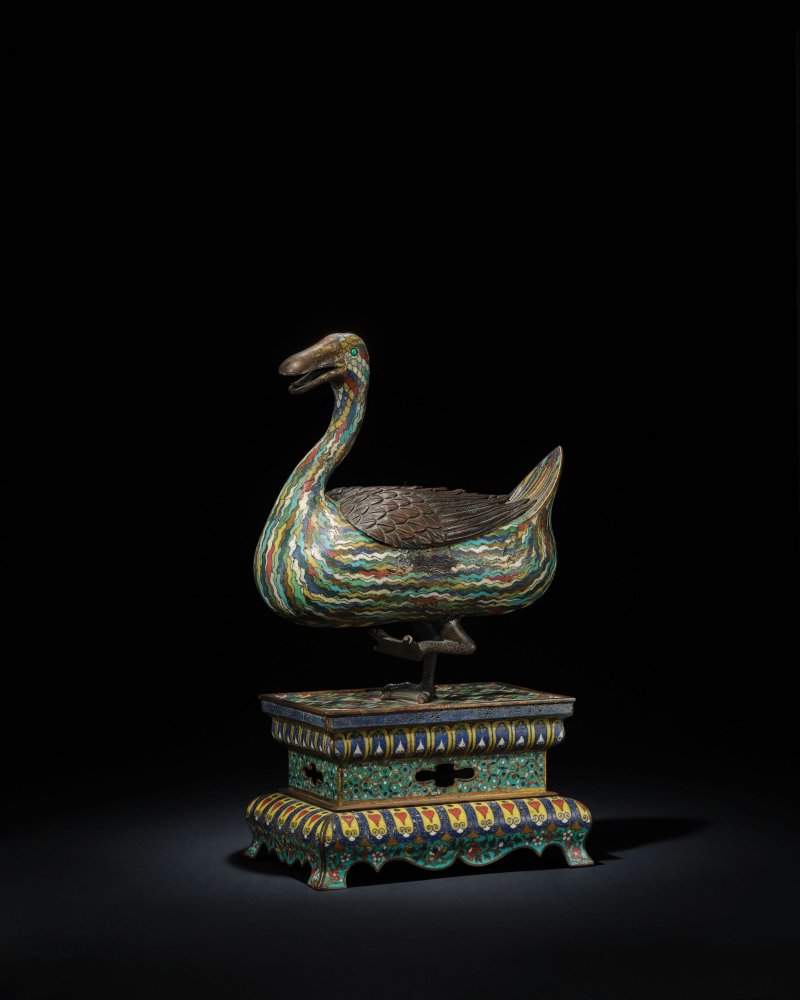

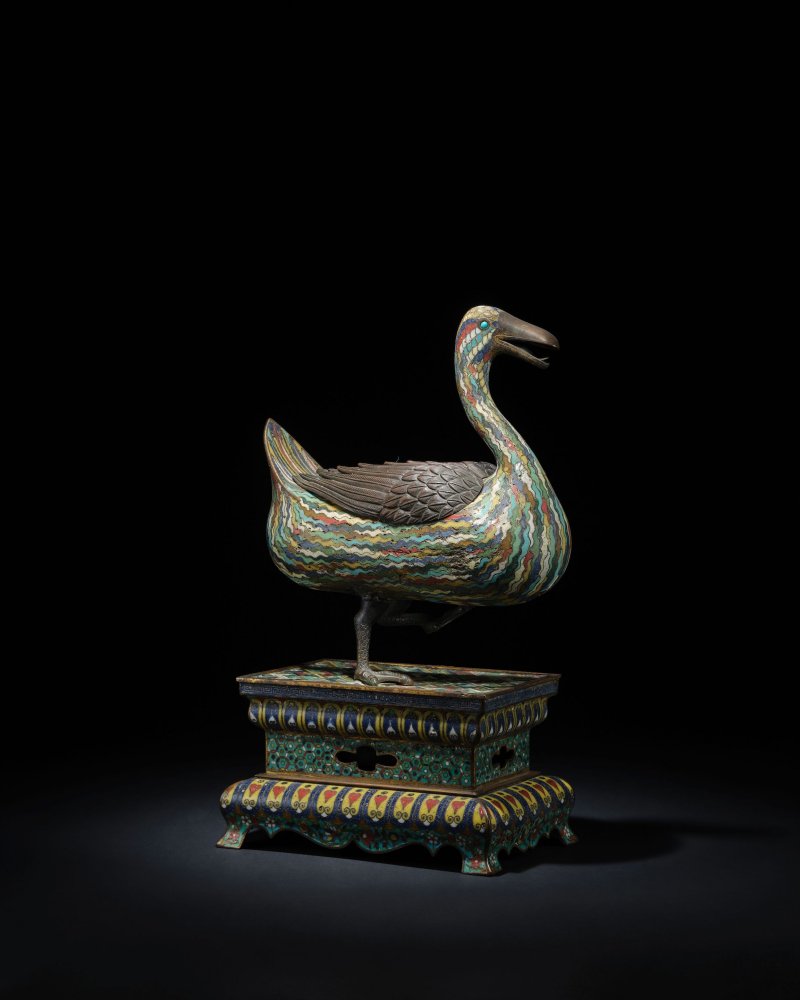
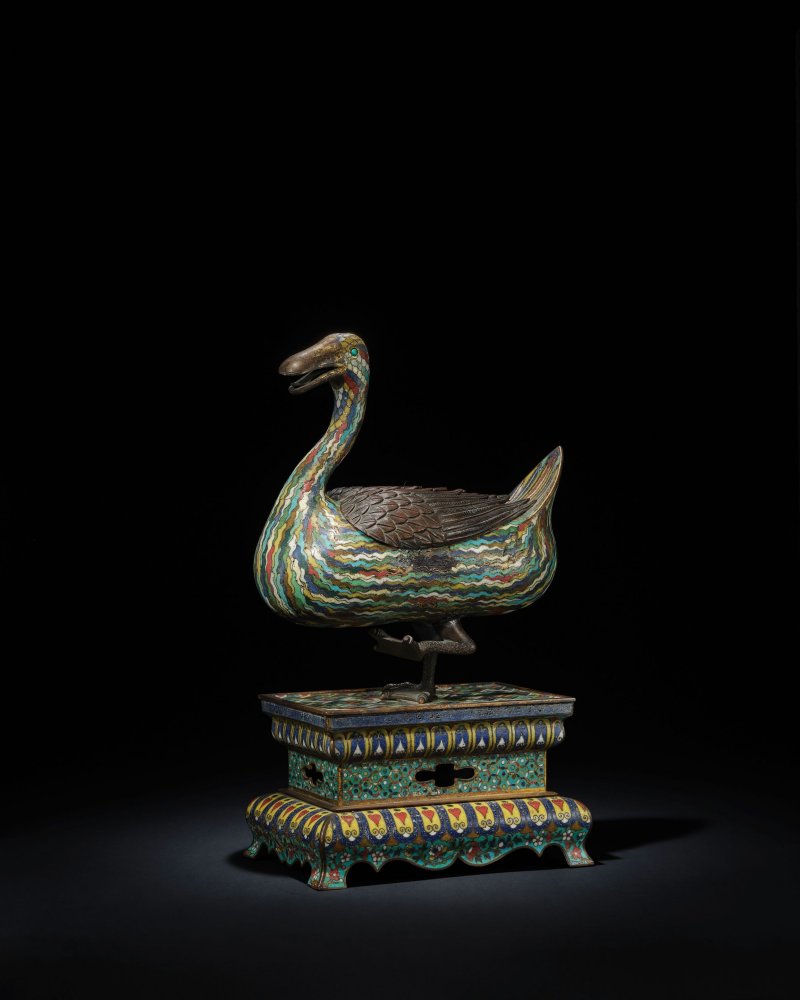
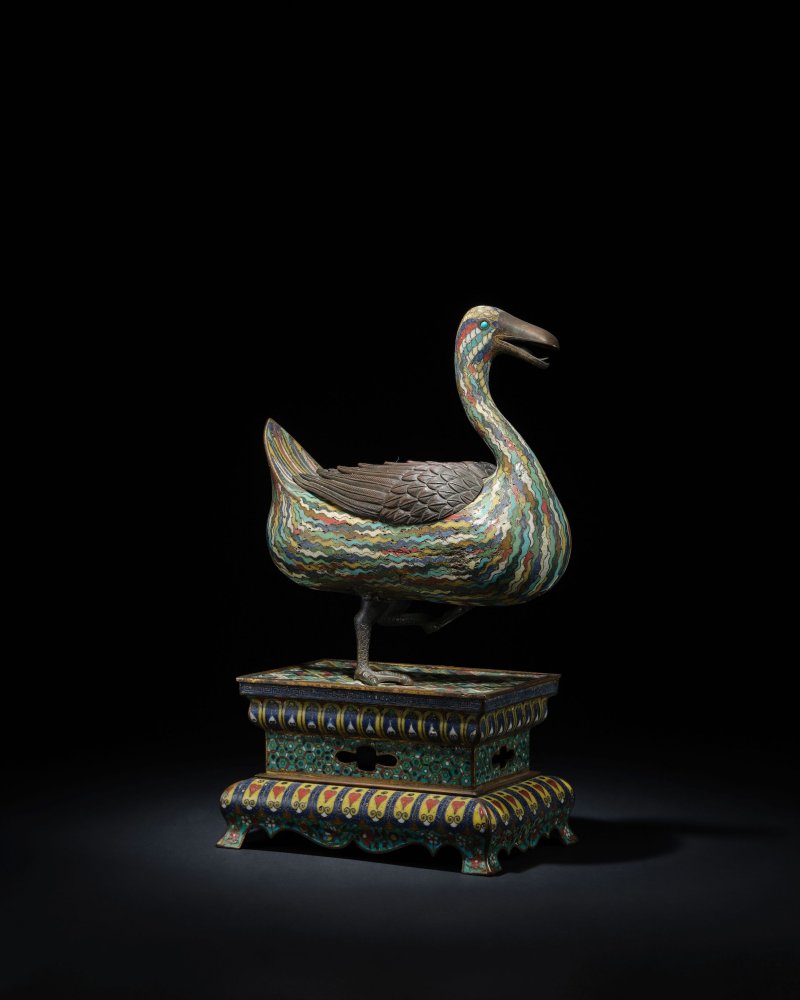
Lot 28 明晚期 掐絲琺瑯寶鴨式熏爐 | A RARE CLOISONNÉ ENAMEL 'DUCK' INCENSE BURNER
落槌价
预展中
成交价
预展中
| 拍卖公司 | 邦瀚斯 |
|---|---|
| 拍卖时间 | 2026年10月28日 |
拍品信息
拍品名称
明晚期 掐絲琺瑯寶鴨式熏爐 | A RARE CLOISONNÉ ENAMEL 'DUCK' INCENSE BURNER
年代
Late Ming Dynasty
起拍价
HKD 200,000
估值区间
HKD 200000 - 300000
尺寸
未知
品相
未知
更多信息
Late Ming Dynasty
Elegantly cast in the form of a duck standing on its right webbed foot, the left raised, atop a stepped pedestal with lappets around the edges, the waisted central section with quatrefoil apertures on each side, the bird naturalistically modelled with its gilt-bronze head turned slightly to the left, the open beak revealing a slender curled tongue, its paste-inset eyes centred by turquoise beads, the hollow body, neck and upswept tail brightly decorated in enamel with undulating bands of plumage, the later replaced and removable bronze cover forming the bird's back with finely chased plumage, fitted box.
38cm (15in) high. (3).
Footnotes
明晚期 掐絲琺瑯寶鴨式熏爐
Provenance:
Lorenzo Hurtado de Saracho Arregui (1889-1984), mayor of Bilbao (1959-1963), and thence by descent
Christie's Paris, 14 December 2016, lot 61
來源:
西班牙畢爾包前市長 Lorenzo Hurtado de Saracho Arregui(1889-1984,1959-1963在任),此後家族傳承
巴黎佳士得,2016年12月14日,拍品編號61
It is rare to encounter a Ming dynasty cloisonné enamel incense burner of such quality in the form of a mandarin duck atop a rectangular stand. Several cloisonné enamel ducks, late Ming dynasty, are in the Qing Court Collection, some standing atop lotus leaves, and are illustrated in , vol.1, Beijing, 2011, pp.274-277, nos.145-148. See also a cloisonné enamel 'duck' incense burner and cover on circular stand, first half 16th century, in the Palace Museum, Taipei, which is illustrated in , Taipei, 1999, no.7. A further related cloisonné enamel incense burner in the form of a goose, late Ming dynasty, from the collection of David David-Weill, is in the Musée des Arts Décoratifs, Paris, and is illustrated by B.Quette, ed., , New York, 2011, p.277, no.104. A pair of cloisonné enamel 'duck' incense burners, Ming dynasty, was sold at Christie's Paris, 7 December 2007, lot 13, and was subsequently illustrated in , Suzhou, 2007, pp.118-19.
Duck and goose form incense burners have a long history in Chinese decorative arts, becoming particularly fashionable as archaistic forms from the Song dynasty onwards. Known as , or 'incense duck', and , 'golden duck', they became closely associated with the cultivated interior and the refined appreciation of fragrance. Their presence in literary sources of the Song period is especially evocative. Lu You (1125–1210), for example, refers to an incense duck in two poems: one composed during a sleepless night and another recalling wine on a bitterly cold evening, where the vessel forms part of the intimate array of objects surrounding the scholar at his desk. By the seventeenth century, the incense duck had acquired a place within the elegant female interior: a painting by Chen Hongshou (1599–1652) depicts one being used to perfume robes, demonstrating that the form served a practical as well as ornamental purpose.
The prototype for these vessels can be traced to Han dynasty bird-shaped censers, whose perforated covers allowed the fragrant smoke to escape. Ming dynasty examples, however, display a strikingly greater degree of naturalism, with the body, plumage and stance of the bird rendered with close attention to the living creature. This development may be understood alongside the Ming revival of earlier painting traditions and the period's wider interest in the observation and representation of nature, transforming an ancient archaistic form into a particularly vivid and luxurious object; see a Han dynasty duck-shaped incense burner, as well as a Song dynasty one, illustrated in , New York, 2025, p.143. A polychrome enamel duck-shaped incense burner, Chenghua, in the Shanghai Museum is illustrated in , p.144.
See a related cloisonné enamel duck-form incense burner and cover, 17th century, which was sold at Christie's New York, 18 September 2014, lot 604.
此明代鴨式爐,一足獨立,神態自然,下承台座,掐絲細緻,色彩豐富,殊不多見 。清宮舊藏晚明數例,包括足踏荷葉者,收入《故宮博物院藏品大系:琺瑯器編》,卷1,北京,2011年,頁274-277,編號145-148 。台北故宮博物院藏十六世紀上半葉之掐絲琺瑯鴨式蓋爐,圓座承之,圖見《明清琺瑯器展覽圖錄》,台北,1999年,編號7 。David David-Weill 舊藏也有一晚明寶鵝式爐,現納入巴黎裝飾藝術博物館,圖載於 B.Quette 編,《Cloisonné: Chinese Enamels from the Yuan, Ming, and Qing Dynasties》,紐約,2011年,頁277,編號104 。另可參考相關明朝成對鴨式熏爐,售於巴黎佳士得,2007年12月7日,拍品編號13,後見於《絢麗、華貴、至尊:香港張宗憲先生珍藏御製宮廷掐絲琺瑯器特展》,蘇州,2007,頁118-119 。
以鴨或鵝等水禽為造型之熏爐,古已有之,至宋伊始,藉著仿古之風,香鴨或金鴨爐延興不衰,用作香具置室溢芬芳,成為書齋不可或缺之雅事,宋代文人時詠之 。例如陸游(1125-1210)便有「金鴨餘香尚暖」和「屏暖半銷香鴨火」之詩句流芳百世。香鴨既美觀又實用,至十七世紀更見於仕女閏房,陳洪綬(1599-1652)筆下,便有描繪香鴨熏衣的畫作 。
此器雛型,可上溯至漢時鳥式鏤空蓋爐 。明代例子鳥姿則更像生自然,身軀飽滿,佇立體態栩栩如生,翎羽刻劃入微 。明朝繪畫慕古為尚,同時強調師法自然,重視寫生傳神。在這樣的美學氛圍下,如此爐的擬古香具應運而生。對比漢與宋朝鴨式熏爐,圖見《鎔古鑄金:宋元明清銅器藝術》,紐約, 2025年,頁143,同書並載明成化素三彩鴨式爐,頁144。
參考一件相關的十七世紀掐絲琺瑯寶鴨式蓋爐,售於紐約佳士得,2014年9月18日,拍品編號 604。
Elegantly cast in the form of a duck standing on its right webbed foot, the left raised, atop a stepped pedestal with lappets around the edges, the waisted central section with quatrefoil apertures on each side, the bird naturalistically modelled with its gilt-bronze head turned slightly to the left, the open beak revealing a slender curled tongue, its paste-inset eyes centred by turquoise beads, the hollow body, neck and upswept tail brightly decorated in enamel with undulating bands of plumage, the later replaced and removable bronze cover forming the bird's back with finely chased plumage, fitted box.
38cm (15in) high. (3).
Footnotes
明晚期 掐絲琺瑯寶鴨式熏爐
Provenance:
Lorenzo Hurtado de Saracho Arregui (1889-1984), mayor of Bilbao (1959-1963), and thence by descent
Christie's Paris, 14 December 2016, lot 61
來源:
西班牙畢爾包前市長 Lorenzo Hurtado de Saracho Arregui(1889-1984,1959-1963在任),此後家族傳承
巴黎佳士得,2016年12月14日,拍品編號61
It is rare to encounter a Ming dynasty cloisonné enamel incense burner of such quality in the form of a mandarin duck atop a rectangular stand. Several cloisonné enamel ducks, late Ming dynasty, are in the Qing Court Collection, some standing atop lotus leaves, and are illustrated in , vol.1, Beijing, 2011, pp.274-277, nos.145-148. See also a cloisonné enamel 'duck' incense burner and cover on circular stand, first half 16th century, in the Palace Museum, Taipei, which is illustrated in , Taipei, 1999, no.7. A further related cloisonné enamel incense burner in the form of a goose, late Ming dynasty, from the collection of David David-Weill, is in the Musée des Arts Décoratifs, Paris, and is illustrated by B.Quette, ed., , New York, 2011, p.277, no.104. A pair of cloisonné enamel 'duck' incense burners, Ming dynasty, was sold at Christie's Paris, 7 December 2007, lot 13, and was subsequently illustrated in , Suzhou, 2007, pp.118-19.
Duck and goose form incense burners have a long history in Chinese decorative arts, becoming particularly fashionable as archaistic forms from the Song dynasty onwards. Known as , or 'incense duck', and , 'golden duck', they became closely associated with the cultivated interior and the refined appreciation of fragrance. Their presence in literary sources of the Song period is especially evocative. Lu You (1125–1210), for example, refers to an incense duck in two poems: one composed during a sleepless night and another recalling wine on a bitterly cold evening, where the vessel forms part of the intimate array of objects surrounding the scholar at his desk. By the seventeenth century, the incense duck had acquired a place within the elegant female interior: a painting by Chen Hongshou (1599–1652) depicts one being used to perfume robes, demonstrating that the form served a practical as well as ornamental purpose.
The prototype for these vessels can be traced to Han dynasty bird-shaped censers, whose perforated covers allowed the fragrant smoke to escape. Ming dynasty examples, however, display a strikingly greater degree of naturalism, with the body, plumage and stance of the bird rendered with close attention to the living creature. This development may be understood alongside the Ming revival of earlier painting traditions and the period's wider interest in the observation and representation of nature, transforming an ancient archaistic form into a particularly vivid and luxurious object; see a Han dynasty duck-shaped incense burner, as well as a Song dynasty one, illustrated in , New York, 2025, p.143. A polychrome enamel duck-shaped incense burner, Chenghua, in the Shanghai Museum is illustrated in , p.144.
See a related cloisonné enamel duck-form incense burner and cover, 17th century, which was sold at Christie's New York, 18 September 2014, lot 604.
此明代鴨式爐,一足獨立,神態自然,下承台座,掐絲細緻,色彩豐富,殊不多見 。清宮舊藏晚明數例,包括足踏荷葉者,收入《故宮博物院藏品大系:琺瑯器編》,卷1,北京,2011年,頁274-277,編號145-148 。台北故宮博物院藏十六世紀上半葉之掐絲琺瑯鴨式蓋爐,圓座承之,圖見《明清琺瑯器展覽圖錄》,台北,1999年,編號7 。David David-Weill 舊藏也有一晚明寶鵝式爐,現納入巴黎裝飾藝術博物館,圖載於 B.Quette 編,《Cloisonné: Chinese Enamels from the Yuan, Ming, and Qing Dynasties》,紐約,2011年,頁277,編號104 。另可參考相關明朝成對鴨式熏爐,售於巴黎佳士得,2007年12月7日,拍品編號13,後見於《絢麗、華貴、至尊:香港張宗憲先生珍藏御製宮廷掐絲琺瑯器特展》,蘇州,2007,頁118-119 。
以鴨或鵝等水禽為造型之熏爐,古已有之,至宋伊始,藉著仿古之風,香鴨或金鴨爐延興不衰,用作香具置室溢芬芳,成為書齋不可或缺之雅事,宋代文人時詠之 。例如陸游(1125-1210)便有「金鴨餘香尚暖」和「屏暖半銷香鴨火」之詩句流芳百世。香鴨既美觀又實用,至十七世紀更見於仕女閏房,陳洪綬(1599-1652)筆下,便有描繪香鴨熏衣的畫作 。
此器雛型,可上溯至漢時鳥式鏤空蓋爐 。明代例子鳥姿則更像生自然,身軀飽滿,佇立體態栩栩如生,翎羽刻劃入微 。明朝繪畫慕古為尚,同時強調師法自然,重視寫生傳神。在這樣的美學氛圍下,如此爐的擬古香具應運而生。對比漢與宋朝鴨式熏爐,圖見《鎔古鑄金:宋元明清銅器藝術》,紐約, 2025年,頁143,同書並載明成化素三彩鴨式爐,頁144。
參考一件相關的十七世紀掐絲琺瑯寶鴨式蓋爐,售於紐約佳士得,2014年9月18日,拍品編號 604。
常见问题
这件明晚期 掐絲琺瑯寶鴨式熏爐 | A RARE CLOISONNÉ ENAMEL 'DUCK' INCENSE BURNER的成交价是多少?
落槌价为 预展中。 成交价为 预展中。