
拍品信息
拍品名称
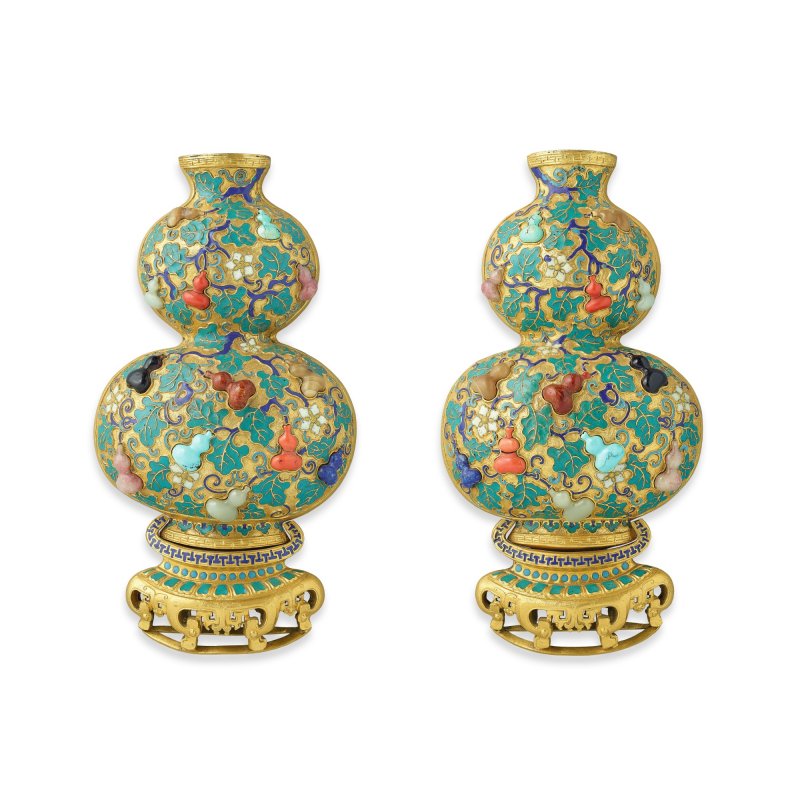
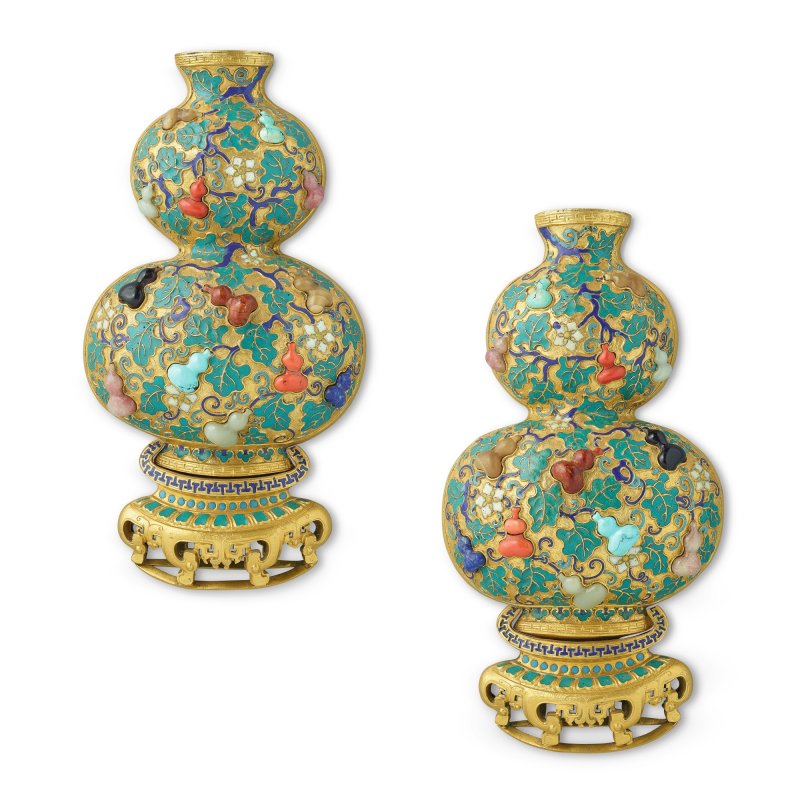
清乾隆 銅鏨胎琺瑯嵌寶子孫萬代紋葫蘆形壁瓶一對
起拍价
USD 60,000
估值区间
60,000 - 80,000 USD
尺寸
未知
品相
如欲了解本拍品狀況的更多資訊,請聯絡 Drew.Lerner@sothebys.com
更多信息
(2)
Height 11⅜ in., 29 cm
来源:Lea (d. 2024) 及 Paul (1930-2013) Reichmann 伉儷收藏,1988年購於倫敦,此後家族傳承
图录
说明:During the reign of the Qianlong Emperor, the manufacture of champlevé, cloisonné and painted enamel products flourished to achieve its most sophisticated level in both range and quality. Palace archival records confirm that huge quantities of enamel wares were produced with a wide range of designs which included luxurious and eye-catching pieces such as this pair of vases. Yang Boda in the catalogue to the exhibition Tributes from Guangdong to the Qing Court, Art Gallery, The Chinese University of Hong Kong, Hong Kong, 1987, p. 54, notes the high quality and quantity of champlevé wares made in Guangzhou, adding that they were ‘second to none during the whole Qing dynasty…’. Guangzhou had indeed become an important artistic center as craftsmen active there were in close contact with European missionaries and traders bringing to China new and innovative techniques. Wares made in this foreign technique were much sought after by the imperial household, hence a large number of champlevé wares were sent as tribute gift to the court in Beijing.
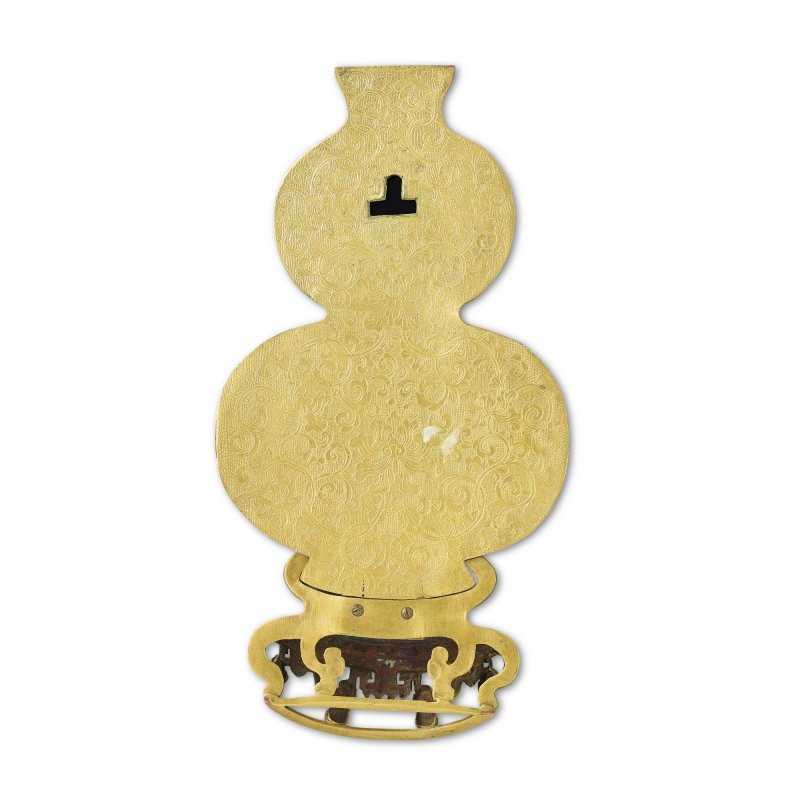
The form of this pair of vases was an innovation of the Qianlong period. Flattened at the back as though cut in half and often made in pairs, these vases, which are known in a variety of media, were commonly hung in private rooms or inside sedan chairs. In a poem on one porcelain wall vase, the Qianlong Emperor commented on the pleasure provided by these vases when filled with flowers, which allowed him to enjoy their fragrance while the ‘red dust’ (cares of the world) could not reach him (see the catalogue to the exhibition China. The Three Emperors 1662-1795, Royal Academy of Arts, London, 2005, pl. 445). This pair is also particularly unusual as they are cast to simulate vases on stands thus falling in the category of trompe-l’oeil. Simulations that were often difficult to distinguish from the ‘real’ were created during the Qianlong reign, and often under his personal supervision, to cater to his penchant for novel and amusing pieces.
Champlevé wall vases are rare, although a pair of double-gourd wall vases decorated with bajixiang and auspicious characters, from the collection of Robert H. and Clarice Smith, was sold at Christie’s New York, 15th December 2011, lot 1172. Compare, also, large double-gourd vases similarly decorated in champlevé enamel with scrolling gourds; one in the Shenyang Palace Museum, Shenyang, illustrated in Imperial Life in the Qing Dynasty. The Empress Palace, Singapore, 1989, pp 18 and 19; one sold in our Hong Kong rooms, 23rd October 2005, lot 403; another sold in our Los Angeles rooms, 5th March 1981, lot 1122; a fourth vase with a Qianlong mark and of the period, sold at Christie’s London, 15th May 2007, lot 170; and a pair, sold at Christie’s New York, 28th October 1977, lot 223. A further large double-gourd vase, but decorated in cloisonné enamels with bronze gourds in relief, in the Palace Museum, Beijing, is illustrated in The Compendium of Collections in the Palace Museum. Enamels, vol. 3, Cloisonné in the Qing Dynasty, Beijing, 2011, pl. 160.
Height 11⅜ in., 29 cm
来源:Lea (d. 2024) 及 Paul (1930-2013) Reichmann 伉儷收藏,1988年購於倫敦,此後家族傳承
图录
说明:During the reign of the Qianlong Emperor, the manufacture of champlevé, cloisonné and painted enamel products flourished to achieve its most sophisticated level in both range and quality. Palace archival records confirm that huge quantities of enamel wares were produced with a wide range of designs which included luxurious and eye-catching pieces such as this pair of vases. Yang Boda in the catalogue to the exhibition Tributes from Guangdong to the Qing Court, Art Gallery, The Chinese University of Hong Kong, Hong Kong, 1987, p. 54, notes the high quality and quantity of champlevé wares made in Guangzhou, adding that they were ‘second to none during the whole Qing dynasty…’. Guangzhou had indeed become an important artistic center as craftsmen active there were in close contact with European missionaries and traders bringing to China new and innovative techniques. Wares made in this foreign technique were much sought after by the imperial household, hence a large number of champlevé wares were sent as tribute gift to the court in Beijing.
The form of this pair of vases was an innovation of the Qianlong period. Flattened at the back as though cut in half and often made in pairs, these vases, which are known in a variety of media, were commonly hung in private rooms or inside sedan chairs. In a poem on one porcelain wall vase, the Qianlong Emperor commented on the pleasure provided by these vases when filled with flowers, which allowed him to enjoy their fragrance while the ‘red dust’ (cares of the world) could not reach him (see the catalogue to the exhibition China. The Three Emperors 1662-1795, Royal Academy of Arts, London, 2005, pl. 445). This pair is also particularly unusual as they are cast to simulate vases on stands thus falling in the category of trompe-l’oeil. Simulations that were often difficult to distinguish from the ‘real’ were created during the Qianlong reign, and often under his personal supervision, to cater to his penchant for novel and amusing pieces.
Champlevé wall vases are rare, although a pair of double-gourd wall vases decorated with bajixiang and auspicious characters, from the collection of Robert H. and Clarice Smith, was sold at Christie’s New York, 15th December 2011, lot 1172. Compare, also, large double-gourd vases similarly decorated in champlevé enamel with scrolling gourds; one in the Shenyang Palace Museum, Shenyang, illustrated in Imperial Life in the Qing Dynasty. The Empress Palace, Singapore, 1989, pp 18 and 19; one sold in our Hong Kong rooms, 23rd October 2005, lot 403; another sold in our Los Angeles rooms, 5th March 1981, lot 1122; a fourth vase with a Qianlong mark and of the period, sold at Christie’s London, 15th May 2007, lot 170; and a pair, sold at Christie’s New York, 28th October 1977, lot 223. A further large double-gourd vase, but decorated in cloisonné enamels with bronze gourds in relief, in the Palace Museum, Beijing, is illustrated in The Compendium of Collections in the Palace Museum. Enamels, vol. 3, Cloisonné in the Qing Dynasty, Beijing, 2011, pl. 160.
常见问题
拍品的品相状况如何?
如欲了解本拍品狀況的更多資訊,請聯絡 Drew.Lerner@sothebys.com
这件拍品的流传来源是什么?
Lea (d. 2024) 及 Paul (1930-2013) Reichmann 伉儷收藏,1988年購於倫敦,此後家族傳承
图录
图录