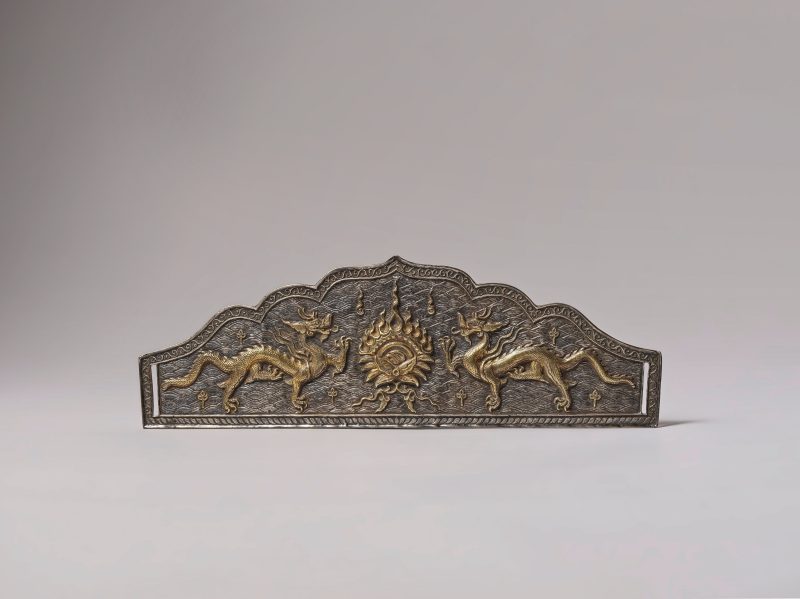

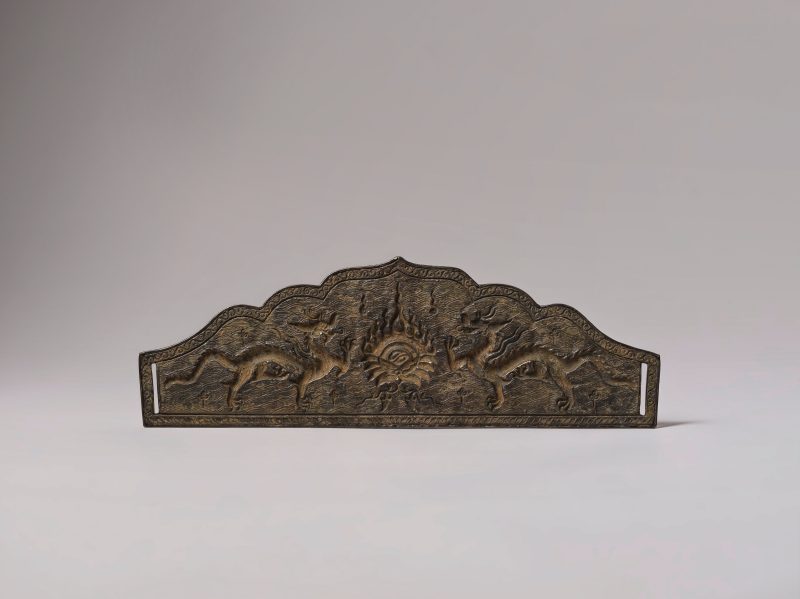
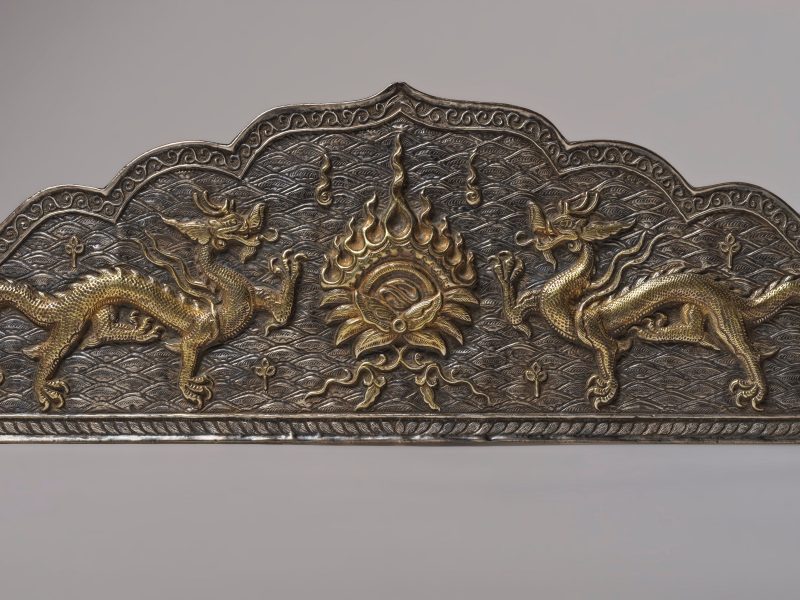
Lot 66 遼代 銀局部鎏金雙龍戲珠紋冠 | RARE GRAND ORNEMENT DE CHEVEUX EN ARGENT REPOUSSÉ PARTIELLEMENT DORÉ
落槌价
预展中
成交价
预展中
| 拍卖公司 | 邦瀚斯 |
|---|---|
| 拍卖时间 | 2026年12月10日 |
拍品信息
拍品名称
遼代 銀局部鎏金雙龍戲珠紋冠 | RARE GRAND ORNEMENT DE CHEVEUX EN ARGENT REPOUSSÉ PARTIELLEMENT DORÉ
年代
遼代
起拍价
未知
估值区间
EUR 12,000–15,000
尺寸
43 cm (16 7/8 in.) long
品相
未知
更多信息
RARE GRAND ORNEMENT DE CHEVEUX EN ARGENT REPOUSSÉ PARTIELLEMENT DORÉ
Dynastie Liao (907-1125)
A RARE LARGE PARCEL-GILT SILVER REPOUSSÉ 'DRAGON' HEADDRESS
Liao Dynasty
Finely worked in repoussé from a single silver sheet, with gilt details, with a straight lower rim and a bracketed upper rim tapering towards the ends pierced with a long slit on each side, decorated with a large central flaming pearl issuing from a lotus flower, flanked by a pair of confronted dragons, each in profile, their long, sinuous bodies unfolding, their heads raised and with a menacing expression, against a dense wave-pattern ground scattered with leafy sprays and whisps of flames, all framed along the top by a floral scroll and a band of lotus petals on the bottom, the raised details highlighted in gilt.
43 cm (16 7/8 in.) long
遼代 銀局部鎏金雙龍戲珠紋冠
Provenance:
Gisèle Croës Arts d'Extrême Orient, Brussels
Published, Exhibited and Illustrated:
Gisèle Croës Arts d'Extrême Orient at Nohra Haime Gallery, New York, Treasures of Ancient Chinese Culture, New York, March 18 - 22 2008, pp. 74-75
來源:
Gisèle Croës Arts d'Extrême Orient,布魯塞爾
展覽著錄:
Gisèle Croës Arts d'Extrême Orient在諾拉·海姆畫廊,紐約,《Treasures of Ancient Chinese Culture》,紐約,2008年3月18-22日,第74-75頁
Under the Liao dynasty, the art of precious metalworking reached new levels as surviving examples of gold, silver or gilt-bronze crowns and headdresses discovered in high-ranking Liao tombs linked to members of the Liao ruling family attest. These finds suggest that the use of such precious headdresses was a privilege reserved for members of the aristocracy, including the royal family and members of the Liao Court. We can assume precious crowns, headdresses and jewellery accompanied deceased members of the ruling family in death as they had in life when worn during important ritual rites and ceremonies, see Jia Xizeng, 'Liaodai jin guan', in Zijincheng, November, 2011, pp 96-113.
Stylistically, the present headdress incorporates elements and techniques already found on precious metalware made during the middle to late Tang dynasty. François Louis has argued that the Liao metalworking tradition that evolved in the tenth century was deeply rooted in the Chinese metalworking tradition but also adopted elements from the Xi and Bohai peoples who had been defeated by the Kitan Liao. Louis has noted that the conquered people contributed even the silver from which the Liao metal crowns and vessels were made, see François Louis, 'Shaping Symbols of Privilege: Precious Metals and the Early Liao Aristocracy', in Journal of Song and Yuan Studies, 33 (2003), pp. 71–109.
In his study of Liao dynasty gilt-bronze and gilt-silver funereal crowns, Wang Chunyan has established a taxonomy of these distinctive headdresses, see Wang Chunyan, Liao dai jinyinqi yanjiu, Beijing, 2020. The first type of headdress or crown is characterised by its complex, sculptural form often executed in overlapping layers of fine metal plates or sheets and openwork panels. The second type is represented by the present headdress, and consists of a single piece of silver sheet that can be bent around the head. The decoration is in the form of repoussé with elements precisely worked and detailed from a thin silver sheet as visible in the present piece. This type of headdress is less common and fewer examples are known. Among them is a larger parcel-gilt silver headdress with the same design of a pair of dragons confronting a flaming pearl, in the collection of the Museum of Fine Arts, Boston (accession no. 40.749). A Liao gilded silver crown also displaying similar striding dragons is illustrated by Emma C. Bunker and Julia M. White, Adornment for the Body and Soul, Hong Kong, 1999, no. 90. And a gilt-bronze headdress with dragons flanking a flaming pearl in the collection of the St. Louis Art Museum, St. Louis, Missouri (accession no. 108:2002).
以下内容由AI翻译:
【描述】
由单张银片精细锤揲而成,部分细节鎏金,底部边缘平直,上缘作曲折形,向两端逐渐收窄,两侧各有一个长缝,中央饰有一朵莲花中的火焰珠,两侧饰有一对相对的龙,每条龙呈侧面姿态,身体蜿蜒展开,头部抬起,表情凶猛,背景为密集的波浪纹,散布着叶状枝条和火焰纹,顶部饰有花卉卷草纹,底部饰有一圈莲花瓣,凸起的细节部分鎏金。
在辽代,贵金属工艺达到了新的水平,与辽代统治家族成员有关的高等级辽墓中出土的金、银或鎏金铜冠与头饰,即为明证。这些发现表明,使用此类贵重头饰是贵族阶层的特权,包括皇室成员和辽朝宫廷成员。我们可以假设,这些贵重的冠饰、头饰和珠宝在重要仪式和典礼中佩戴时伴随统治家族成员,死后也随他们一同埋葬,见贾希增,《辽代金冠》,《紫禁城》,2011年11月,第96-113页。
从风格上看,这件头饰融合了中晚唐时期贵金属器皿上的元素和技术。François Louis认为,十世纪发展起来的辽代金属工艺深深植根于中国的金属工艺传统,但也吸收了被契丹辽征服的奚族和渤海人的元素。Louis指出,被征服的人们甚至提供了制作辽代金属冠饰和器皿所需的白银,见François Louis,《塑造特权象征:早期辽代贵族的贵金属》,《宋元研究杂志》,33卷(2003年),第71-109页。
王春燕在其关于辽代鎏金铜及鎏金银葬冠的研究中,建立了这些独特头饰的分类体系,见王春燕,《辽代金银器研究》,北京,2020年。第一种类型的头饰或冠饰以其复杂的雕塑形式为特征,通常由多层精细金属板或镂空面板制成。第二种类型则以这件头饰为代表,由一张银片弯曲成头饰形状。装饰采用锤揲技术,从薄银片上精确细致地制作出图案。这种类型的头饰较为少见,已知的例子较少。其中一件较大的局部鎏金银冠饰,同样饰有一对相对的龙和火焰珠,现藏于波士顿美术馆(馆藏编号40.749)。一件类似的辽代鎏金银冠饰,也展示了类似的行走龙,见Emma C. Bunker和Julia M. White,《身体与灵魂的装饰》,香港,1999年,编号90。还有一件饰有龙和火焰珠的鎏金青铜头饰,现藏于密苏里州圣路易斯艺术博物馆(馆藏编号108:2002)。
常见问题
这件遼代 銀局部鎏金雙龍戲珠紋冠 | RARE GRAND ORNEMENT DE CHEVEUX EN ARGENT REPOUSSÉ PARTIELLEMENT DORÉ的成交价是多少?
落槌价为 预展中。 成交价为 预展中。
拍品的尺寸是多少?
43 cm (16 7/8 in.) long