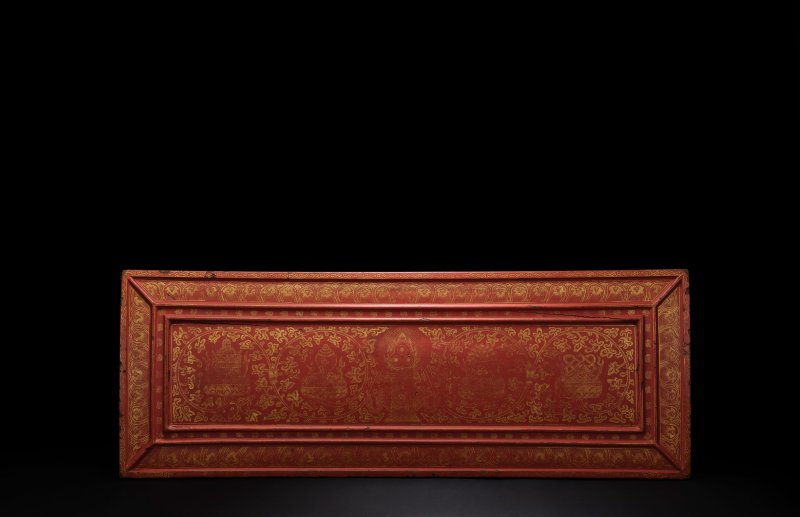

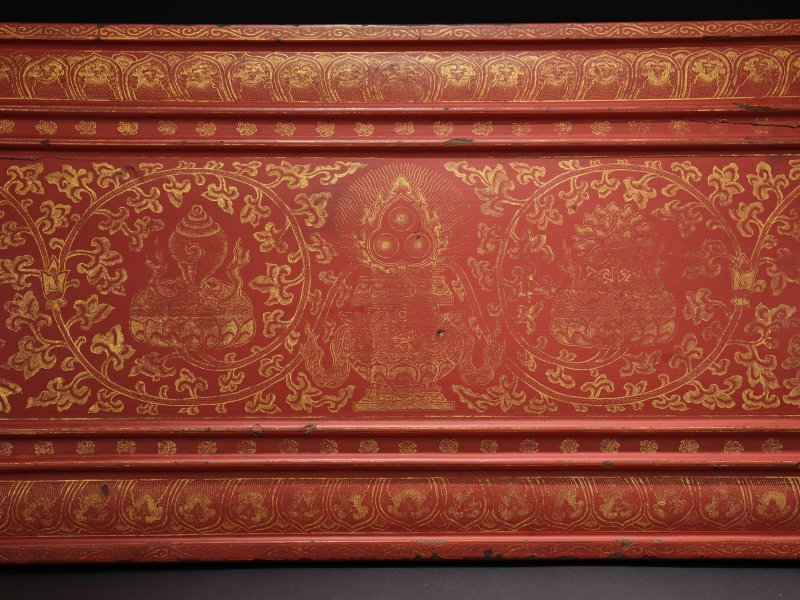
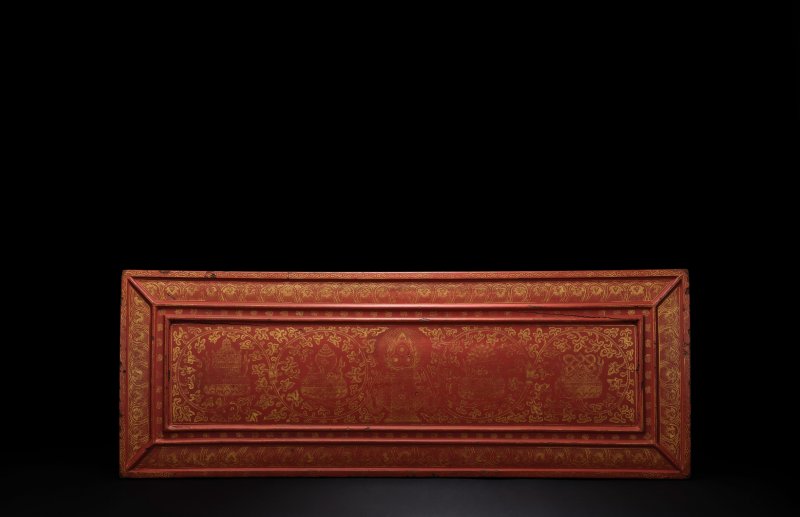
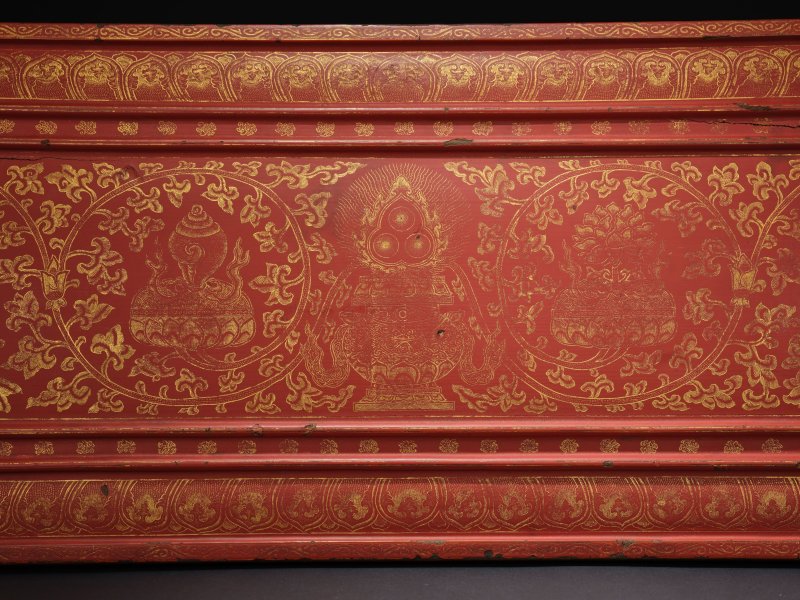
Lot 12 明永樂 紅漆戧金八寶蓮瓣紋經板 | AN ENGRAVED AND GILT-DECORATED RED-LACQUERED WOOD SUTRA COVER
落槌价
预展中
成交价
预展中
| 拍卖公司 | 邦瀚斯 |
|---|---|
| 拍卖时间 | 2026年10月28日 |
拍品信息
拍品名称
明永樂 紅漆戧金八寶蓮瓣紋經板 | AN ENGRAVED AND GILT-DECORATED RED-LACQUERED WOOD SUTRA COVER
年代
Yongle
起拍价
HKD 120,000
估值区间
HKD 120000 - 150000
尺寸
未知
品相
未知
更多信息
Yongle
Of rectangular section, finely engraved and gilt in qiangjin technique in the recessed horizontal panel with a central canopied vase supporting a flaming cintamani emblem and issuing leafy scrolls, flanked by four bajixiang emblems, all framed by bands of florets, petal lappets and classic scrolls, the sides further decorated with meandering floral scrolls, the reverse applied with plain red lacquer.
73.2cm (28 7/8in) long.
Footnotes
明永樂 紅漆戧金八寶蓮瓣紋經板
Provenance:
Acquired in Taiwan, April 2022
來源:
購自台灣,2022年4月
A pair of similar qiangjin and red lacquer sutra covers with inscription, Yongle, is in the Qing Court Collection, Palace Museum, Beijing (acc.no.xin00202332). Another similar pair of red lacquer sutra covers, Ming dynasty, 15th century, is in the Palace Museum, Taipei, illustrated in , Taipei, 2008, pp.46-47, no.27. Another two similar sutra covers, circa 1410, are illustrated in , New York, 1991, pp.116-7, pl.49. A similar red lacquer with decoration, Yongle, is also illustrated in , Hong Kong, 1993, pp.152-153, no.79.
The present lot probably formed part of the set commissioned by the Yongle Emperor for the first printed edition of the Tibetan Buddhist canon. In the eighth year of the Yongle reign (1410), the Emperor commissioned the Fifth Karmapa, Dezhin Shegpa, to oversee the compilation of the canon and ordered its printing at Linggu Temple in Nanjing. Completed in 1414, copies were subsequently presented to leading figures of the Sakya, Karma Kagyu and Gelug traditions of Tibetan Buddhism. The surviving covers from these sets, including those preserved at the Palace Museum and the Sa-skya monastery, display closely related designs and provide important evidence for the appearance of lacquer produced in the Imperial workshops during the Yongle period.
The significance of these covers for the history of Chinese lacquer is manifold. They provide one of the earliest known examples of official Ming style work. In earlier Yuan dynasty lacquer work with engraved gilt decoration, the grooves are sharply cut with a straight-edged instrument, freely manipulated across the surface much as a pencil might be used in a sketch. On the present cover, by contrast, the incisions are more regular, evenly spaced and consistent in width, suggesting the use of a channelling tool that produced a characteristic U-shaped groove.
Compare with several and red lacquer sutra covers, Yongle, including an inscribed set from the Lee Family collection, which was later sold at Christie's Hong Kong, 1 December 2009, lot 1821; another set from the Baoyizhai collection, which was sold at Sotheby's Hong Kong, 8 April 2014, lot 38; and a set which was sold at Christie's New York, 24 Mar 2023, lot 1212. A single cover with the underside similarly applied with plain red lacquer was sold at Christie's Hong Kong, 31 May 2017, lot 2816.
經板呈長方形,通體髹朱漆,以描金裝飾。板面作二道弦紋,隨形凸起,內成開光,正中繪雙耳簋式寶瓶,兩側各繪纏枝蓮托八吉祥,此板見其中四寶;寶瓶上置三如意寶珠,光芒四射,向左右伸出枝葉,由左而右分別為傘蓋、寶螺、蓮花、盤長。開光外繪蓮瓣紋,居中對稱,左右斜傾,外圍與經板四角相連。
參考清宮舊藏一對永樂朝紅漆戧金八吉祥紋經文夾板,陰刻漢、藏二體文字經名,現藏北京故宮博物院(館藏編號:新00202332)。台北故宮博物院藏另一對明十五世紀紅漆戧金八寶紋經板,著錄於《和光剔彩:故宮藏漆》,台北,2008年,頁46至47,編號27。另見兩件約1410年之紅漆戧金經板,為歐雲伉儷收藏,載於《East Asian Lacquer: The Florence and Herbert Irving Collection》,紐約,1991年,頁116至117,圖版49;及永樂朝一例,著錄於《中國漆藝二千年》,香港,1993年,頁152至153,編號79。
本品或為永樂帝敕造之《大藏經》首部刊刻本所用經板之一。永樂八年(1410年),永樂帝命第五世噶瑪巴(德新謝巴),主持編纂此藏經,並於南京靈谷寺刊刻。永樂十二年(1414年)竣工後,分賜藏傳佛教薩迦、噶舉、格魯諸派高僧。此類經板之傳世者,包括故宮博物院及薩迦寺所藏,紋飾與本品相似,亦為戧金漆器出現於永樂朝宮廷作坊之證。
此類經板對中國漆器史具有重要意義,為已知最早之明代官方所製戧金漆器。元代早期之戧金漆器,其陰刻線條以利器刻成,走刀自由,猶如鉛筆起稿;而本品刻線則更為規整,間距均勻,寬度一致,反映已採用特定工具,形成規範線條。
比較數件永樂朝紅漆戧金經板,包括李氏家族舊藏一組帶銘文者,後售於香港佳士得,2009年12月1日,拍品編號1821;及抱一齋舊藏一組,售於香港蘇富比,2014年4月8日,拍品編號38;另有一組售於紐約佳士得,2023年3月24日,拍品編號1212。另見一件紅漆戧金經板,底面同樣紅漆素面,售於香港佳士得,2017年5月31日,拍品編號2816。
Of rectangular section, finely engraved and gilt in qiangjin technique in the recessed horizontal panel with a central canopied vase supporting a flaming cintamani emblem and issuing leafy scrolls, flanked by four bajixiang emblems, all framed by bands of florets, petal lappets and classic scrolls, the sides further decorated with meandering floral scrolls, the reverse applied with plain red lacquer.
73.2cm (28 7/8in) long.
Footnotes
明永樂 紅漆戧金八寶蓮瓣紋經板
Provenance:
Acquired in Taiwan, April 2022
來源:
購自台灣,2022年4月
A pair of similar qiangjin and red lacquer sutra covers with inscription, Yongle, is in the Qing Court Collection, Palace Museum, Beijing (acc.no.xin00202332). Another similar pair of red lacquer sutra covers, Ming dynasty, 15th century, is in the Palace Museum, Taipei, illustrated in , Taipei, 2008, pp.46-47, no.27. Another two similar sutra covers, circa 1410, are illustrated in , New York, 1991, pp.116-7, pl.49. A similar red lacquer with decoration, Yongle, is also illustrated in , Hong Kong, 1993, pp.152-153, no.79.
The present lot probably formed part of the set commissioned by the Yongle Emperor for the first printed edition of the Tibetan Buddhist canon. In the eighth year of the Yongle reign (1410), the Emperor commissioned the Fifth Karmapa, Dezhin Shegpa, to oversee the compilation of the canon and ordered its printing at Linggu Temple in Nanjing. Completed in 1414, copies were subsequently presented to leading figures of the Sakya, Karma Kagyu and Gelug traditions of Tibetan Buddhism. The surviving covers from these sets, including those preserved at the Palace Museum and the Sa-skya monastery, display closely related designs and provide important evidence for the appearance of lacquer produced in the Imperial workshops during the Yongle period.
The significance of these covers for the history of Chinese lacquer is manifold. They provide one of the earliest known examples of official Ming style work. In earlier Yuan dynasty lacquer work with engraved gilt decoration, the grooves are sharply cut with a straight-edged instrument, freely manipulated across the surface much as a pencil might be used in a sketch. On the present cover, by contrast, the incisions are more regular, evenly spaced and consistent in width, suggesting the use of a channelling tool that produced a characteristic U-shaped groove.
Compare with several and red lacquer sutra covers, Yongle, including an inscribed set from the Lee Family collection, which was later sold at Christie's Hong Kong, 1 December 2009, lot 1821; another set from the Baoyizhai collection, which was sold at Sotheby's Hong Kong, 8 April 2014, lot 38; and a set which was sold at Christie's New York, 24 Mar 2023, lot 1212. A single cover with the underside similarly applied with plain red lacquer was sold at Christie's Hong Kong, 31 May 2017, lot 2816.
經板呈長方形,通體髹朱漆,以描金裝飾。板面作二道弦紋,隨形凸起,內成開光,正中繪雙耳簋式寶瓶,兩側各繪纏枝蓮托八吉祥,此板見其中四寶;寶瓶上置三如意寶珠,光芒四射,向左右伸出枝葉,由左而右分別為傘蓋、寶螺、蓮花、盤長。開光外繪蓮瓣紋,居中對稱,左右斜傾,外圍與經板四角相連。
參考清宮舊藏一對永樂朝紅漆戧金八吉祥紋經文夾板,陰刻漢、藏二體文字經名,現藏北京故宮博物院(館藏編號:新00202332)。台北故宮博物院藏另一對明十五世紀紅漆戧金八寶紋經板,著錄於《和光剔彩:故宮藏漆》,台北,2008年,頁46至47,編號27。另見兩件約1410年之紅漆戧金經板,為歐雲伉儷收藏,載於《East Asian Lacquer: The Florence and Herbert Irving Collection》,紐約,1991年,頁116至117,圖版49;及永樂朝一例,著錄於《中國漆藝二千年》,香港,1993年,頁152至153,編號79。
本品或為永樂帝敕造之《大藏經》首部刊刻本所用經板之一。永樂八年(1410年),永樂帝命第五世噶瑪巴(德新謝巴),主持編纂此藏經,並於南京靈谷寺刊刻。永樂十二年(1414年)竣工後,分賜藏傳佛教薩迦、噶舉、格魯諸派高僧。此類經板之傳世者,包括故宮博物院及薩迦寺所藏,紋飾與本品相似,亦為戧金漆器出現於永樂朝宮廷作坊之證。
此類經板對中國漆器史具有重要意義,為已知最早之明代官方所製戧金漆器。元代早期之戧金漆器,其陰刻線條以利器刻成,走刀自由,猶如鉛筆起稿;而本品刻線則更為規整,間距均勻,寬度一致,反映已採用特定工具,形成規範線條。
比較數件永樂朝紅漆戧金經板,包括李氏家族舊藏一組帶銘文者,後售於香港佳士得,2009年12月1日,拍品編號1821;及抱一齋舊藏一組,售於香港蘇富比,2014年4月8日,拍品編號38;另有一組售於紐約佳士得,2023年3月24日,拍品編號1212。另見一件紅漆戧金經板,底面同樣紅漆素面,售於香港佳士得,2017年5月31日,拍品編號2816。
常见问题
这件明永樂 紅漆戧金八寶蓮瓣紋經板 | AN ENGRAVED AND GILT-DECORATED RED-LACQUERED WOOD SUTRA COVER的成交价是多少?
落槌价为 预展中。 成交价为 预展中。