
拍品信息
拍品名称
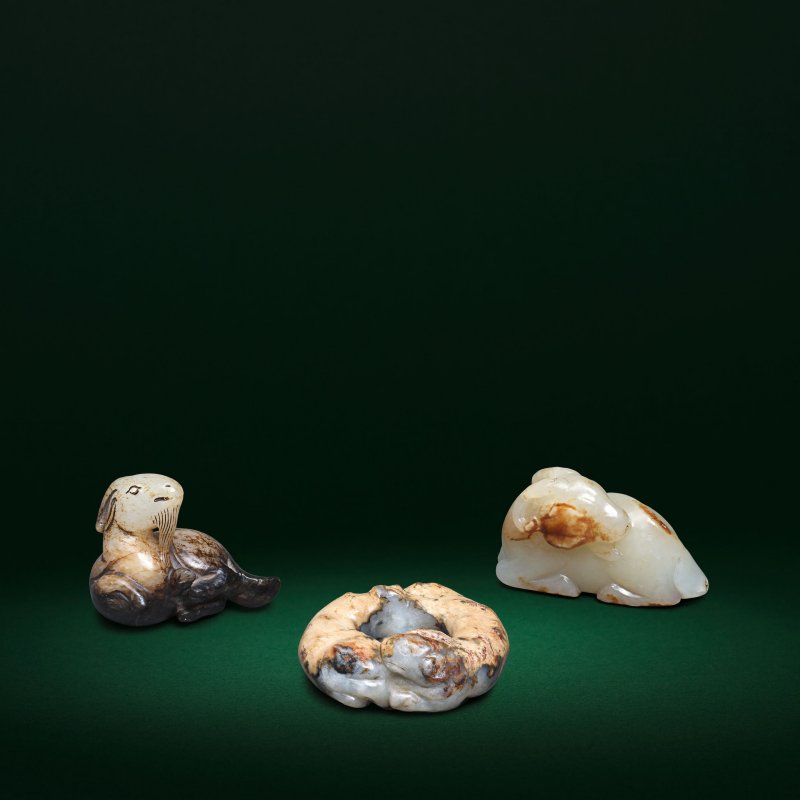
明及其后 玉羊 一組三件 | THREE JADE 'RAM' GROUPS
年代
Ming Dynasty and later
起拍价
GBP 2,000
估值区间
GBP 2000 - 3000
尺寸
未知
品相
未知
更多信息
Ming Dynasty and later
Comprising: a jade ram carved recumbent with its head turned to the left, surmounted by a pair of large curled horns, the right foreleg raised and bent, the remaining legs tucked beneath the body, the stone of pale green tone with russet inclusions, 4.7cm (1 7/8in) wide; a ram carved with a rounded body, the head raised and turned to the left, the stone of mottled white and black tone, 4cm (1 3/4in) wide; and a pair of rams arranged in a circular composition, the stone of greyish tone with creamy beige and black inclusions, 4.2cm (1 5/8in) wide. (3).
Footnotes
明及其后 玉羊 一組三件
The image of the ram (yang 羊), has long been an auspicious motif in China, owing to its homophonic association with xiang (祥), meaning 'propitious' or 'lucky.' Over time, the symbolism of the ram expanded through its phonetic connection with yang (陽), denoting the sun and the active, warm, and masculine principle in Chinese cosmology. See a related white and russet jade goat, Ming dynasty, in the Qing Court Collection, Palace Museum, Taipei (acc.no.故玉004219N000000000).
See a related yellow and russet jade carving of a recumbent ram, Ming dynasty, which was sold at Bonhams Knightsbridge, 14 May 2024, lot 366.
Comprising: a jade ram carved recumbent with its head turned to the left, surmounted by a pair of large curled horns, the right foreleg raised and bent, the remaining legs tucked beneath the body, the stone of pale green tone with russet inclusions, 4.7cm (1 7/8in) wide; a ram carved with a rounded body, the head raised and turned to the left, the stone of mottled white and black tone, 4cm (1 3/4in) wide; and a pair of rams arranged in a circular composition, the stone of greyish tone with creamy beige and black inclusions, 4.2cm (1 5/8in) wide. (3).
Footnotes
明及其后 玉羊 一組三件
The image of the ram (yang 羊), has long been an auspicious motif in China, owing to its homophonic association with xiang (祥), meaning 'propitious' or 'lucky.' Over time, the symbolism of the ram expanded through its phonetic connection with yang (陽), denoting the sun and the active, warm, and masculine principle in Chinese cosmology. See a related white and russet jade goat, Ming dynasty, in the Qing Court Collection, Palace Museum, Taipei (acc.no.故玉004219N000000000).
See a related yellow and russet jade carving of a recumbent ram, Ming dynasty, which was sold at Bonhams Knightsbridge, 14 May 2024, lot 366.
常见问题
这件明及其后 玉羊 一組三件 | THREE JADE 'RAM' GROUPS的成交价是多少?
落槌价为 预展中。 成交价为 预展中。


