
拍品信息
拍品名称
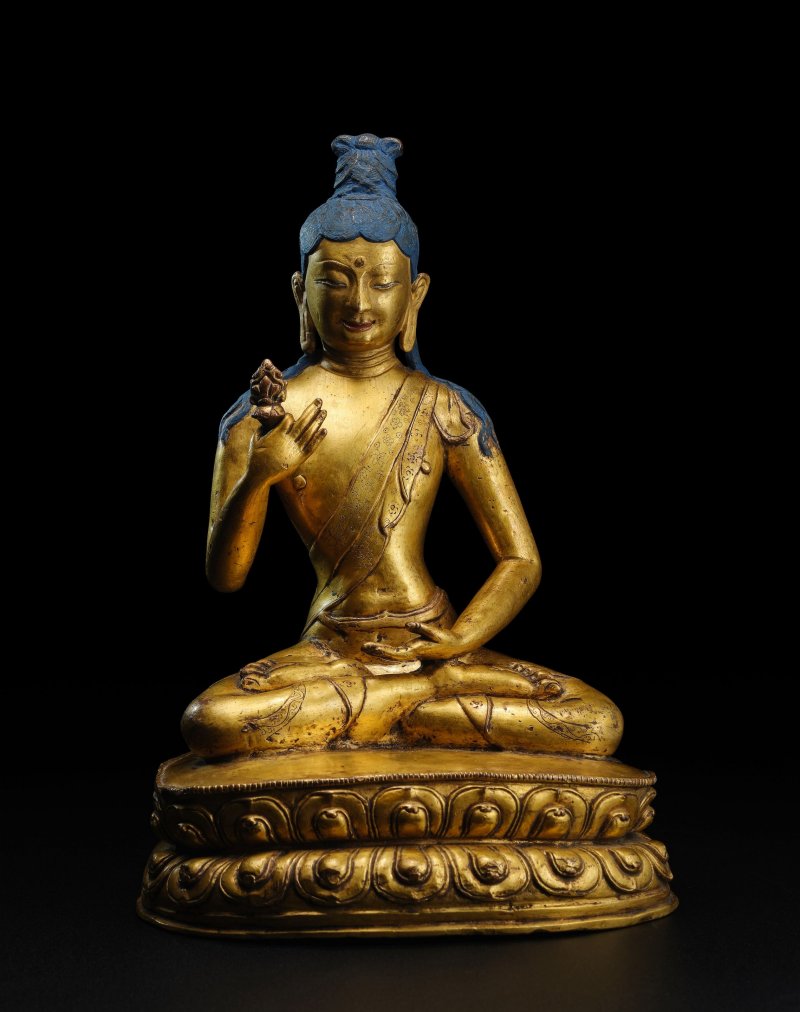
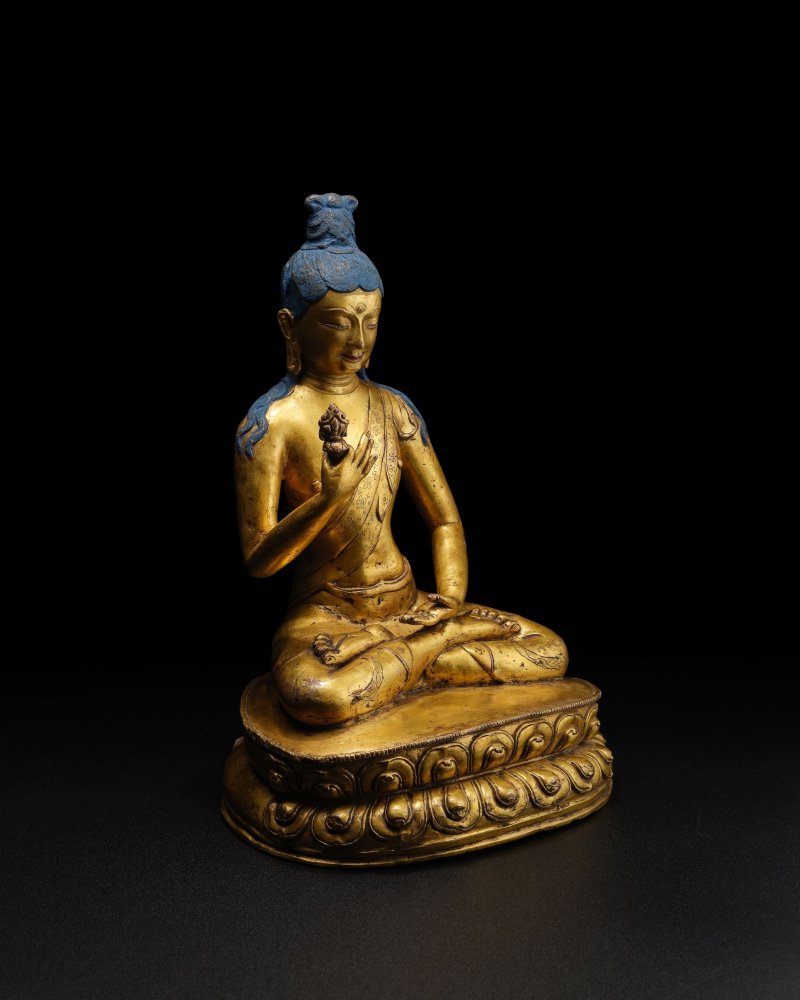
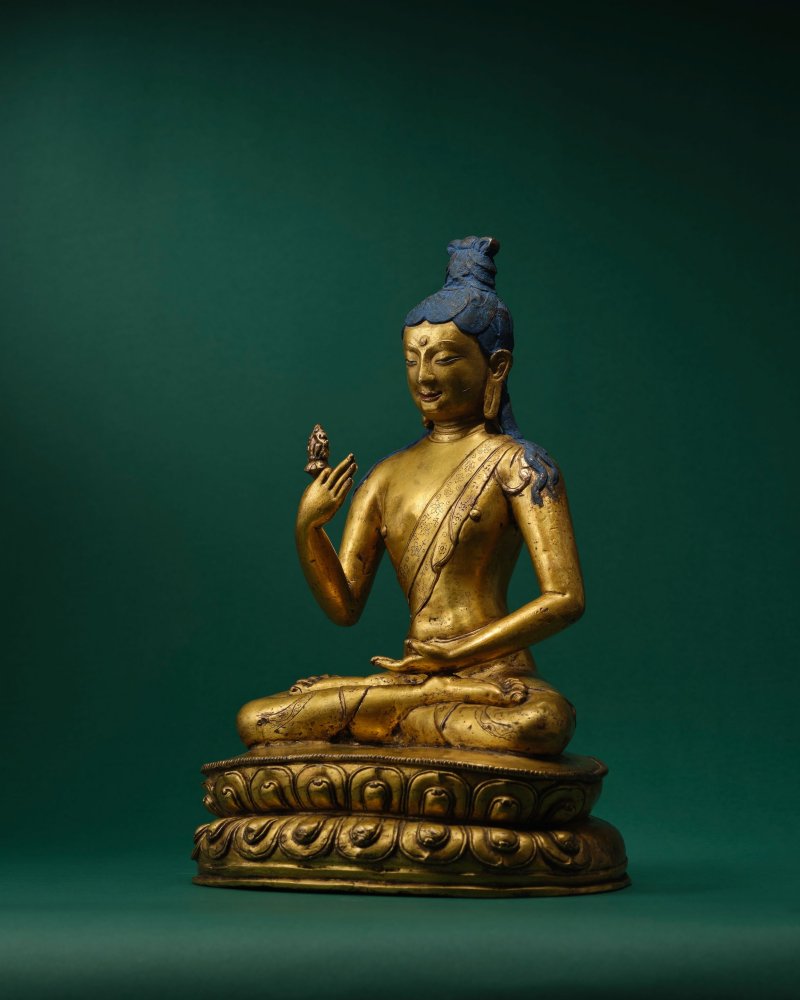
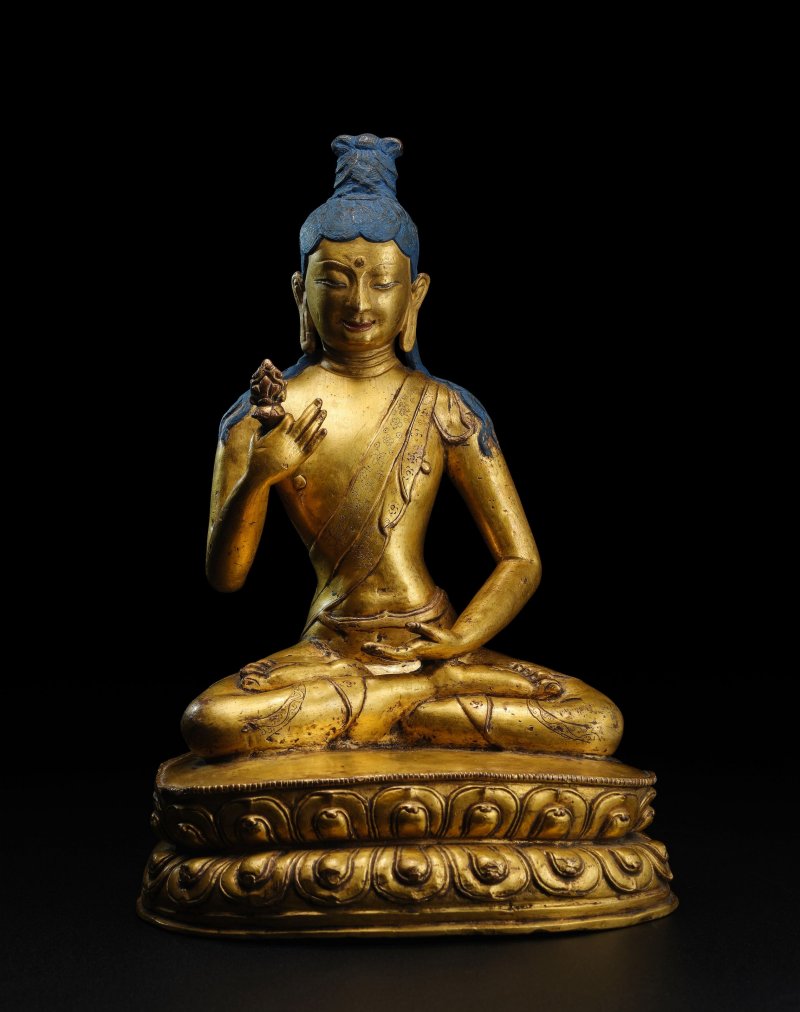
西藏 十五世紀 銅鎏金持寶手菩薩像 | A GILT COPPER ALLOY FIGURE OF RATNAPANI
年代
TIBET, 15TH CENTURY
起拍价
HKD 250,000
估值区间
HKD 250000 - 350000
尺寸
未知
品相
未知
更多信息
TIBET, 15TH CENTURY
With traces of pigments.
Himalayan Art Resources item no. 8899
28.5 cm (11 1/4 in.) high
Footnotes
西藏 十五世紀 銅鎏金持寶手菩薩像
Provenance
Private American Collection, 2015
John and Karina Stewart Collection
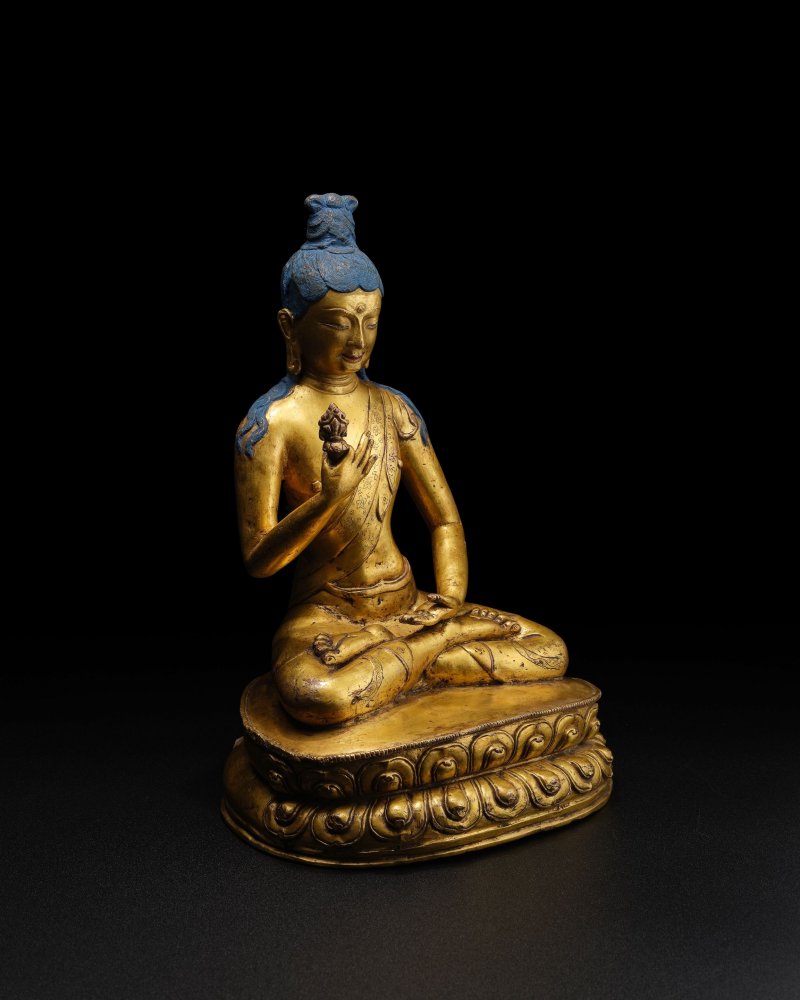
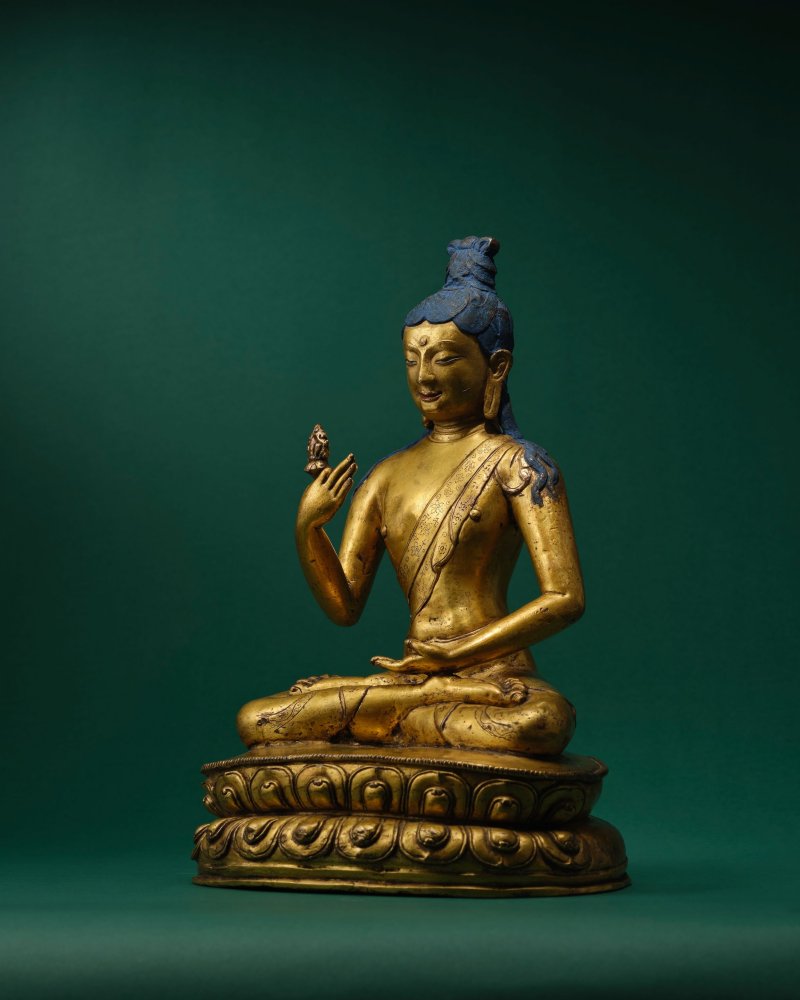
Luminously gilt, with hair of vivid lapis blue, this serene figure represents Ratnapani, "Jewel-in-Hand" (Tib. Phyag na rin chen). Among the five bodhisattvas who correspond to the five Buddha families, he belongs to the Jewel Family (ratnakula), presided over by the transcendent Buddha Ratnasambhava. Ratnapani appears mostly within mandala paintings and sets of bodhisattvas, while independent sculptures of him are exceptionally scarce.
Seated in vajrasana upon a double lotus base, he raises his right hand before his chest, grasping the short stem of a flower that supports a flaming jewel, the emblem of his family, while his left hand rests in his lap in the gesture of meditation (). Ratnapani is represented only rarely in sculpture across the northern Buddhist world, and the identification of proposed examples remains tentative. Two bodhisattvas in the Norton Simon Museum, for example, have been suggested by Dr. Pal as representations of Ratnapani (see Pal, , 2003, pp. 70–73, pls. 41–42). Against this background, the distinctive flaming jewel attribute of the present figure is particularly noteworthy.
Equally unusual is his dress. Bodhisattvas are customarily shown as princes, wearing crowns, earrings, necklaces and armlets, while the plain monastic robe without ornament is the customary garb of the Buddha. Here the sculptor has clothed Ratnapani simply in a monastic robe () draped over the left shoulder. Its borders are finely incised with floral and foliate sprays formed of punched dots, a motif repeated along the hems across his shins. Only his piled-up hair and the long locks falling over his shoulders distinguish him as a bodhisattva, lending the image a sense of restraint and dignity.
His robust yet elegantly proportioned body, with broad shoulders tapering to a slender waist, is modelled with great sensitivity. The hair, gathered into a tall chignon and framing the brow in a gently scalloped line, is painted deep blue, offsetting the warm gold of the face. The countenance conveys calm compassion. Long, downcast eyes, defined in pigment, lend an air of serene introspection, while the full lips, retaining traces of red pigment, curve into a faint, benevolent smile.
The lotus base is characteristic of Central Tibetan work of the 15th century. Beneath a beaded upper rim, broad, full petals rise to pointed tips, those of the outer row outlined with incised grooves. A comparable base appears on a 15th-century figure of Amitayus sold at Bonhams, Hong Kong, 2 October 2018, lot 44.
Uniting a seldom-represented subject with sumptuous gilding and a face of great tenderness, the present figure is a beautiful and exceptionally rare image of this elusive bodhisattva.
With traces of pigments.
Himalayan Art Resources item no. 8899
28.5 cm (11 1/4 in.) high
Footnotes
西藏 十五世紀 銅鎏金持寶手菩薩像
Provenance
Private American Collection, 2015
John and Karina Stewart Collection
Luminously gilt, with hair of vivid lapis blue, this serene figure represents Ratnapani, "Jewel-in-Hand" (Tib. Phyag na rin chen). Among the five bodhisattvas who correspond to the five Buddha families, he belongs to the Jewel Family (ratnakula), presided over by the transcendent Buddha Ratnasambhava. Ratnapani appears mostly within mandala paintings and sets of bodhisattvas, while independent sculptures of him are exceptionally scarce.
Seated in vajrasana upon a double lotus base, he raises his right hand before his chest, grasping the short stem of a flower that supports a flaming jewel, the emblem of his family, while his left hand rests in his lap in the gesture of meditation (). Ratnapani is represented only rarely in sculpture across the northern Buddhist world, and the identification of proposed examples remains tentative. Two bodhisattvas in the Norton Simon Museum, for example, have been suggested by Dr. Pal as representations of Ratnapani (see Pal, , 2003, pp. 70–73, pls. 41–42). Against this background, the distinctive flaming jewel attribute of the present figure is particularly noteworthy.
Equally unusual is his dress. Bodhisattvas are customarily shown as princes, wearing crowns, earrings, necklaces and armlets, while the plain monastic robe without ornament is the customary garb of the Buddha. Here the sculptor has clothed Ratnapani simply in a monastic robe () draped over the left shoulder. Its borders are finely incised with floral and foliate sprays formed of punched dots, a motif repeated along the hems across his shins. Only his piled-up hair and the long locks falling over his shoulders distinguish him as a bodhisattva, lending the image a sense of restraint and dignity.
His robust yet elegantly proportioned body, with broad shoulders tapering to a slender waist, is modelled with great sensitivity. The hair, gathered into a tall chignon and framing the brow in a gently scalloped line, is painted deep blue, offsetting the warm gold of the face. The countenance conveys calm compassion. Long, downcast eyes, defined in pigment, lend an air of serene introspection, while the full lips, retaining traces of red pigment, curve into a faint, benevolent smile.
The lotus base is characteristic of Central Tibetan work of the 15th century. Beneath a beaded upper rim, broad, full petals rise to pointed tips, those of the outer row outlined with incised grooves. A comparable base appears on a 15th-century figure of Amitayus sold at Bonhams, Hong Kong, 2 October 2018, lot 44.
Uniting a seldom-represented subject with sumptuous gilding and a face of great tenderness, the present figure is a beautiful and exceptionally rare image of this elusive bodhisattva.
常见问题
这件西藏 十五世紀 銅鎏金持寶手菩薩像 | A GILT COPPER ALLOY FIGURE OF RATNAPANI的成交价是多少?
落槌价为 预展中。 成交价为 预展中。