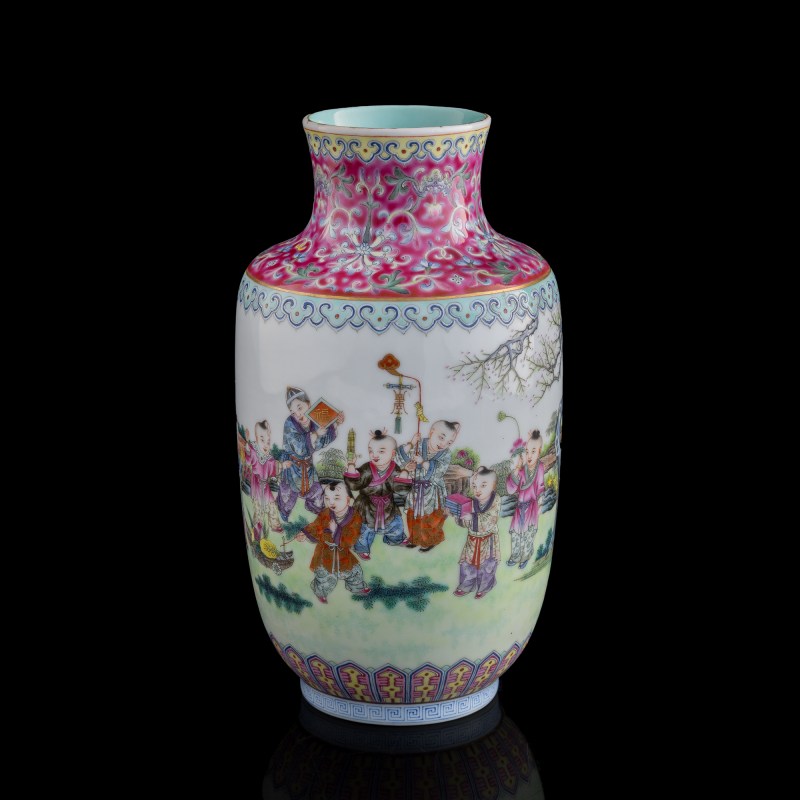

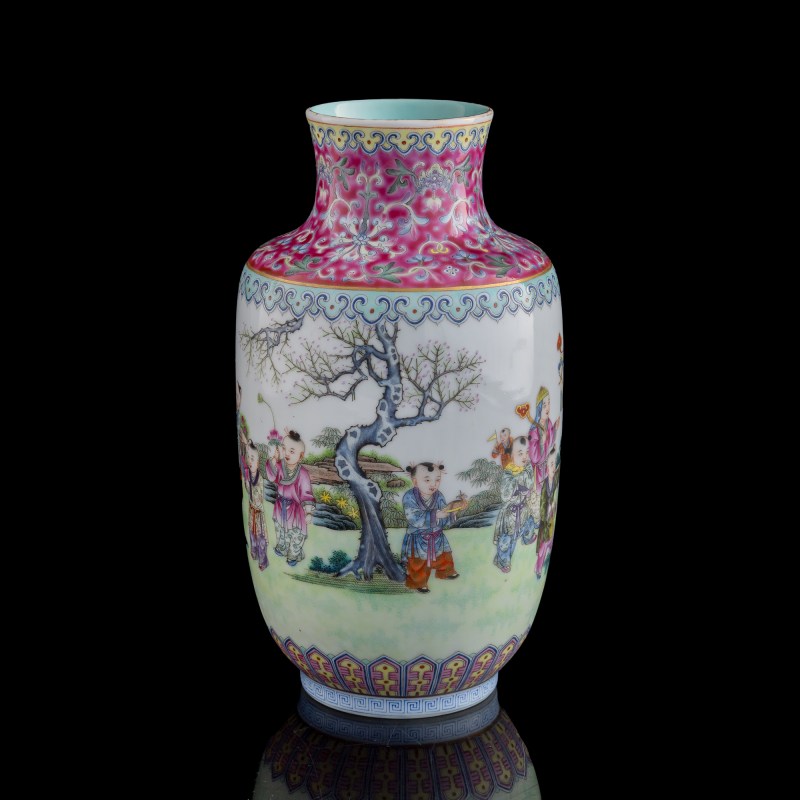
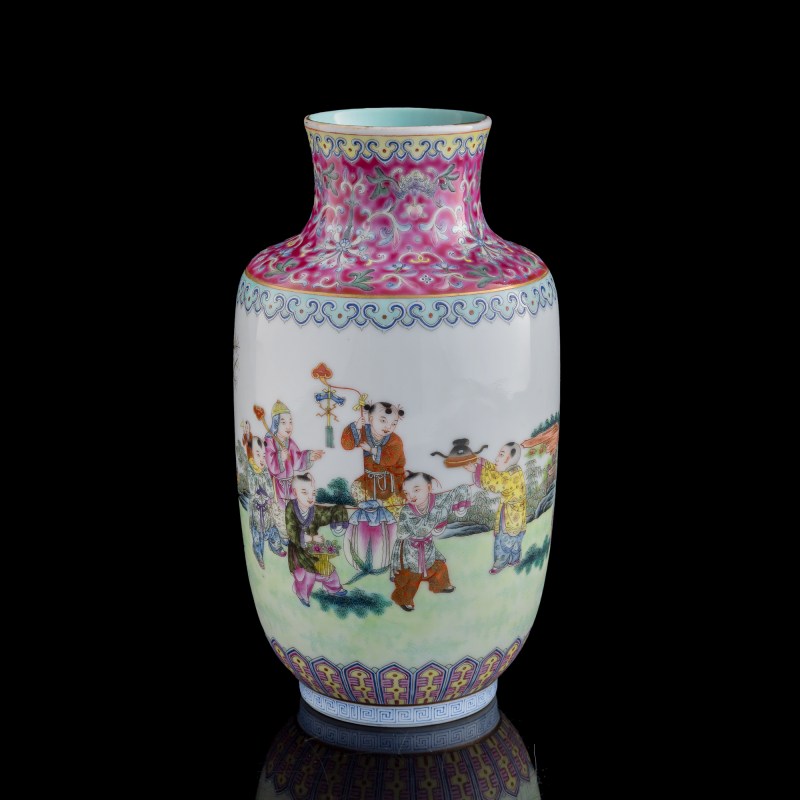
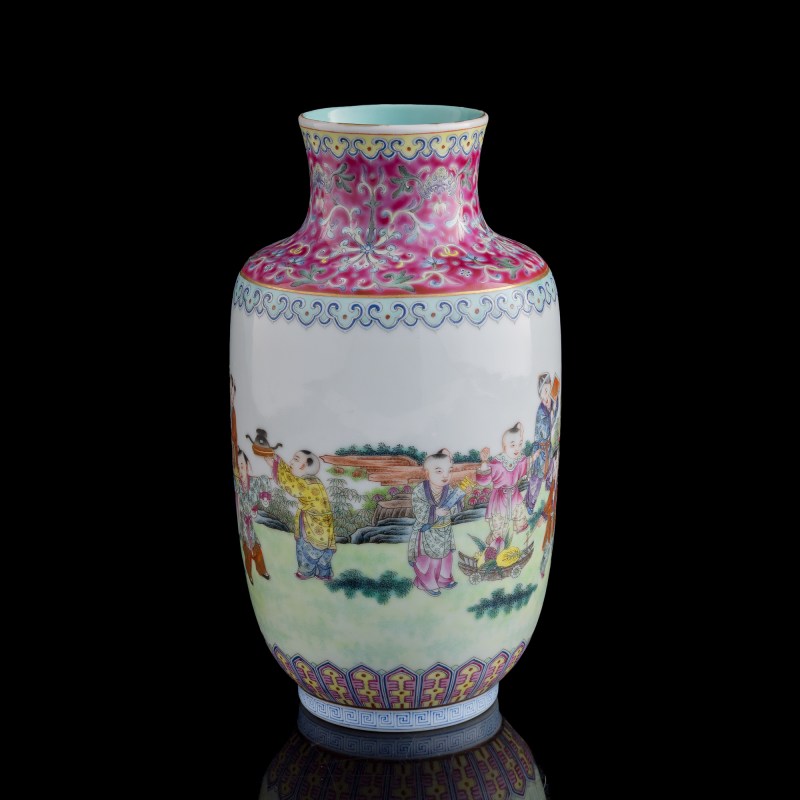
Lot 272 清同治 胭脂紅地粉彩嬰戲圖燈籠瓶 | A Chinese famille rose and ruby red lantern vase, Tongzhi period, Qing dynasty
落槌价
****
成交价
****
拍品信息
拍品名称
清同治 胭脂紅地粉彩嬰戲圖燈籠瓶 | A Chinese famille rose and ruby red lantern vase, Tongzhi period, Qing dynasty
年代
Tongzhi period, Qing dynasty
起拍价
USD 1,500
估值区间
$3,000 - $5,000
尺寸
H: 9 1/2, Dia: 5 1/4 in. (H: 24.1, Dia: 13.3 cm.)
品相
Overall good condition.
總體品相良好
總體品相良好
更多信息
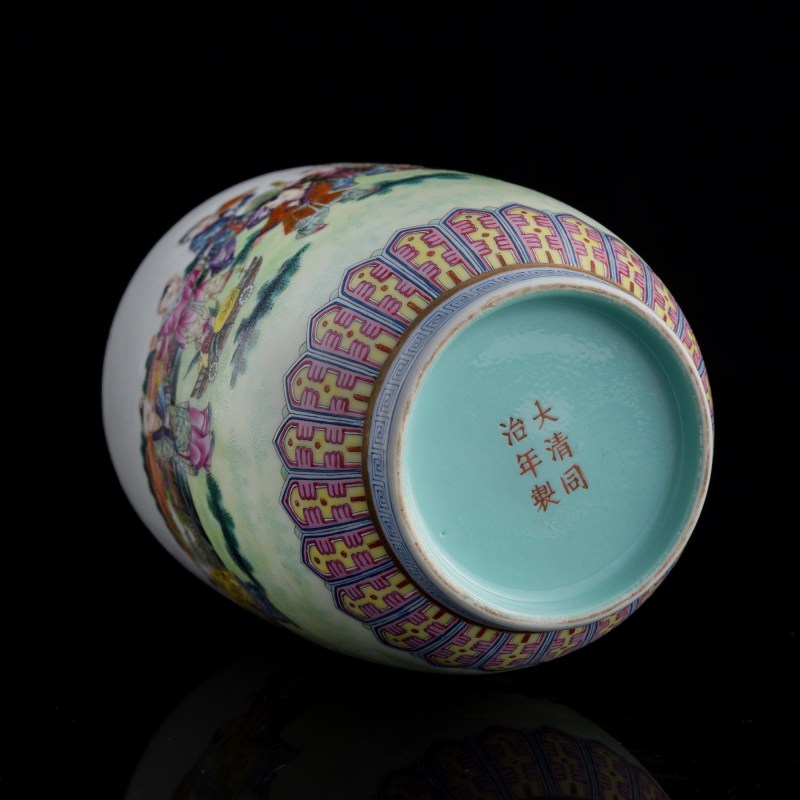
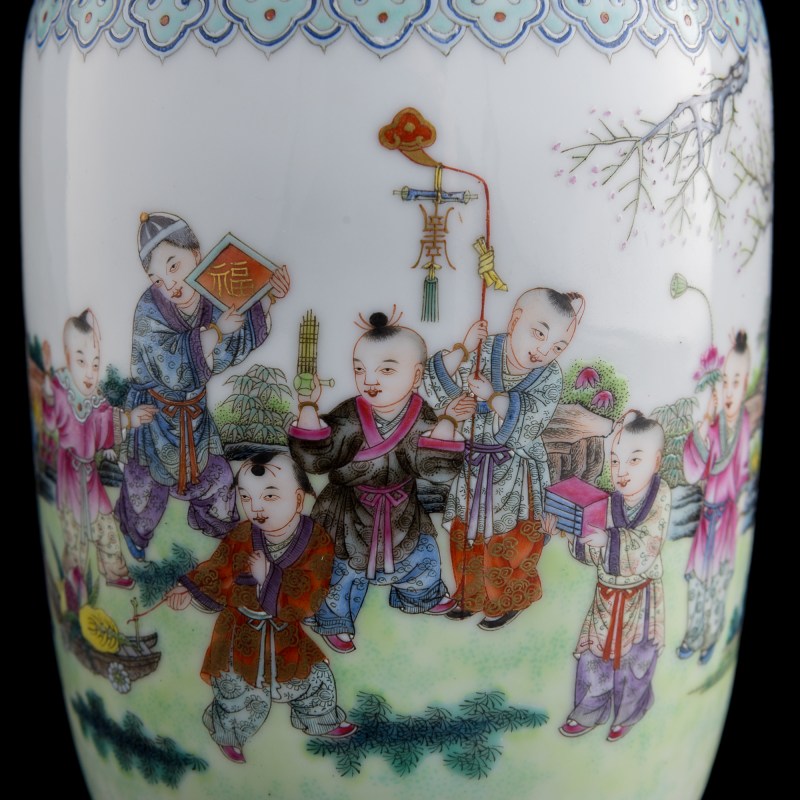
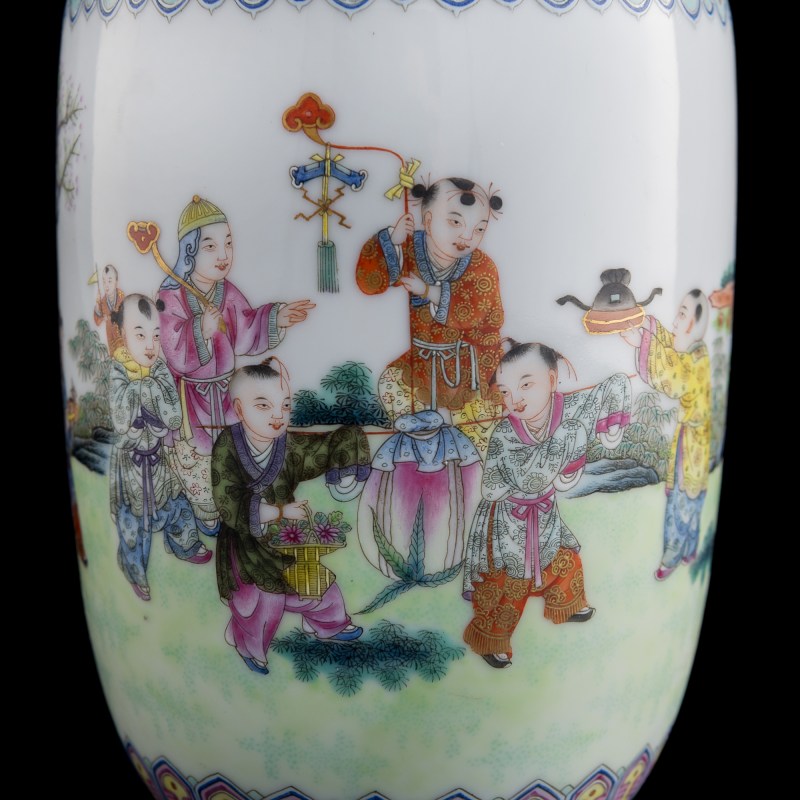
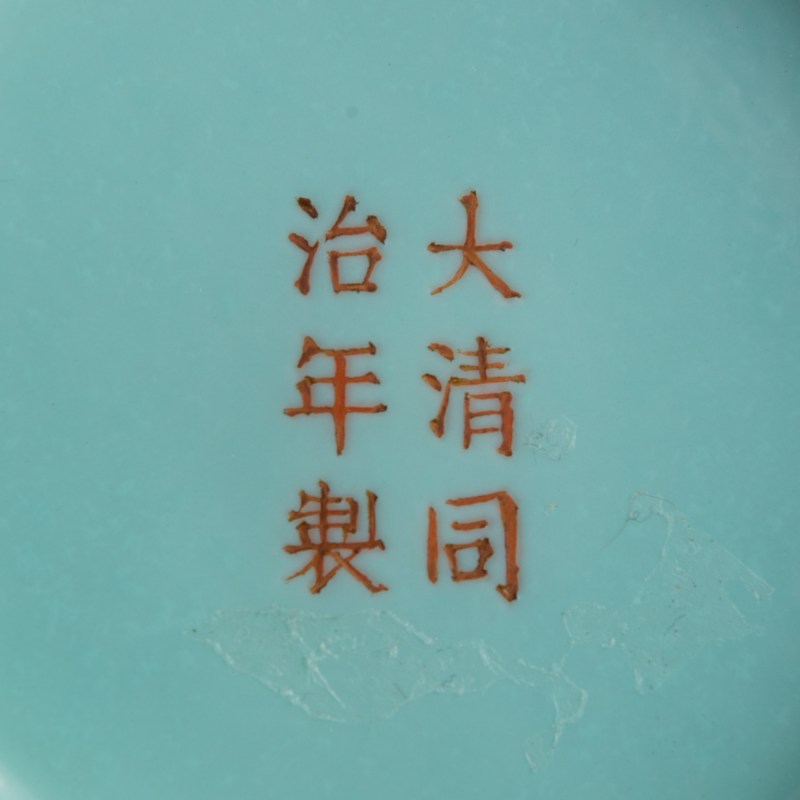
With six-character 'Tongzhi' mark to underside. Painted with fifteen boys holding various auspicious emblems. These include mouth organs, Ruyi scepters, books, and so forth, representing things such as good fortune, fertility, longevity, scholarship, and wealth.
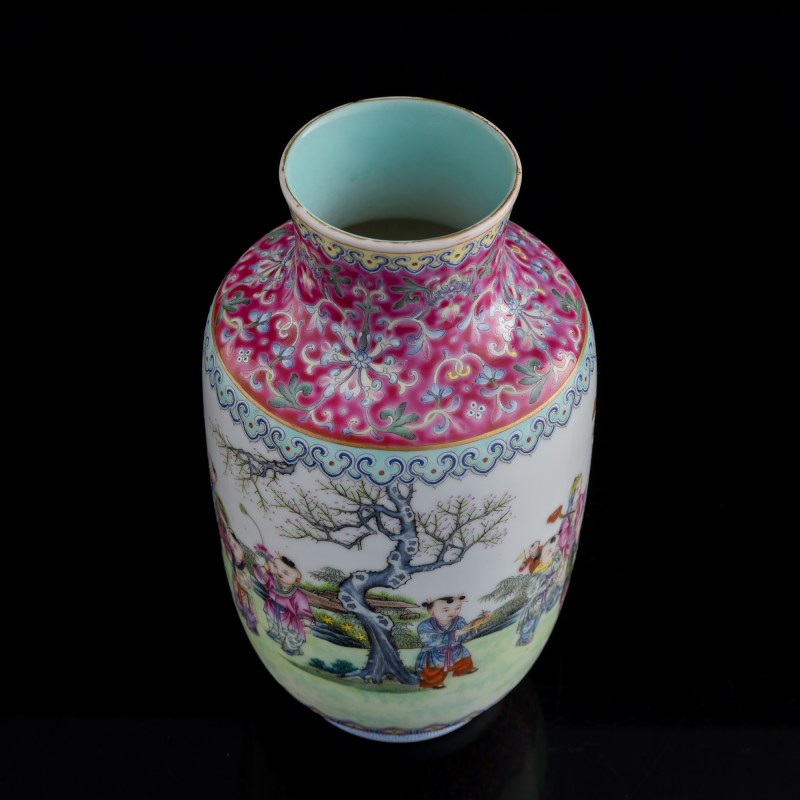
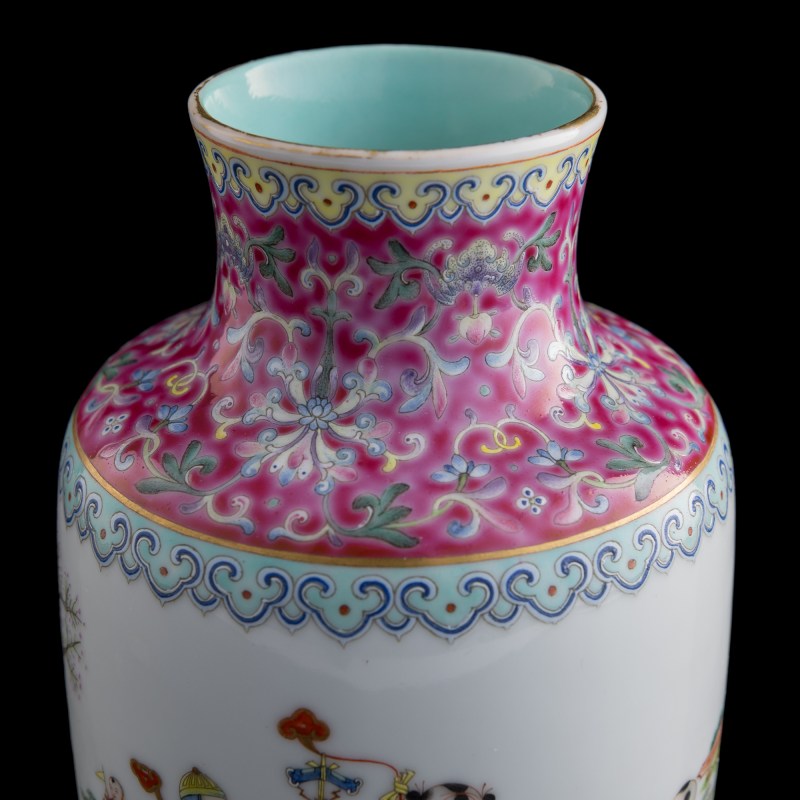
This finely potted lantern vase exemplifies the refined decorative wares produced in the imperial style during the Tongzhi reign. The vase is of classic denglong form, with a flaring mouth rising from a waisted neck to broad shoulders and a straight-sided body, supported on a neatly finished circular foot. The proportions are well balanced and dignified, with smooth, confident contours conveying a sense of restrained elegance.
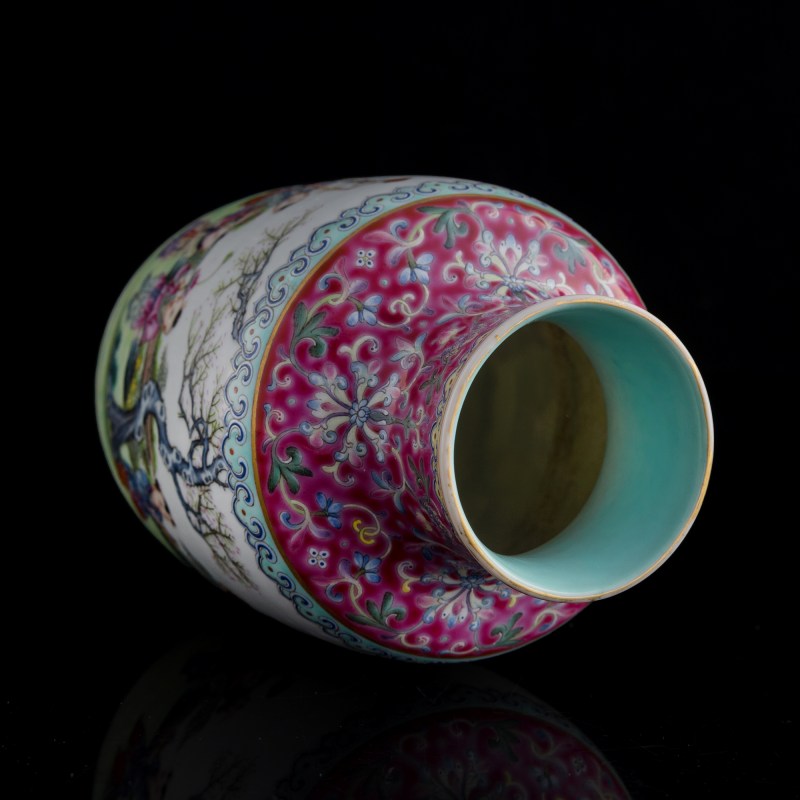
The neck is set against a rich rouge (yanzhi hong) ground, meticulously painted in famille-rose enamels with dense scrolling floral sprays, combining technical sophistication with auspicious symbolism. The base bears a six-character Tongzhi reign mark in two vertical lines, written in regular script.
Encircling the mouthrim and shoulder are continuous bands of ruyi-head motifs, the gilt outlines crisp and well preserved. The rouge ground, lavish yet controlled, enhances the palace aesthetic and conveys wishes for unbroken good fortune and fulfillment. Rouge glaze, long regarded as a high-ranking and technically demanding color in the Qing imperial palette, was reserved primarily for court wares and ritual objects. Its use during the Tongzhi period consciously perpetuates earlier imperial traditions, and on the present vase the tone is even, deep, and refined, displaying a warm, noble luster characteristic of official production.
The body is decorated in a continuous scene of yingxi (children at play), one of the most beloved auspicious themes in Qing court art. During the Tongzhi reign, such scenes were deliberately modeled after compositions and figure types established during the Qianlong and Daoguang periods, preserving an archaistic elegance. Set within a tranquil garden landscape of scholar’s rocks, flowering plants, and pavilions, numerous children engage in animated play. Their expressions are lively and joyful, the figures rendered with fluid outlines, delicately shaded garments, and a bright yet harmonious palette.
Each child carries a symbolic object conveying layered auspicious meanings: a ruyi scepter for fulfillment of wishes; flower baskets for flourishing prosperity; peaches for longevity; an official’s hat for promotion and rank; musical instruments for cultured harmony; longevity lanterns expressing blessings of long life; a deer—homophonous with lu—for emolument; and lotus blossoms symbolizing harmony and union. Additional motifs include a festive boat laden with the “Three Abundances”—peach, pomegranate, and Buddha’s hand—encapsulating blessings of longevity, fertility, happiness, wealth, and success. The composition is rich yet carefully ordered, seamlessly blending imperial symbolism with popular auspicious imagery.
The rouge ground remains stable and evenly fired, while the famille-rose enamels retain their soft translucency and freshness despite the passage of time. The porcelain body is dense and well fired, the glaze smooth and lustrous, and the foot neatly finished, all hallmarks of high-quality Tongzhi-period display porcelain.
Although bearing a Tongzhi reign mark, the form, decorative program, palette, and painterly style consciously emulate the imperial wares of the Qianlong and Jiaqing periods, reflecting the late Qing court’s reverence for earlier standards and its commitment to preserving canonical models. Comparable lantern vases decorated in rouge-ground famille-rose yingxi scenes from the Qianlong and Jiaqing reigns have appeared frequently in major auctions, underscoring the continuity of this esteemed type within the imperial tradition.
Distinguished by its auspicious subject matter, accomplished painting, harmonious proportions, and excellent state of preservation, this lantern vase represents a highly desirable example of late Qing court-style famille-rose porcelain, suitable for both scholarly appreciation and refined interior display.
See below references for similar items:
Palace Museum, Beijing, accession no. Gu 00155018
Sotheby’s, Hong Kong, October 2010, lot 2163.
本品爲清同治朝禦窑風格經典陳設器,形制取法燈籠瓶,撇口束頸、豐肩直腹、圈足穩重,器形周正端莊,綫條雍容典雅,頸部以胭脂紅爲地,粉彩精工滿繪纏枝花卉紋,集宮廷彩瓷工藝與吉祥寓意于一身,是晚清粉彩中品相完整、畫工繁細、題材祥瑞的收藏佳器。底書“大清同治年制”六字雙行楷書款。
瓶口沿與肩部分別繪飾滿圈如意頭紋,口沿、肩部金綫光潔挺括,胭脂紅地繪以纏枝花卉紋,富麗堂皇,盡顯宮廷規制與富貴氣象,寓意事事如意、瑞氣連綿。
胭脂紅地于清代官窑體系中,向來是等級頗高、工藝考究的重要色彩,因其燒制難度大、呈色要求嚴苛,多用于宮廷陳設瓷與禮器之上,同治一朝承續此制,以胭脂紅爲地者尤顯尊貴,本品發色沉穩勻淨,色澤溫潤華貴,盡顯同治禦窑風格之莊重典雅。
瓶身主體通景繪製嬰戲紋,此題材爲清代宮廷經典吉祥紋樣,同治時期多刻意摹仿前朝乾隆、道光兩朝之構圖範式與人物意態,傳承有緒,古韵盎然。畫面之中,庭院布景清雅,奇石花木錯落有致,群嬰于園中嬉戲玩耍,神態天真爛漫,衣褶綫條流暢,設色明快粉潤,盡顯童趣盎然。童子各持瑞物:手持如意者,寓意稱心如意;手捧花籃者,寓意花開富貴;搬運壽桃者,寓意福壽綿長;手執官帽者,寓意加官進爵;撫琴、執簫、持拂者,寓意清雅福壽、平安順遂;手舉壽字燈者,直抒壽喜雙全;手牽瑞鹿者,以鹿諧音“祿”,寓意祿位高升;手持荷花者,寓意和合美滿。更有彩舟滿載壽桃、石榴、佛手三多瑞果,福、祿、壽、喜、財一應俱全,構圖飽滿繁而不亂,將宮廷祈福文化與世俗吉祥意趣融爲一體。
胭脂紅地發色沉穩勻淨,粉彩暈染柔和通透,曆百年猶存光澤,胎質堅致、釉面瑩潤,修足規整,兼具同治朝陳設瓷的典型特徵。整器從形制、釉色、畫工到題材,均體現晚清宮廷彩瓷的審美與工藝高度,題材吉祥、畫工繁複、保存完好、傳承清晰,既可入藏家典藏,亦宜廳堂雅陳、禮贈嘉會,兼具歷史價值、藝術價值與收藏價值。
本品雖署同治年款,然器式、紋飾、設色與繪法皆刻意追摹乾隆、嘉慶兩朝禦窑舊制,法度謹嚴,古韵猶存。查蘇富比、佳士得歷年拍賣紀錄,乾嘉二朝胭脂紅地粉彩嬰戲紋燈籠瓶屢經上拍,形制紋樣與本品一脉相承,同屬清宮陳設雅器,足見此式爲清代官窑一脉相承之經典,亦爲晚清禦窑踵武前賢、恪守官樣之明證,流傳有緒,堪爲珍賞。
相似藏品可參閱:
故宮博物院館藏,編號故00155018
蘇富比拍賣2010年10月香港拍賣,編號2163。
**Provenance**
Private collection, Southern California.
南加州私人收藏
以下内容由AI翻译:
【名称】
清同治 胭脂紅地粉彩嬰戲圖燈籠瓶
【年代】
同治时期,清朝
【描述】
底书六字“同治”款。绘有十五个手持各种吉祥物的男孩。这些包括口琴、如意权杖、书籍等,代表了诸如好运、生育、长寿、学问和财富等寓意。
这件精美的灯笼瓶体现了同治年间生产的宫廷风格装饰瓷器。瓶子为经典的灯笼形,撇口束颈、丰肩直腹,支撑在一个整洁的圆形足上。比例均衡且庄重,流畅自信的轮廓传达出一种克制的优雅。
颈部以丰富的胭脂红(yanzhi hong)为底,用粉彩精心绘制密集的缠枝花卉图案,结合了技术精湛与吉祥象征。底部有两行竖写的六字同治年款,用楷书写成。
口沿和肩部环绕着连续的如意头纹饰,金色轮廓清晰且保存完好。富丽堂皇但又不失控制的胭脂红底色增强了宫廷美学,并传达了对不断的好运和圆满的祝愿。胭脂红釉在清代官窑体系中一直被视为等级高且技术要求高的颜色,主要用于宫廷陈设瓷和礼器。同治时期的使用延续了早期的宫廷传统,在此瓶上色调均匀、深沉且精致,展现出官方生产特有的温暖而高贵的光泽。
瓶身通景描绘婴戏图,这是清代宫廷艺术中最受欢迎的吉祥主题之一。同治年间,这类场景刻意模仿乾隆和道光时期的构图和人物类型,保留了一种古雅的韵味。画面中的庭院布景宁静,奇石、花草和亭台错落有致,众多儿童在园中嬉戏玩耍。他们的表情生动愉快,人物线条流畅,衣着细腻渲染,色彩明亮和谐。
每个孩子都持有一个具有多重吉祥意义的象征物:如意权杖表示愿望实现;花篮表示繁荣昌盛;桃子表示长寿;官帽表示晋升和地位;乐器表示文化和谐;长寿灯表示长寿祝福;鹿(与“禄”谐音)表示俸禄;莲花表示和谐与团结。其他图案还包括一艘满载“三多”——桃子、石榴和佛手柑——的节日船,寓意长寿、生育、幸福、财富和成功。构图丰富但井然有序,将宫廷象征与流行的吉祥图像无缝融合。
胭脂红底色稳定且均匀烧制,尽管经过时间的流逝,粉彩仍然保持其柔和的透明度和新鲜感。瓷器胎体致密且烧制良好,釉面光滑且有光泽,足部整洁,这些都是高质量同治时期展示瓷器的标志。
虽然带有同治年款,但形式、装饰方案、调色板和绘画风格自觉模仿乾隆和嘉庆时期的宫廷瓷器,反映了晚清宫廷对早期标准的崇敬及其致力于保存经典模型。在主要拍卖会上,经常出现类似的乾隆和嘉庆时期的胭脂红底粉彩婴戏图灯笼瓶,强调了这种受尊敬的类型在宫廷传统中的连续性。
以其吉祥的主题、精湛的绘画、和谐的比例和良好的保存状态,这件灯笼瓶代表了晚清宫廷风格粉彩瓷器的一个非常理想的例子,适合学术欣赏和精致的室内展示。
参见以下类似物品的参考文献:
【品相】
总体品相良好。
This finely potted lantern vase exemplifies the refined decorative wares produced in the imperial style during the Tongzhi reign. The vase is of classic denglong form, with a flaring mouth rising from a waisted neck to broad shoulders and a straight-sided body, supported on a neatly finished circular foot. The proportions are well balanced and dignified, with smooth, confident contours conveying a sense of restrained elegance.
The neck is set against a rich rouge (yanzhi hong) ground, meticulously painted in famille-rose enamels with dense scrolling floral sprays, combining technical sophistication with auspicious symbolism. The base bears a six-character Tongzhi reign mark in two vertical lines, written in regular script.
Encircling the mouthrim and shoulder are continuous bands of ruyi-head motifs, the gilt outlines crisp and well preserved. The rouge ground, lavish yet controlled, enhances the palace aesthetic and conveys wishes for unbroken good fortune and fulfillment. Rouge glaze, long regarded as a high-ranking and technically demanding color in the Qing imperial palette, was reserved primarily for court wares and ritual objects. Its use during the Tongzhi period consciously perpetuates earlier imperial traditions, and on the present vase the tone is even, deep, and refined, displaying a warm, noble luster characteristic of official production.
The body is decorated in a continuous scene of yingxi (children at play), one of the most beloved auspicious themes in Qing court art. During the Tongzhi reign, such scenes were deliberately modeled after compositions and figure types established during the Qianlong and Daoguang periods, preserving an archaistic elegance. Set within a tranquil garden landscape of scholar’s rocks, flowering plants, and pavilions, numerous children engage in animated play. Their expressions are lively and joyful, the figures rendered with fluid outlines, delicately shaded garments, and a bright yet harmonious palette.
Each child carries a symbolic object conveying layered auspicious meanings: a ruyi scepter for fulfillment of wishes; flower baskets for flourishing prosperity; peaches for longevity; an official’s hat for promotion and rank; musical instruments for cultured harmony; longevity lanterns expressing blessings of long life; a deer—homophonous with lu—for emolument; and lotus blossoms symbolizing harmony and union. Additional motifs include a festive boat laden with the “Three Abundances”—peach, pomegranate, and Buddha’s hand—encapsulating blessings of longevity, fertility, happiness, wealth, and success. The composition is rich yet carefully ordered, seamlessly blending imperial symbolism with popular auspicious imagery.
The rouge ground remains stable and evenly fired, while the famille-rose enamels retain their soft translucency and freshness despite the passage of time. The porcelain body is dense and well fired, the glaze smooth and lustrous, and the foot neatly finished, all hallmarks of high-quality Tongzhi-period display porcelain.
Although bearing a Tongzhi reign mark, the form, decorative program, palette, and painterly style consciously emulate the imperial wares of the Qianlong and Jiaqing periods, reflecting the late Qing court’s reverence for earlier standards and its commitment to preserving canonical models. Comparable lantern vases decorated in rouge-ground famille-rose yingxi scenes from the Qianlong and Jiaqing reigns have appeared frequently in major auctions, underscoring the continuity of this esteemed type within the imperial tradition.
Distinguished by its auspicious subject matter, accomplished painting, harmonious proportions, and excellent state of preservation, this lantern vase represents a highly desirable example of late Qing court-style famille-rose porcelain, suitable for both scholarly appreciation and refined interior display.
See below references for similar items:
Palace Museum, Beijing, accession no. Gu 00155018
Sotheby’s, Hong Kong, October 2010, lot 2163.
本品爲清同治朝禦窑風格經典陳設器,形制取法燈籠瓶,撇口束頸、豐肩直腹、圈足穩重,器形周正端莊,綫條雍容典雅,頸部以胭脂紅爲地,粉彩精工滿繪纏枝花卉紋,集宮廷彩瓷工藝與吉祥寓意于一身,是晚清粉彩中品相完整、畫工繁細、題材祥瑞的收藏佳器。底書“大清同治年制”六字雙行楷書款。
瓶口沿與肩部分別繪飾滿圈如意頭紋,口沿、肩部金綫光潔挺括,胭脂紅地繪以纏枝花卉紋,富麗堂皇,盡顯宮廷規制與富貴氣象,寓意事事如意、瑞氣連綿。
胭脂紅地于清代官窑體系中,向來是等級頗高、工藝考究的重要色彩,因其燒制難度大、呈色要求嚴苛,多用于宮廷陳設瓷與禮器之上,同治一朝承續此制,以胭脂紅爲地者尤顯尊貴,本品發色沉穩勻淨,色澤溫潤華貴,盡顯同治禦窑風格之莊重典雅。
瓶身主體通景繪製嬰戲紋,此題材爲清代宮廷經典吉祥紋樣,同治時期多刻意摹仿前朝乾隆、道光兩朝之構圖範式與人物意態,傳承有緒,古韵盎然。畫面之中,庭院布景清雅,奇石花木錯落有致,群嬰于園中嬉戲玩耍,神態天真爛漫,衣褶綫條流暢,設色明快粉潤,盡顯童趣盎然。童子各持瑞物:手持如意者,寓意稱心如意;手捧花籃者,寓意花開富貴;搬運壽桃者,寓意福壽綿長;手執官帽者,寓意加官進爵;撫琴、執簫、持拂者,寓意清雅福壽、平安順遂;手舉壽字燈者,直抒壽喜雙全;手牽瑞鹿者,以鹿諧音“祿”,寓意祿位高升;手持荷花者,寓意和合美滿。更有彩舟滿載壽桃、石榴、佛手三多瑞果,福、祿、壽、喜、財一應俱全,構圖飽滿繁而不亂,將宮廷祈福文化與世俗吉祥意趣融爲一體。
胭脂紅地發色沉穩勻淨,粉彩暈染柔和通透,曆百年猶存光澤,胎質堅致、釉面瑩潤,修足規整,兼具同治朝陳設瓷的典型特徵。整器從形制、釉色、畫工到題材,均體現晚清宮廷彩瓷的審美與工藝高度,題材吉祥、畫工繁複、保存完好、傳承清晰,既可入藏家典藏,亦宜廳堂雅陳、禮贈嘉會,兼具歷史價值、藝術價值與收藏價值。
本品雖署同治年款,然器式、紋飾、設色與繪法皆刻意追摹乾隆、嘉慶兩朝禦窑舊制,法度謹嚴,古韵猶存。查蘇富比、佳士得歷年拍賣紀錄,乾嘉二朝胭脂紅地粉彩嬰戲紋燈籠瓶屢經上拍,形制紋樣與本品一脉相承,同屬清宮陳設雅器,足見此式爲清代官窑一脉相承之經典,亦爲晚清禦窑踵武前賢、恪守官樣之明證,流傳有緒,堪爲珍賞。
相似藏品可參閱:
故宮博物院館藏,編號故00155018
蘇富比拍賣2010年10月香港拍賣,編號2163。
**Provenance**
Private collection, Southern California.
南加州私人收藏
以下内容由AI翻译:
【名称】
清同治 胭脂紅地粉彩嬰戲圖燈籠瓶
【年代】
同治时期,清朝
【描述】
底书六字“同治”款。绘有十五个手持各种吉祥物的男孩。这些包括口琴、如意权杖、书籍等,代表了诸如好运、生育、长寿、学问和财富等寓意。
这件精美的灯笼瓶体现了同治年间生产的宫廷风格装饰瓷器。瓶子为经典的灯笼形,撇口束颈、丰肩直腹,支撑在一个整洁的圆形足上。比例均衡且庄重,流畅自信的轮廓传达出一种克制的优雅。
颈部以丰富的胭脂红(yanzhi hong)为底,用粉彩精心绘制密集的缠枝花卉图案,结合了技术精湛与吉祥象征。底部有两行竖写的六字同治年款,用楷书写成。
口沿和肩部环绕着连续的如意头纹饰,金色轮廓清晰且保存完好。富丽堂皇但又不失控制的胭脂红底色增强了宫廷美学,并传达了对不断的好运和圆满的祝愿。胭脂红釉在清代官窑体系中一直被视为等级高且技术要求高的颜色,主要用于宫廷陈设瓷和礼器。同治时期的使用延续了早期的宫廷传统,在此瓶上色调均匀、深沉且精致,展现出官方生产特有的温暖而高贵的光泽。
瓶身通景描绘婴戏图,这是清代宫廷艺术中最受欢迎的吉祥主题之一。同治年间,这类场景刻意模仿乾隆和道光时期的构图和人物类型,保留了一种古雅的韵味。画面中的庭院布景宁静,奇石、花草和亭台错落有致,众多儿童在园中嬉戏玩耍。他们的表情生动愉快,人物线条流畅,衣着细腻渲染,色彩明亮和谐。
每个孩子都持有一个具有多重吉祥意义的象征物:如意权杖表示愿望实现;花篮表示繁荣昌盛;桃子表示长寿;官帽表示晋升和地位;乐器表示文化和谐;长寿灯表示长寿祝福;鹿(与“禄”谐音)表示俸禄;莲花表示和谐与团结。其他图案还包括一艘满载“三多”——桃子、石榴和佛手柑——的节日船,寓意长寿、生育、幸福、财富和成功。构图丰富但井然有序,将宫廷象征与流行的吉祥图像无缝融合。
胭脂红底色稳定且均匀烧制,尽管经过时间的流逝,粉彩仍然保持其柔和的透明度和新鲜感。瓷器胎体致密且烧制良好,釉面光滑且有光泽,足部整洁,这些都是高质量同治时期展示瓷器的标志。
虽然带有同治年款,但形式、装饰方案、调色板和绘画风格自觉模仿乾隆和嘉庆时期的宫廷瓷器,反映了晚清宫廷对早期标准的崇敬及其致力于保存经典模型。在主要拍卖会上,经常出现类似的乾隆和嘉庆时期的胭脂红底粉彩婴戏图灯笼瓶,强调了这种受尊敬的类型在宫廷传统中的连续性。
以其吉祥的主题、精湛的绘画、和谐的比例和良好的保存状态,这件灯笼瓶代表了晚清宫廷风格粉彩瓷器的一个非常理想的例子,适合学术欣赏和精致的室内展示。
参见以下类似物品的参考文献:
【品相】
总体品相良好。
常见问题
拍品的品相状况如何?
Overall good condition.
總體品相良好
總體品相良好
拍品的尺寸是多少?
H: 9 1/2, Dia: 5 1/4 in. (H: 24.1, Dia: 13.3 cm.)