
拍品信息
拍品名称
明宣德 掐絲琺瑯纏枝蓮紋出戟尊 | AN EXCEPTIONALLY RARE CLOISONNÉ ENAMEL AND GILT-BRONZE VASE, ZUN
年代
Xuande
起拍价
HKD 2,000,000
估值区间
HKD 2000000 - 3000000
尺寸
未知
品相
未知
更多信息
Xuande
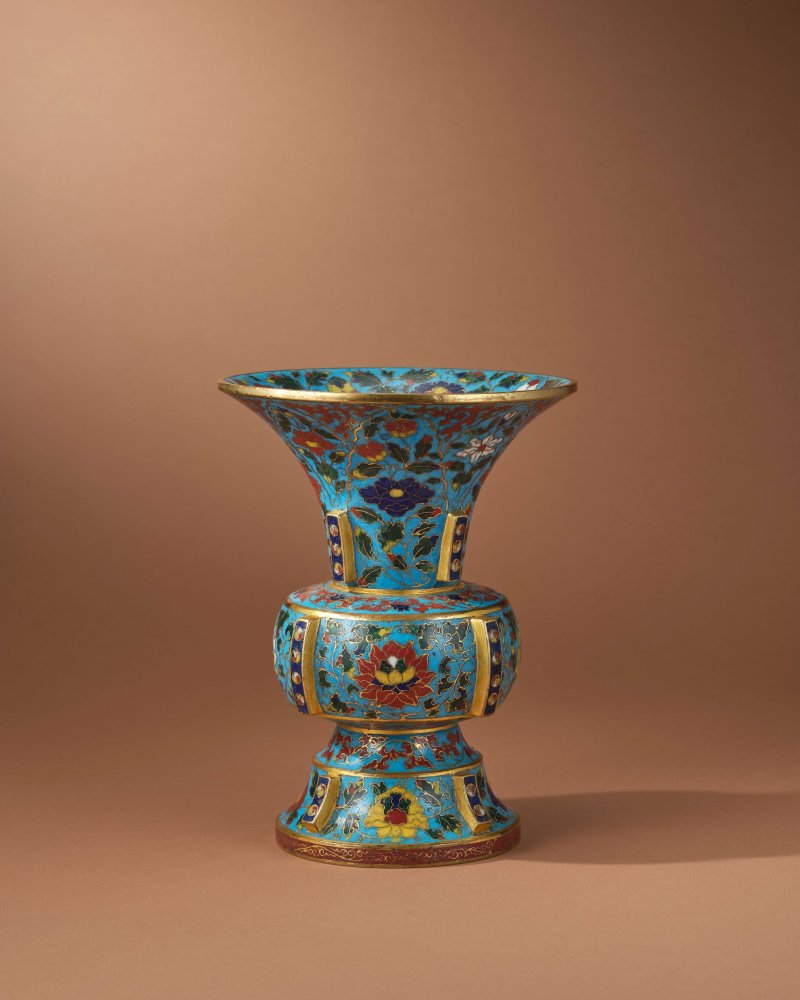
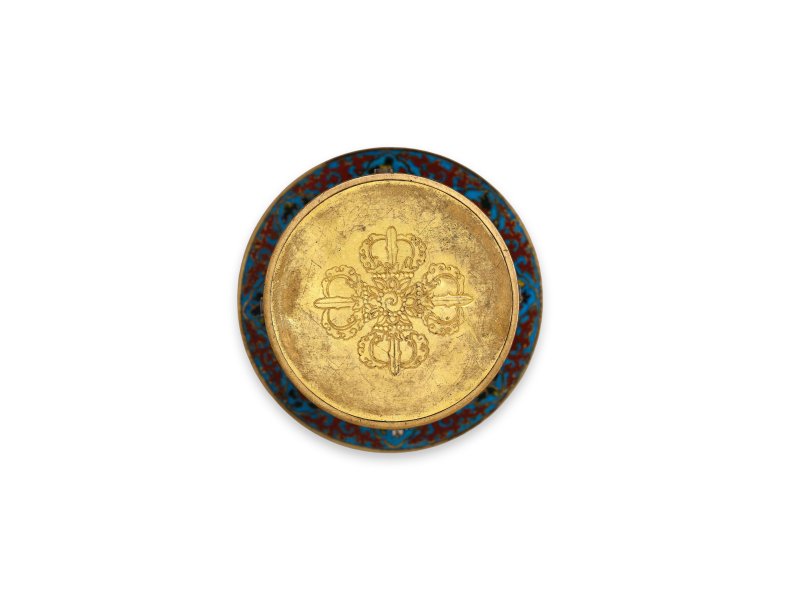
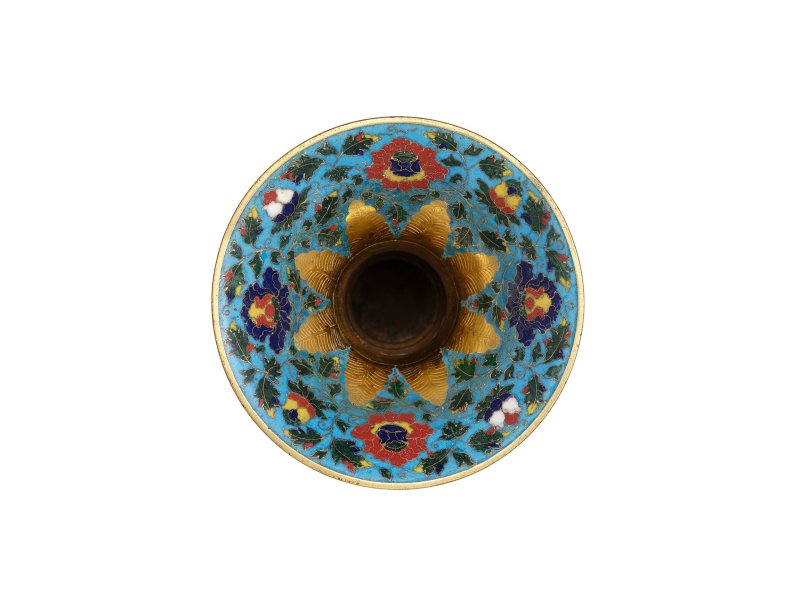
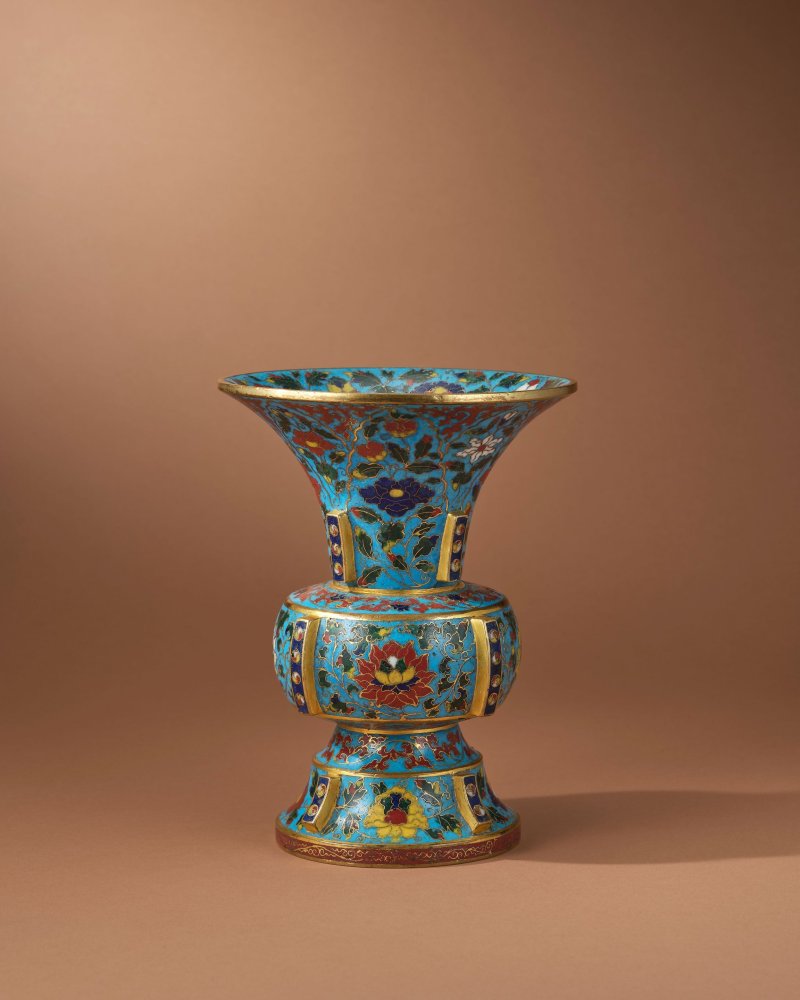
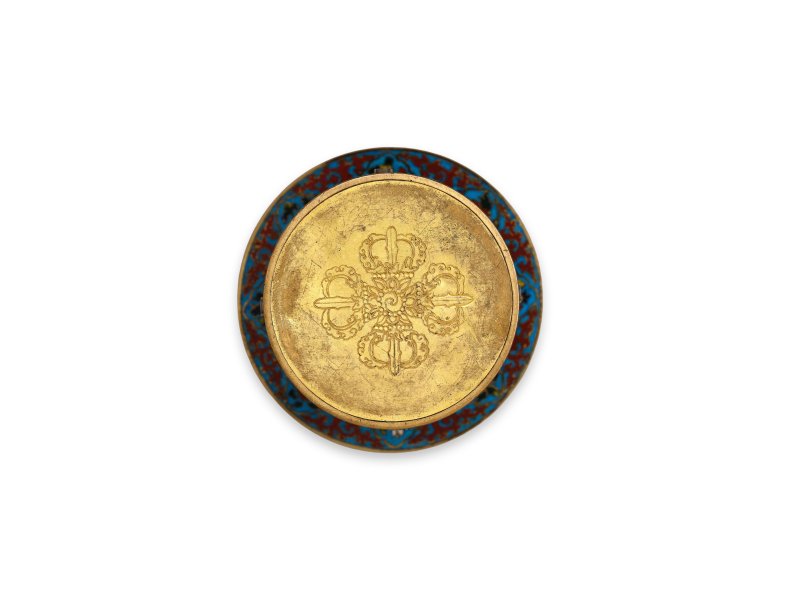
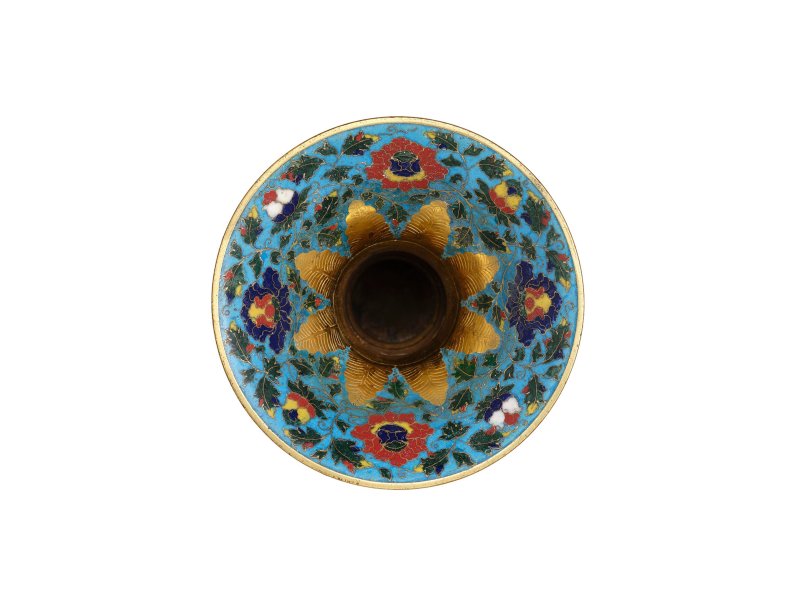
Finely cast and boldly enamelled, of archaic form, with a flaring trumpet neck issuing from a central drum-shaped section supported from a spreading base, each section divided by four evenly spaced vertical flanges, the exterior superbly decorated in yellow, blue, white, green and red enamels with lotuses and leafy scrolls, all against a turquoise-blue ground, the interior of the neck decorated around eight incised and gilded plantain leaves, the gilded base plate incised with a four-pronged vajra.
18.5cm (7 1/4in) high.
Footnotes
明宣德 掐絲琺瑯纏枝蓮紋出戟尊
Provenance:
J.J. Lally & Co., New York, circa 1980s
來源:
紐約古董商藍理捷藝廊,約1980年代
Early Ming cloisonné enamels are often regarded as the most accomplished and visually forceful ever produced in China. Their impact lies in the vigour of the decoration, the assured palette, the lavish gilding and the substantial casting. Encountering these masterpieces today invites reflection on the splendour they projected in their original Imperial environment, where they served to convey authority, wealth and refinement. In the early Ming period, such works would still have represented a relatively recent development at Court, the technique having been introduced only late in the Yuan dynasty.
Only a handful of comparable pieces such as the present lot survive. Among them is a cloisonné enamel vase, Xuande, with a Jingtai six-character mark, in the Qing Court Collection, illustrated in , Beijing, 2011, pp.84-85. In , vol.10, Beijing, 1987, p.162, no.299, the same vessel is attributed to the , a branch of the (Inner Treasury) responsible for furnishing the Imperial Household. Another example from this group, formerly in the collection of P.M. Moreau, Paris, and acquired there before 1924, was published by Eskenazi Ltd., , New York, 17-29 March 2008, no.18.
Particularly noteworthy is the gilded base plate, engraved at the centre with a four-pronged . The ( 金剛杵), one of the principal ritual implements of Esoteric Buddhism, was associated with indestructibility and spiritual power, and its incorporation into the base strongly suggests that the present vessel was made for a Buddhist ritual or devotional context. Vajra imagery is notably rare on early Ming cloisonné enamels; compare, for example, a rare cloisonné enamel dish decorated with lotus scrolls and double , sold at Bonhams Hong Kong, 2 December 2021, lot 28. A closely related -form vessel, also raised on a gilded base engraved with a four-pronged vajra, was sold at Christie's New York, 2 December 1989, lot 58.
Another distinctive feature of the present is the treatment of its gilt-bronze flanges. Whereas flanges on related vessels are often left plain, here they are enriched with enamelled circles divided into three sections, demonstrating an additional level of technical ambition. Comparable workmanship appears on a Xuande cloisonné vase, with a Jingtai six-character mark on a later red copper base, in the Asian Art Museum of San Francisco (Avery Brundage Collection), illustrated by B.Quette, , New York, 2011, p.236, no.24.
The form itself derives from ancient ritual bronzes of the Shang (c.1600–1046 BC) and Western Zhou (c.1046–771 BC) dynasties; for comparison, see a bronze of the 12th–11th century BC illustrated by R.W.Bagley, , Washington D.C., 1987, p.284, no.47.
For a cloisonné enamel , Xuande, but without enamelled flanges and with a later base plate, see one which was sold at Sotheby's Paris, 14 June 2007, lot 58.
侈口,長頸,圈足外撇,四出戟,口內飾銅鎏金鏨花蕉葉紋一圈。通體以淺藍琺瑯釉為地,飾纏枝蓮紋,圈足外飾卷紋,底部鏨刻十字金剛杵紋。
明初掐絲琺瑯,實為中國琺瑯工藝登峰造極之代表作,器物紋飾雄渾,設色典雅,鎏金璀璨,鑄造厚重,氣象非凡。今人觀之,猶可想此器當年於宮廷之中所煥發之輝煌光采,象徵皇室之權威與雅緻品味。溯其源流,此藝於明初尚屬新興,其技術至元末方始傳入宮廷。
此類器物存世極少,本品即為其一。類似例子包括清宮舊藏一件宣德時期掐絲琺瑯纏枝蓮紋尊,器底陰刻楷書「大明景泰年製」六字款,著錄於《故宮博物院藏品大系:琺瑯器編1:元明掐絲琺瑯》,北京,2011年,頁84至85;同器於《中國美術全集》一書被歸為內府御用監所製,該監掌宮廷器用之事,見卷10,北京,1987年,頁162,編號299。另一件同類器,原為巴黎P.M. Moreau舊藏,入藏於1924年以前,後經倫敦古董商埃斯卡納齊於展覽圖錄《Chinese Sculpture and Works of Art》中出版,紐約,2008年,編號18。
其器底鎏金鏨刻十字金剛杵紋,尤見匠心獨運。金剛杵乃密教重要法器,象徵堅固不壞之性與無上威力,其出現於器底,暗示此器或為佛教儀軌或供養之用。金剛杵紋飾於明初掐絲琺瑯中極為罕見,比較一件明早期銅胎掐絲琺瑯纏枝番蓮紋盤,售於香港邦瀚斯,2021年12月2日,拍品編號28。另有一件掐絲琺瑯尊,形制與本品相近,器底鎏金鏨刻十字金剛杵紋,售於紐約佳士得,1989年12月2日,拍品編號58。
其鎏金出戟之處理,亦別具一格。同類器之出戟多素面無飾,本品則以圓形圖案分三段裝飾,設計更精緻獨到。舊金山亞洲藝術博物館藏一件Avery Brundage收藏之宣德時期掐絲琺瑯尊,後加底有景泰六字款,其工藝與本品相類,見B.Quette,《Cloisonné: Chinese Enamels from the Yuan, Ming and Qing Dynasties》,紐約,2011年,頁236,編號24。
尊之器形源自商(約西元前1600-1046年)及西周(約西元前1046-771年)青銅禮器。比對一件西元前12至11世紀青銅尊,見R.W.Bagley,《Shang Ritual Bronzes in the Arthur M. Sackler Collections》,華盛頓特區,1987年,頁284,編號47。
參考一件宣德時期掐絲琺瑯尊,然出戟無琺瑯裝飾,售於巴黎蘇富比,2007年6月14日,拍品編號58。
Finely cast and boldly enamelled, of archaic form, with a flaring trumpet neck issuing from a central drum-shaped section supported from a spreading base, each section divided by four evenly spaced vertical flanges, the exterior superbly decorated in yellow, blue, white, green and red enamels with lotuses and leafy scrolls, all against a turquoise-blue ground, the interior of the neck decorated around eight incised and gilded plantain leaves, the gilded base plate incised with a four-pronged vajra.
18.5cm (7 1/4in) high.
Footnotes
明宣德 掐絲琺瑯纏枝蓮紋出戟尊
Provenance:
J.J. Lally & Co., New York, circa 1980s
來源:
紐約古董商藍理捷藝廊,約1980年代
Early Ming cloisonné enamels are often regarded as the most accomplished and visually forceful ever produced in China. Their impact lies in the vigour of the decoration, the assured palette, the lavish gilding and the substantial casting. Encountering these masterpieces today invites reflection on the splendour they projected in their original Imperial environment, where they served to convey authority, wealth and refinement. In the early Ming period, such works would still have represented a relatively recent development at Court, the technique having been introduced only late in the Yuan dynasty.
Only a handful of comparable pieces such as the present lot survive. Among them is a cloisonné enamel vase, Xuande, with a Jingtai six-character mark, in the Qing Court Collection, illustrated in , Beijing, 2011, pp.84-85. In , vol.10, Beijing, 1987, p.162, no.299, the same vessel is attributed to the , a branch of the (Inner Treasury) responsible for furnishing the Imperial Household. Another example from this group, formerly in the collection of P.M. Moreau, Paris, and acquired there before 1924, was published by Eskenazi Ltd., , New York, 17-29 March 2008, no.18.
Particularly noteworthy is the gilded base plate, engraved at the centre with a four-pronged . The ( 金剛杵), one of the principal ritual implements of Esoteric Buddhism, was associated with indestructibility and spiritual power, and its incorporation into the base strongly suggests that the present vessel was made for a Buddhist ritual or devotional context. Vajra imagery is notably rare on early Ming cloisonné enamels; compare, for example, a rare cloisonné enamel dish decorated with lotus scrolls and double , sold at Bonhams Hong Kong, 2 December 2021, lot 28. A closely related -form vessel, also raised on a gilded base engraved with a four-pronged vajra, was sold at Christie's New York, 2 December 1989, lot 58.
Another distinctive feature of the present is the treatment of its gilt-bronze flanges. Whereas flanges on related vessels are often left plain, here they are enriched with enamelled circles divided into three sections, demonstrating an additional level of technical ambition. Comparable workmanship appears on a Xuande cloisonné vase, with a Jingtai six-character mark on a later red copper base, in the Asian Art Museum of San Francisco (Avery Brundage Collection), illustrated by B.Quette, , New York, 2011, p.236, no.24.
The form itself derives from ancient ritual bronzes of the Shang (c.1600–1046 BC) and Western Zhou (c.1046–771 BC) dynasties; for comparison, see a bronze of the 12th–11th century BC illustrated by R.W.Bagley, , Washington D.C., 1987, p.284, no.47.
For a cloisonné enamel , Xuande, but without enamelled flanges and with a later base plate, see one which was sold at Sotheby's Paris, 14 June 2007, lot 58.
侈口,長頸,圈足外撇,四出戟,口內飾銅鎏金鏨花蕉葉紋一圈。通體以淺藍琺瑯釉為地,飾纏枝蓮紋,圈足外飾卷紋,底部鏨刻十字金剛杵紋。
明初掐絲琺瑯,實為中國琺瑯工藝登峰造極之代表作,器物紋飾雄渾,設色典雅,鎏金璀璨,鑄造厚重,氣象非凡。今人觀之,猶可想此器當年於宮廷之中所煥發之輝煌光采,象徵皇室之權威與雅緻品味。溯其源流,此藝於明初尚屬新興,其技術至元末方始傳入宮廷。
此類器物存世極少,本品即為其一。類似例子包括清宮舊藏一件宣德時期掐絲琺瑯纏枝蓮紋尊,器底陰刻楷書「大明景泰年製」六字款,著錄於《故宮博物院藏品大系:琺瑯器編1:元明掐絲琺瑯》,北京,2011年,頁84至85;同器於《中國美術全集》一書被歸為內府御用監所製,該監掌宮廷器用之事,見卷10,北京,1987年,頁162,編號299。另一件同類器,原為巴黎P.M. Moreau舊藏,入藏於1924年以前,後經倫敦古董商埃斯卡納齊於展覽圖錄《Chinese Sculpture and Works of Art》中出版,紐約,2008年,編號18。
其器底鎏金鏨刻十字金剛杵紋,尤見匠心獨運。金剛杵乃密教重要法器,象徵堅固不壞之性與無上威力,其出現於器底,暗示此器或為佛教儀軌或供養之用。金剛杵紋飾於明初掐絲琺瑯中極為罕見,比較一件明早期銅胎掐絲琺瑯纏枝番蓮紋盤,售於香港邦瀚斯,2021年12月2日,拍品編號28。另有一件掐絲琺瑯尊,形制與本品相近,器底鎏金鏨刻十字金剛杵紋,售於紐約佳士得,1989年12月2日,拍品編號58。
其鎏金出戟之處理,亦別具一格。同類器之出戟多素面無飾,本品則以圓形圖案分三段裝飾,設計更精緻獨到。舊金山亞洲藝術博物館藏一件Avery Brundage收藏之宣德時期掐絲琺瑯尊,後加底有景泰六字款,其工藝與本品相類,見B.Quette,《Cloisonné: Chinese Enamels from the Yuan, Ming and Qing Dynasties》,紐約,2011年,頁236,編號24。
尊之器形源自商(約西元前1600-1046年)及西周(約西元前1046-771年)青銅禮器。比對一件西元前12至11世紀青銅尊,見R.W.Bagley,《Shang Ritual Bronzes in the Arthur M. Sackler Collections》,華盛頓特區,1987年,頁284,編號47。
參考一件宣德時期掐絲琺瑯尊,然出戟無琺瑯裝飾,售於巴黎蘇富比,2007年6月14日,拍品編號58。
常见问题
这件明宣德 掐絲琺瑯纏枝蓮紋出戟尊 | AN EXCEPTIONALLY RARE CLOISONNÉ ENAMEL AND GILT-BRONZE VASE, ZUN的成交价是多少?
落槌价为 预展中。 成交价为 预展中。