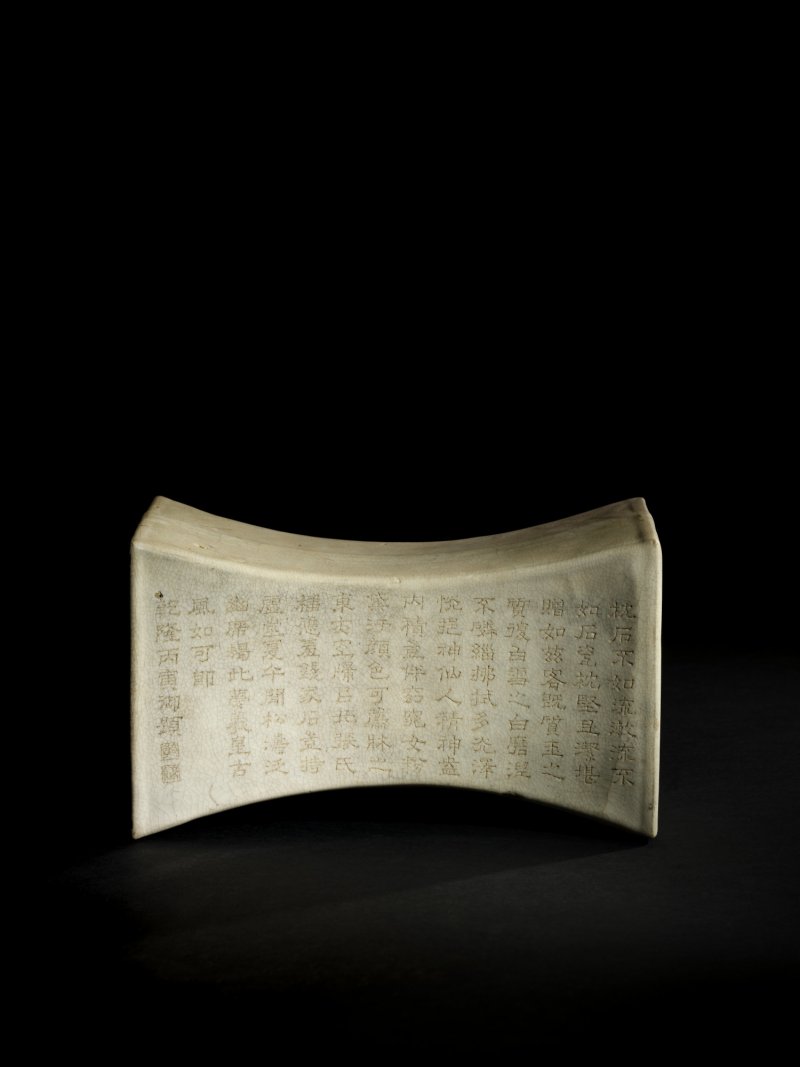

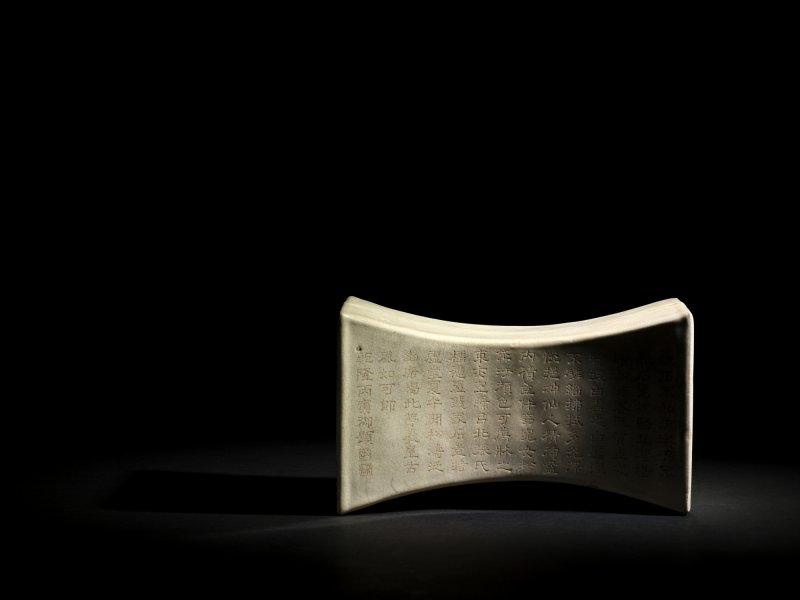
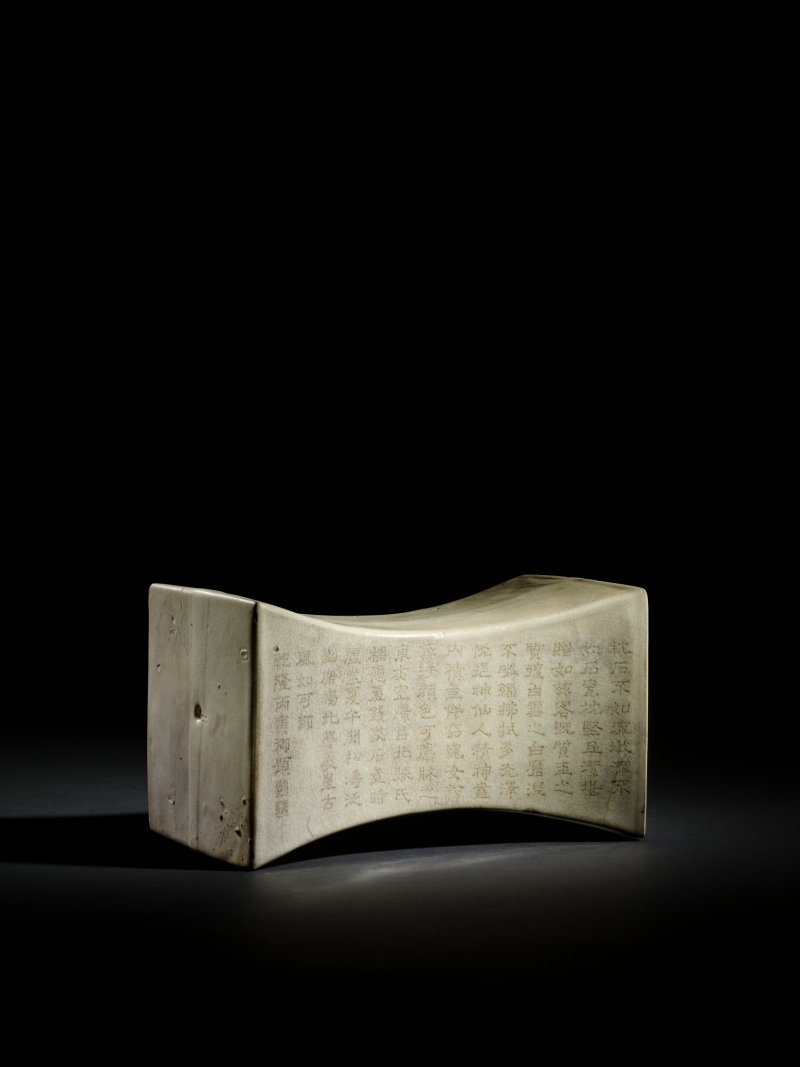
Lot 8028 A very rare imperially inscribed white-glazed ingot-shaped pillow, Song dynasty; Inscription dated to the bingyin year of the Qianlong period (1746) | 宋 乾隆御題白瓷錠形枕 《乾隆丙寅御題》款 「乾」「隆」印
落槌价
预展中
成交价
预展中
| 拍卖公司 | 苏富比 |
|---|---|
| 拍卖时间 | 2026年10月30日 |
拍品信息
拍品名称
A very rare imperially inscribed white-glazed ingot-shaped pillow, Song dynasty; Inscription dated to the bingyin year of the Qianlong period (1746) | 宋 乾隆御題白瓷錠形枕 《乾隆丙寅御題》款 「乾」「隆」印
起拍价
HKD 4,000,000
估值区间
4,000,000 - 8,000,000 HKD
尺寸
未知
品相
如欲了解本拍品狀況的更多資訊,請聯絡 Rubie.Fong@sothebys.com
更多信息
21.4 cm
来源:Yamanaka & Company, Inc, Parke-Bernet Galleries, 1943, lot 715.
Collection of Rosalind Ching Pastor (1920–2019), Chicago.
Bonhams New York, 15th March 2021, lot 86.
展览:Art Institute of Chicago, loan exhibition, 1997.
Masterworks of Chinese Art, The Rosalind Ching Pastor Collection, Honolulu Academy of Arts, Honolulu, 2005, pp. 12-13.
著录:Parke-Bernet Galleries, 'Yamanaka & Company, Inc.' Catalogue, 1943, illustrated on 3rd shelf (center) of six shelves.
图录
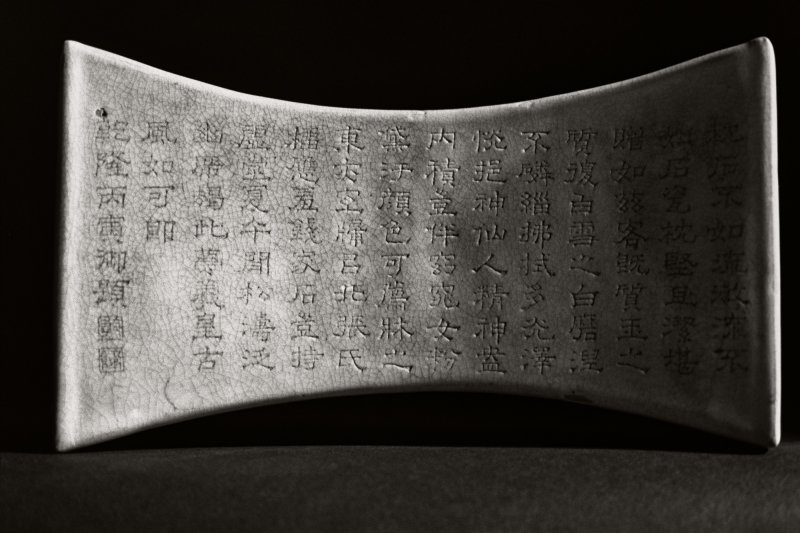
说明:枕石不如流,漱流不如石,瓷枕堅且潔,堪贈如茲客,
既質玉之質,復白雪之白,磨涅不磷緇,拂拭多光澤,
恍挹神仙人,精神盍內積,豈伴窈窕女,粉黛汙顏色,
可薦床之東,亦宜牖以北,張氏榴應羞,錢家石豈特,
虛堂夏午間,松濤泛幽席,竭此夢羲皇,古風如可即。
乾隆丙寅御題 「乾」、「隆」
To use a stone as a pillow is not as good as a stream flowing beneath;
But to rinse one's mouth with a stream is not as good as rinsing it with stone.
This ceramic pillow is both hard and pure,
Worthy indeed to be presented to such a guest.
Possessing the substance of jade itself,
And the whiteness of fresh snow yet,
Even when rubbed with black dye it will not darken nor lose its lustre;
When dusted and wiped, it shines all the more brilliantly.
One seems almost to encounter an Immortal,
Whose vital spirit is stored within.
How could it keep company with a graceful beauty,
Whose powders and cosmetics would stain its colour?
It may be placed at the eastern side of the bed,
And is equally fitting beneath a northern window.
The Zhang family's pomegranate pillow should feel ashamed before it;
The Qian family's stone pillow can hardly compare.
In an empty hall at noon in summer,
The sound of wind in the pines washes over the secluded mat.
Resting upon it, one may dream of the age of Emperor Fuxi;
Such ancient elegance seems almost within reach.
來源
山中商會,Parke-Bernet Galleries,1943年,編號715
Rosalind Ching Pastor(1920–2019年)收藏,芝加哥
紐約邦瀚斯2021年3月15日,編號86
出版
Parke-Bernet Galleries,山中商會拍賣圖錄,1943年,圖見六層展示架之第三層(中)
展覽
芝加哥藝術博物館,借展,1997年
《Masterworks of Chinese Art, The Rosalind Ching Pastor Collection》,檀香山藝術博物館,檀香山,2005年,頁12–13
Filled with historical allusions and quiet contemplation, finely carved in a characterful clerical script, this poem was composed by the Qianlong Emperor himself in the eleventh year of his reign (1746) and transforms an otherwise understated object into a symbol of stateliness and imperial majesty.
Raised amidst the antiques and artworks of the imperial collection, the Qianlong Emperor (r. 1736-1795) was as much a scholar as he was a mighty statesman. An avid reader, calligrapher and connoisseur, the Emperor is said to have spent much of his youth absorbing the rich artistic traditions of China from the splendour of his grandfather’s palaces, and honing his own skills as a poet and artist. Throughout his sixty-year reign and well into his retirement, the Emperor appears to have been among the most prolific poets of his day, said to have composed over forty thousand poems, most of which survive today alongside the present in imperial compendia.
Of these myriad poems, perhaps the most beloved and fascinating are those composed by the Emperor on the subject of his art collection. Like his father and grandfather before him, the Qianlong Emperor was not only a passive admirer of art but an avid collector. Receiving tributes from across the empire and commissioning ever more complex works from the imperial kilns of Jingdezhen, the Qianlong Emperor was a true aesthete and composed around one hundred and ninety poems in praise of ceramics. Particularly notable among these are the more than a hundred and fifty compositions on the subject of Song ceramics; see Feng Xianming, Annotated Collection of Historical Documents on Ancient Chinese Ceramics, Taipei, 2000, p. 271ff. Minimalist yet full of complexity, ancient yet serene, it was pieces like the present pillow that most struck the poetic mind of the emperor.
In the most radical yet simple act of communing with the ancients, the Emperor often ordered for his poems to be carved like the present into the surface of his antiques. As if personally reaching back to the antiquity of his dreams and the age of Fuxi, the emperor’s inscriptions serve as a physical manifestation of his antiquarian passion; adding his own mark to the centuries of storytelling and treasured ownership represented in each object. Many of these unique transtemporal objects survive today but are almost exclusively preserved in the Beijing Palace Museum and Taipei Palace Museum; many of the latter included in the 2012 exhibition Obtaining Refined Enjoyment, The Qianlong Emperor's Taste in Ceramics, described in Yu Peichin, “Consummate Images: Emperor Qianlong's Vision of the Ideal Kiln”, Orientations, vol. 42, no. 8 (November-December 2011), pp 80-88.
One other Cizhou pillow is attested bearing the same inscription as the present, preserved in the Taipei Palace Museum (accession no. gu ci 017426) and illustrated in The Qianlong Emperor's Taste in Ceramics, Taipei, 2012, cat. no. 9. Of a more well-known Cizhou sgraffiato design and ogival form, this pillow carries the present inscription in a gilt regular kaishu script to the base. Given its form and ground base, this pillow presumably corresponds to the ‘white ceramic carved ruyi cooling pillow (白瓷暗花如意凉枕)’ recorded in the described in the records of the Wood Department of the Imperial Workshop on the 27th day of the 3rd month of 1746, conveniently aligning with the date of the present poem’s composition. Another ‘Song dynasty ceramic pillow’ (宋磁枕) is similarly recorded amidst the imperial collection around 1746. Described in the records of the Ruyiguan (Office of Wish Fulfilment) in the seventh month of 1747, this pillow was sent by eunuch Hu Shijie to be “ground level” and “engraved with an inscription in blue and vermilion pigments”.
This pattern of returning to the same favourite poems and ceramics again and again appears to have been a favoured pastime of the emperor, though these pillows represent a particularly early example of this phenomenon. Compare a closely related group of three more white ceramic pillows inscribed with the same 1768 poem In Praise of a Ding Pillow in closely related hands of clerical script: one of very similar form to the present, sold in our London rooms, 5th November 2025, lot 17; the second of oval form and incised peony decoration quite dissimilar to the poem’s description of a ‘pure white’ surface, preserved in the Palace Museum, Beijing, illustrated in The Life of Emperor Qian Long, Macau Museum of Art, Macau, 2002, cat. no. 51; and the third, purchased by the Freer Gallery of Art (National Museum of Asian Art), Washington, from T. H. Ching in 1942 (accession no. F1942.21), included in Chuimei Ho and Bennet Bronson, Splendors of China's Forbidden City. The Glorious Reign of Emperor Qianlong, The Field Museum, Chicago, 2004, cat. no. 293.
For further examples of imperially inscribed pillows in Taipei and Beijing, compare a Ding pillow moulded in the shape of a recumbent child, preserved in the Taipei Palace Museum (accession no. gu ci 004923), inscribed with a Poem in Praise of the Sleeping Boy Pillow of the Ding kilns (Yong Dingyao chui hai’er zhen, 1773), illustrated in Decorated Porcelains of Dingzhou, Palace Museum, Taipei, 2014, cat. no. II-90; a Jun-glazed pillow preserved in the Taipei Palace Museum (accession no. gu ci 017431), inscribed with a poem attributing it to the semi-mythical ‘Chai’ kiln; and a Cizhou pillow in the Palace Museum, Beijing, inscribed with a poem In Praise of an Ancient Ceramic Pillow (Yong gu ci zhen, 1788), apparently unpublished but discussed in Goa Xiaoran, “Qianlong yuzhi shi ciqi kaolun / Studies of Ceramics with Inscriptions of ‘Imperial Poems’ Composed by Emperor Qianlong”, Gugong Xuekan, 2011, p. 297.
The present pillow traces its more recent history to the storerooms of Yamanaka & Company. Among the most important dealers of the early twentieth century, Yamanaka Sadajiro (1866-1936) and his successors began their operations in Osaka but expanded to New York, Chicago, Boston and London, from where they supplied the leading collectors and institutions of their day. Following the outbreak of the Second World War, the contents of all of Yamanaka’s American stores were confiscated under the supervision of the Alien Property Custodian of the United States of America and sold in a now famous series of sales at the Parke-Bernet Galleries.
此詩乃乾隆帝於御極十一年(1746年)親撰,典故紛陳,意境清幽,並以個性鮮明的隸書鐫刻於枕上;原本素淨含蓄的器物,遂化為天子端莊威儀的象徵。
乾隆皇帝(1736-1795年在位)自幼於宮廷古玩與藝術收藏中薰陶成長,既為雄才大略的國君,亦具文人風範。他酷愛讀書,精於書法,尤好鑑賞,據載少年時代常流連於祖父宮苑之藝術瑰寶間,浸淫於中國深厚的藝術傳統,並不斷磨練詩藝。其在位六十年間,乃至禪位以後,為當世最多產的詩人之一,據稱賦詩逾四萬首,其中大多與此詩一同載入清宮典籍,流傳至今。
萬千御製詩中,最為人稱道、亦最引人入勝者,當屬乾隆帝吟詠其藝術收藏之作。乾隆帝繼承康雍二朝的傳統,不僅雅好鑑賞,更熱衷收藏珍品,宮中廣納四方貢品,又命景德鎮御窰廠燒製更為繁複精巧之器物。乾隆帝品味卓然,作詠瓷詩約一百九十首,其中尤以一百五十餘首詠宋瓷詩最為可觀,詳見馮先銘,《中國古陶瓷文獻集釋》,台北,2000年,頁271起。與本枕相類之器物簡素而意趣繁富、古雅靜穆,最能觸發帝王詩興。
乾隆帝常命人將御製詩如本品一般鐫刻於古物表面,以最直接質樸的方式與古人神交,猶如親臨夢寐嚮往的遠古伏羲之世,實乃慕古情懷之具體呈現;器物承載數百年的掌故與遞藏,從此又添一筆帝王印記。此類跨越時空的獨特器物不少流傳至今,惟幾乎悉數藏於北京故宮博物院與台北故宮博物院;台北故宮多例2012年曾於《得佳趣:乾隆皇帝的陶瓷品味》展出,見余佩瑾,〈Consummate Images: Emperor Qianlong's Vision of the Ideal Kiln〉,《美成在久》,卷42,第8期(2011年11-12月),頁80-88。
另有一件磁州窰枕,亦題有與本枕相同的詩作,現藏台北故宮博物院(藏品編號:故瓷017426),見《得佳趣——乾隆皇帝的陶瓷品味》,台北,2012年,編號9。該枕呈如意形,飾以磁州窰較常見的劃花,底部以楷書鐫刻此詩描金。綜合其器形及底部磨平的特徵,應即內務府造辦處木作檔案於乾隆十一年三月二十七日(1746年)所載「白瓷暗花如意涼枕」,日期恰與本詩之寫成時間相符。另有一件「宋磁枕」於1746年前後亦見於內務府收藏紀錄;乾隆十二年七月(1747年)的如意館檔案記載,太監胡世傑將該枕送交磨平並刻字填青、朱二色。
反覆品味心儀詩作與瓷器,似為乾隆帝尤愛的雅事,此組瓷枕正是極早期的實例。可比較另外三件相近的白瓷枕,均鐫1768年所作之詠定窰枕詩,隸書筆法亦相近:其一形制與本品極為相似,2025年11月5日售於倫敦蘇富比,拍品編號17;其二呈橢圓形,刻牡丹紋,與詩中所述純白表面頗不相符,現藏北京故宮博物院,錄《懷抱古今──乾隆皇帝文化生活藝術》,澳門藝術博物館,澳門,2002年,編號51;其三於1942年由華盛頓弗利爾美術館購自T. H. Ching(藏品編號F1942.21),錄何翠媚、Bennet Bronson,《Splendors of China's Forbidden City. The Glorious Reign of Emperor Qianlong》,菲爾德博物館,芝加哥,2004年,編號293。
更多兩岸御題瓷枕例,可參考一件台北故宮博物院藏定窰白瓷嬰兒枕(藏品編號:故瓷004923),上鐫《詠定窰睡孩兒枕》(1773年),載於《定州花瓷》,故宮博物院,台北,2014年,圖版II-90;一件台北故宮博物院藏鈞窯長方枕(藏品編號:故瓷017431),題詩將其歸為尚待考證之柴窰;另有北京故宮博物院藏磁州窰枕,題詩《詠古瓷枕》(1788年),似未曾發表,惟見高曉然,〈乾隆御制詩瓷器考論〉,《故宮學刊》,2011年,頁297。
本枕近世流傳史可追溯至山中商會庫藏。山中定次郎(1866-1936年)及其繼承者乃二十世紀初最重要的古董商之一,業務始於大阪,後拓展至紐約、芝加哥、波士頓及倫敦,向當時的主要收藏家與機構供應藝術品。第二次世界大戰爆發後,山中商會在美國的全部庫存在美國敵產管理局(Alien Property Custodian of the United States of America)監管下遭沒收,其後於Parke-Bernet Galleries日後聞名遐邇的一系列拍賣中售出。
常见问题
这件A very rare imperially inscribed white-glazed ingot-shaped pillow, Song dynasty; Inscription dated to the bingyin year of the Qianlong period (1746) | 宋 乾隆御題白瓷錠形枕 《乾隆丙寅御題》款 「乾」「隆」印的成交价是多少?
落槌价为 预展中。 成交价为 预展中。
拍品的品相状况如何?
如欲了解本拍品狀況的更多資訊,請聯絡 Rubie.Fong@sothebys.com
这件拍品的流传来源是什么?
Yamanaka & Company, Inc, Parke-Bernet Galleries, 1943, lot 715.
Collection of Rosalind Ching Pastor (1920–2019), Chicago.
Bonhams New York, 15th March 2021, lot 86.
Collection of Rosalind Ching Pastor (1920–2019), Chicago.
Bonhams New York, 15th March 2021, lot 86.
这件拍品曾在哪些展览中展出过?
Art Institute of Chicago, loan exhibition, 1997.
Masterworks of Chinese Art, The Rosalind Ching Pastor Collection, Honolulu Academy of Arts, Honolulu, 2005, pp. 12-13.
Masterworks of Chinese Art, The Rosalind Ching Pastor Collection, Honolulu Academy of Arts, Honolulu, 2005, pp. 12-13.
这件拍品被哪些著录书籍记载?
Parke-Bernet Galleries, 'Yamanaka & Company, Inc.' Catalogue, 1943, illustrated on 3rd shelf (center) of six shelves.
图录
图录