
拍品信息
拍品名称
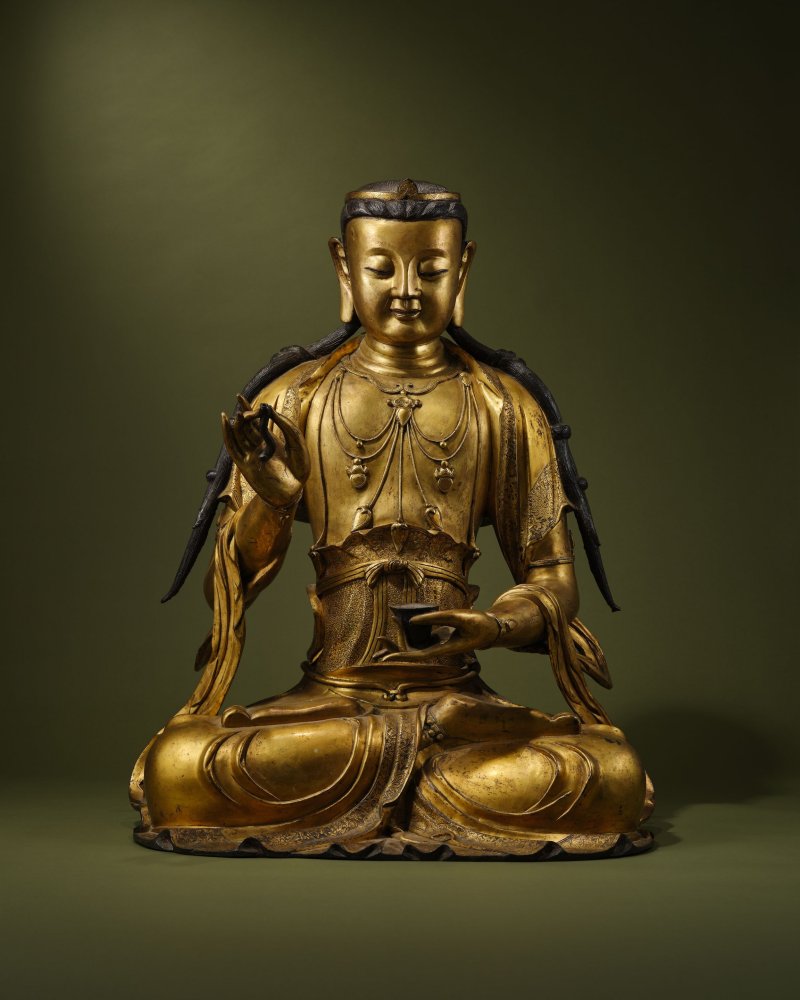
元/明 銅鎏金觀音坐像 | AN EXCEPTIONALLY RARE MONUMENTAL GILT-BRONZE FIGURE OF AVALOKITESVARA
年代
Yuan/Ming Dynasty
起拍价
HKD 7,000,000
估值区间
HKD 7000000 - 9000000
尺寸
未知
品相
未知
更多信息
Yuan/Ming Dynasty
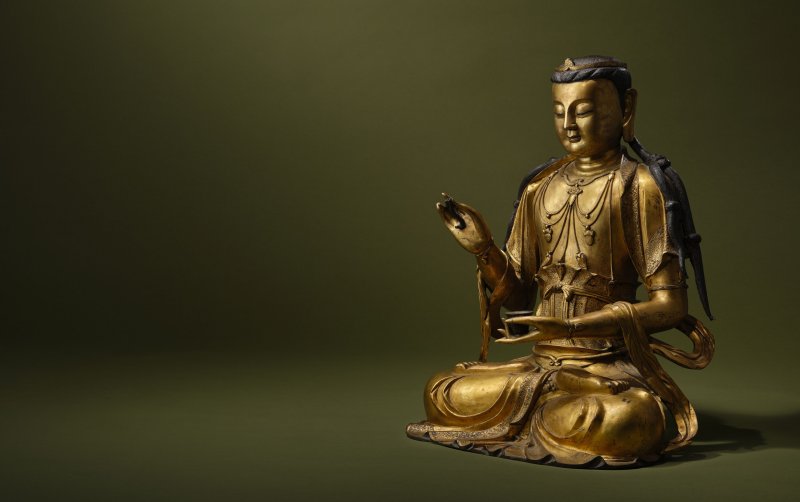
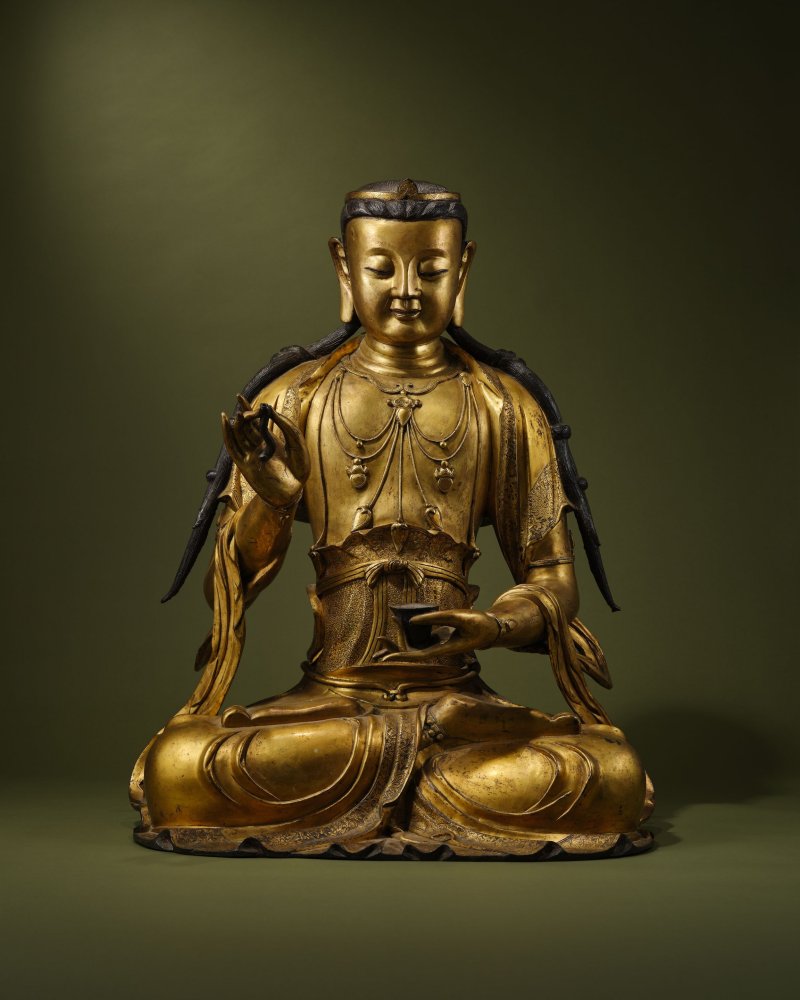
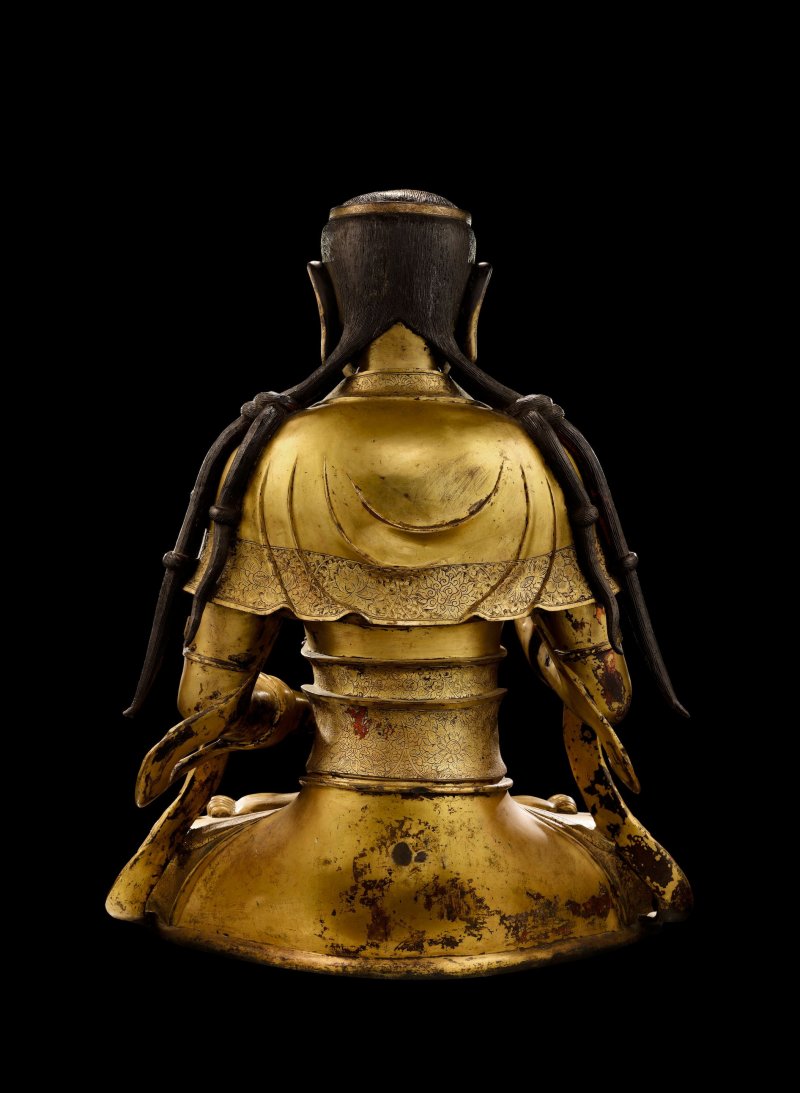
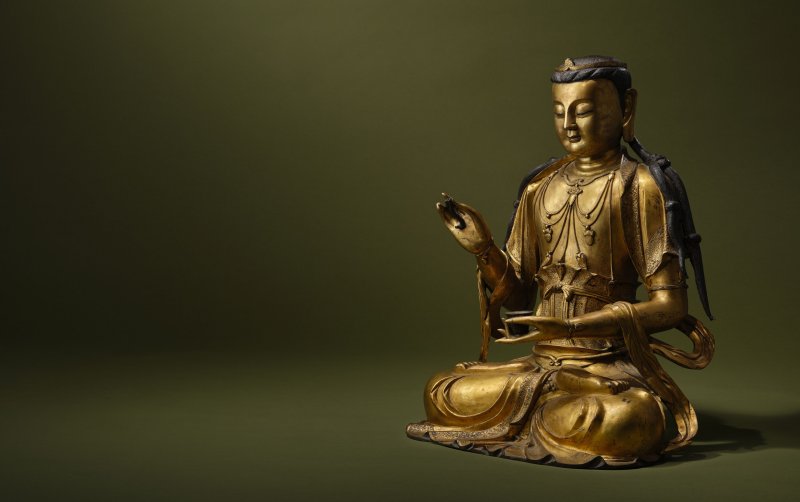
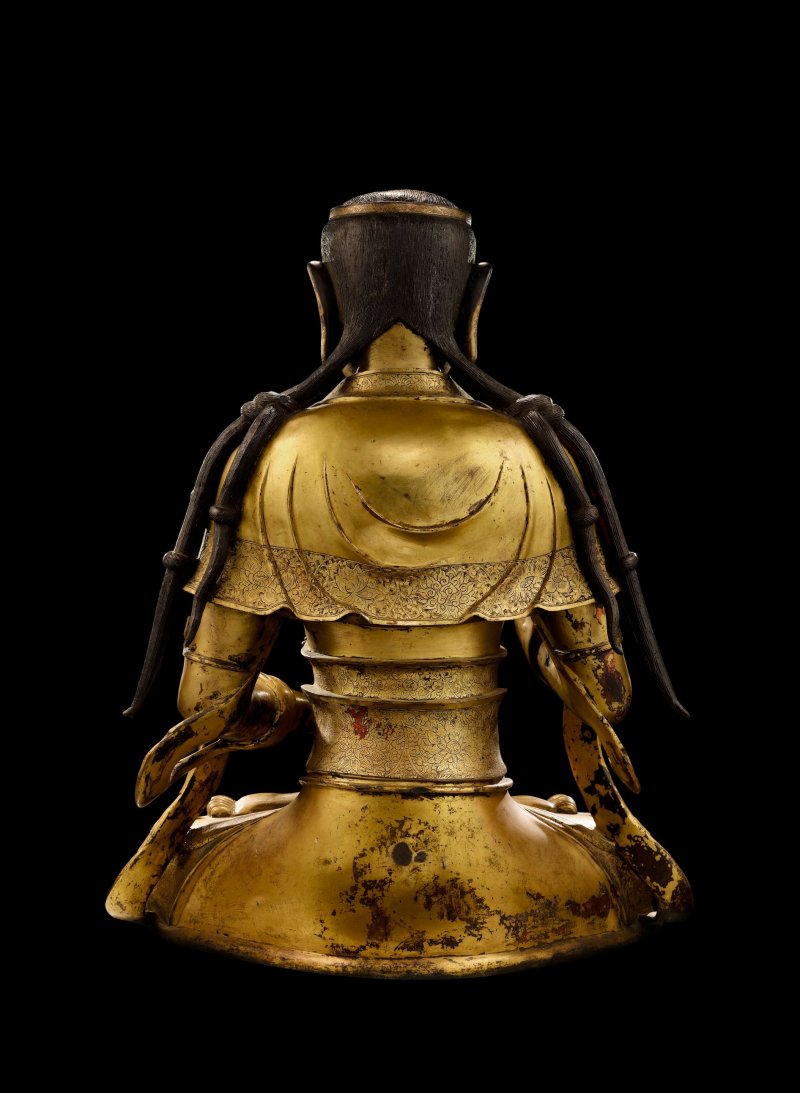
Superbly cast and richly gilt, the bodhisattva shown seated in dhyanasana, the right hand raised in vitarka mudra, the left resting in the lap supporting a small bowl, the serene, downcast expression framed by long pendulous ears and an elegant, sharply modelled coiffure falling down the shoulders and secured with a tiara, clad in layered, rhythmic robes falling in deep, naturalistic folds exposing the chest adorned with finely detailed beaded jewellery and foliate pendants, the hems incised with exquisite detail.
77cm (30 1/4in) high.
Footnotes
元/明 銅鎏金觀音坐像
Provenance:
Dr Otto Burchard (1892-1965), Berlin, acquired circa 1920
Dr Weimann, Berlin
China-Bohlken, Berlin, acquired in 1953
Lempertz, Cologne, 4-5 June 1999, lot 221
, Völklingen, 2016, pp.172-173, no.59
Otto Burchard博士(1892–1965),柏林,約1920年入藏
Weimann博士,柏林
China-Bohlken,柏林,1953年入藏
Lempertz,科隆,1999年6月4至5日,拍品編號221
《Buddha: 2000 Years of Buddhist Art. 232 Masterpieces》,弗爾克林根,2016年,頁172至173,編號59
Dr Otto Burchard was known for Chinese Song dynasty ceramics. He underwrote the First International Dada Fair in Berlin in 1920. In 1926 he founded Dr. Otto Burchard & Co., a gallery in Berlin devoted to Chinese art, as a part of the Margraf Group, an art trade firm, with a further branch in New York. His collection was sold at auction in Berlin, 19-21 May 1928, with the catalogue 'Die Sammlung des Herrn Dr. Otto Burchard', Berlin, Versteigerung: Dienstag, den 22. Mai 1928", edited by William Cohn (Berlin: P. Cassirer and H. Helbing, 1928). In 1929, the Margraf Concern was acquired by Jakob and Rosa Oppenheimer. Additionally he authored the book .
China-Bohlken was founded by Theodor Bohlken after the First World War. Initially selling tea, he also went on to offer works of art from China and Japan. His 'buyer' was Dr Otto Burchard and then Johann Jenssen and Heinrich Peters. In November 1927 he opened a gallery in Potsdamer Straße 16, Berlin, calling it China-Bohlken, which included four floors, three of which displayed Buddhist sculpture from the Wei to the Ming dynasty. His gallery moved to Leipziger Straße 39 in 1943, and after the Second World War, his gallery branch in Westerland on the island of Sylt became the main location.
The present gilt-bronze figure represents Avalokitesvara, the Bodhisattva of Compassion, depicted seated in meditation and holding the characteristic attributes of a willow branch and ambrosia vase. Remarkable for both its scale and refinement, the sculpture belongs to a rare group of large gilt-bronze Buddhist images produced during the Yuan and Ming dynasties. The period witnessed a profound transformation in Chinese Buddhist sculpture, as established Chinese traditions encountered new artistic forms and iconographic conventions transmitted through the increasingly cosmopolitan Buddhist networks linking China with Tibet and Nepal.
Stylistically, the present figure is characterised by an elongated and attenuated physique, a high-waisted lower garment tied immediately beneath the ribcage, a bare torso adorned with elaborate jewellery, and a light shawl falling across the shoulders. These features can be compared with a rare pair of smaller parcel-gilt bronze bodhisattvas, 14th century, sold at Sotheby's Paris, 10 December 2019, lot 14, which similarly displays elongated proportions, elaborate jewellery, flowing locks of hair and high-waisted garments. See also a gilt-bronze figure of a Bodhisattva, 15th-17th century, with similarly high-waisted garment, in the National Museum of Scotland, Edinburgh (acc.no.A.1954.47). Compare also with a large bronze figure of Vairocana, 16th/17th century, in the Royal Ontario Museum, Toronto, (acc.no.921.31.30). Compare also with a smaller (28cm high) gilt-bronze figure of a seated Bodhisattva, Yuan dynasty, with similar head band and long torso, illustrated in , Sydney, 2003, pp.96-97.
See also a very large finely cast gilt-bronze figure of Vairocana, 16th century, which was sold at Christie's New York, 15 September 2011, lot 1383. Compare the garments with those on a rare gilt-bronze seated figure of Avalokitesvara, late Yuan dynasty, 14th century, which was sold at Christie's New York, 24 March 2004, lot 83. See also a large gilt-bronze figure of Vairocana, 16th century, which was sold at Christie's Hong Kong, 1 June 2011, lot 3770. Compare also with a gilt-bronze seated figure of a Bodhisattva, early Ming dynasty, late 14th-15th century, which was sold at Christie's London, 14 May 2019, lot 116.
The development of this sculptural vocabulary can be traced to earlier Song dynasty prototypes. See a gilt-bronze figure of Avalokitesvara, Song dynasty, in the Asian Art Museum of San Francisco, illustrated by René-Yvon Lefebvre d'Argencé, ed., , San Francisco, 1974, pl.159. A small gilt-bronze seated bodhisattva, 12th/13th century, in the Ashmolean Museum, Oxford (acc.no.EA1956.1376), likewise already displays several features that recur in later Chinese Buddhist sculpture, including the full oval face, bare chest ornamented with necklaces, delicate shawl and voluminous lower garment. In the present figure, these inherited elements are developed into a more elongated and sophisticated sculptural language, demonstrating the continuity of Chinese Buddhist sculptural traditions across the Yuan and Ming dynasties.
The elongated proportions and high-waisted garments of the present figure also find parallels in Yuan dynasty Qingbai sculpture. Two seated figures are illustrated in , Hong Kong, 1984, pp.54–55, while a figure of Guanyin in the Capital Museum, Beijing, is illustrated in , New York, 2011, p.92, fig.122. See also four Qingbai figures of Guanyin from the collections of C.P. Lin, the Nelson-Atkins Museum of Art, the Victoria and Albert Museum, London, and the Metropolitan Museum of Art, New York, illustrated by S.Pierson, , London, 2002, pls.119–122. Although executed in porcelain rather than gilt-bronze, these figures demonstrate the wider currency of the elongated bodhisattva type during the Yuan period and provide a useful parallel for the proportions and treatment of the present figure.
The development of new Buddhist sculptural forms during the Yuan dynasty coincided with the unprecedented prominence of Tibetan Buddhism at the Mongol Court. Following the Mongol incorporation of Tibet, Kublai Khan (1215–1294) established close ties with the Sa skya hierarch 'Phags pa (1235–1280), whose influence contributed to the elevated position of Tibetan Buddhism within the Yuan Imperial sphere. The movement of monks, patrons and craftsmen between Tibet, Nepal and China encouraged the transmission of new artistic forms and resulted in a sophisticated synthesis of Chinese, Tibetan and Nepalese traditions. Particularly significant was the presence of Nepalese-Newar craftsmen at the Yuan Court, among them the celebrated artist Anige (1245–1306), whose work played an important role in the development of Yuan Buddhist sculpture. For a discussion of Anige and his influence, see S.McCausland, , London, 2014, p.66.
The present sculpture reflects this cosmopolitan artistic environment while retaining distinctly Chinese characteristics. The serene expression, gently downcast eyes and sensitively modelled features recall the refinement of earlier Chinese Buddhist sculpture, while the elongated torso, elaborate jewellery and carefully arranged drapery reflect the broader artistic vocabulary associated with the Sino-Tibetan Buddhist world. The deeply modelled folds of the robes impart a sense of monumentality, while the exceptionally fine casting and surviving gilding testify to the high level of technical skill invested in the production of the figure.
The extraordinary scale of the present sculpture would have made it a costly and technically demanding commission, requiring a substantial quantity of metal, highly skilled craftsmen and considerable financial and institutional patronage. Large gilt-bronze Buddhist images of this quality were therefore likely intended for important religious establishments or other prestigious contexts. The combination of monumental scale, sophisticated modelling and the synthesis of Chinese and Sino-Tibetan artistic traditions places the present figure within an important tradition of large-scale Buddhist sculpture of the Yuan/ Ming dynasty.
Otto Burchard 博士以研究宋代陶瓷聞名。1920年,他資助了柏林首屆國際達達博覽會。1926年,他於柏林創立 Dr. Otto Burchard & Co. 藝廊,專營中國藝術,隸屬藝術貿易公司 Margraf Group,並在紐約設立分店。其收藏於1928年5月19至21日在柏林拍賣,圖錄為《Die Sammlung des Herrn Dr. Otto Burchard, Berlin, Versteigerung: Dienstag, den 22. Mai 1928》,由 William Cohn 編輯(柏林,P. Cassirer 與 H. Helbing,1928年)。1929年,Margraf 集團由 Jakob 與 Rosa Oppenheimer 收購。此外,他亦著有《Chinesische Kleinplastik》一書。
China-Bohlken 由 Theodor Bohlken 於第一次世界大戰後創立,初以茶葉貿易為主,其後亦經營中日藝術品。其客戶包括 Otto Burchard博士, Johann Jenssen 及 Heinrich Peters。1927年11月,他在柏林 Potsdamer Straße 16 開設藝廊,命名為 China-Bohlken,佔地四層,其中三層陳列北魏至明代佛教雕塑。1943年,藝廊遷至 Leipziger Straße 39;第二次世界大戰後,其位於敘爾特島 Westerland 之分店成為主要據點。
觀音像尺寸碩大,銅質厚重,通體鎏金。佛結跏趺坐,法相莊嚴而慈和,左手置腹前,右手舉起作無畏印,手指纖細修長,姿態輕柔。頭戴寶冠,髮辮垂肩,臉圓眉長,雙目垂視,鼻樑高直,面含微笑。肩披披帛,袒上身,胸飾纓絡,腰繫裙,裙裝、衣擺及邊緣均飾花卉紋。
此造像鑄造精細,身體豐滿圓潤,腰腹線條優美自然,細節表現一絲不苟。佛像五官勻稱,靜穆柔美,衣飾華美,屬元代至明初大型銅鎏金造像中極為珍罕之類。此時期為中國佛教藝術發展之關鍵,漢地傳統與連結西藏、尼泊爾之日益國際化的佛教文化所引入之新藝術形式與圖像互相融合,使中國佛教雕塑經歷重要轉變。
此類觀音菩薩造像之特徵為修長身形,裙腰高束於肋骨之下,上身袒露,佩飾華麗瓔珞,肩披披帛。比較一對十四世紀鎏金銅菩蕯坐像,尺寸較小,售於巴黎蘇富比,2019年12月10日,拍品編號14;其身姿、瓔珞、髮辮及高束腰裙之特徵,皆與本拍品相似。另參考蘇格蘭國家博物館藏一件十五至十七世紀銅鎏金菩薩像(館藏編號A.1954.47),亦具高束腰裙之特徵。多倫多皇家安大略博物館亦藏一件十六或十七世紀銅毗盧遮那佛像(館藏編號921.31.30),可資參照。另可比對一件尺寸較小(高28厘米)之元代銅鎏金菩薩坐像,其冠飾與修長身姿與本品相似,著錄於《The Asian Collections: Art Gallery of New South Wales》,悉尼,2003年,頁96至97。
另見一件十六世紀銅鎏金毗盧遮那佛像,體量碩大,鑄造精良,售於紐約佳士得,2011年9月15日,拍品編號1383。可比對一件十四世紀晚期元代銅鎏金觀音坐像,其衣紋處理可資參照,售於紐約佳士得,2004年3月24日,拍品編號83。另見一件十六世紀銅鎏金毗盧遮那佛像,售於香港佳士得,2011年6月1日,拍品編號3770。又可比對一件明初(十四世紀晚期至十五世紀)銅鎏金菩薩坐像,售於倫敦佳士得,2019年5月14日,拍品編號116。
其風格可上溯至宋代造像,舊金山亞洲藝術博物館藏一件宋代銅鎏金觀音像,可資參照,見René-Yvon Lefebvre d'Argencé編,《Chinese, Korean and Japanese Sculpture in the Avery Brundage Collection》,舊金山,1974年,圖版159。牛津阿什莫林博物館藏一件尺寸較小之銅鎏金菩薩坐像(館藏編號:EA1956.1376),定十二至十三世紀,此像已具元代佛教造像諸多特徵:豐滿鵝蛋臉、袒胸佩瓔珞、肩披披帛、衣褶層疊。本拍品亦承襲這些元素,並轉化為更優雅的十四世紀風格,既見宋代傳統之延續,亦反映蒙元治下新興藝術之影響。
類似的修長身姿與高腰裙特徵,亦見於元代青白瓷造像,例如坐像兩例,著錄於《Jingdezhen Wares: The Yuan Evolution》,香港,1984年,頁54至55;及北京首都博物館藏一觀音像,見《The World of Khubilai Khan: Chinese Art in the Yuan Dynasty》,紐約,2011年,頁92,圖122。另可比對四件青白瓷觀音像,分別為長青館、納爾遜阿特金斯藝術博物館、倫敦維多利亞與艾伯特博物館及紐約大都會藝術博物館所藏,見S.Pierson著《Qingbai Ware: Chinese Porcelain of the Song and Yuan Dynasties》,倫敦,2002年,圖版119至122。觀音像雖以瓷製而非銅鎏金為材,然可證元代菩薩多為身形修長之流布,其比例與處理方式,足為本品之參照。
此類造像風格之勃興,正值藏傳佛教於元代備受尊崇之際。自西藏納入蒙古版圖,忽必烈(1215–1295)與薩迦派高僧八思巴(1235–1280)建立深厚關係,藏傳佛教遂於帝國境內取得舉足輕重之地位。其時僧侶、施主與工匠往來於西藏、尼泊爾及中原之間,引進嶄新之藝術形式與風格,促成多元文化傳統之融合。其中尤以尼泊爾紐瓦爾工匠東來最為重要,名匠阿尼哥(1245–1306)即為代表,其作品對元代佛教視覺文化影響深遠,詳見S.McCausland,《The Mongol Century: Visual Cultures of Yuan China, 1271–1368》,倫敦,2014年,頁66。
本拍品正是此藝術發展之具體見證。其面容靜穆,雙目低垂,五官刻劃細膩傳神,猶存宋代漢傳造像之典雅含蓄;而身軀修長、瓔珞華美、衣紋轉折流暢細膩,則見藏傳與尼泊爾傳統之影響。此外,造像衣褶深鏤,營造莊嚴宏偉之氣勢;鑄造與鎏金工藝之精良,更顯作坊技藝之卓越。
如此碩大之銅鎏金造像製作成本高昂,技術要求極高,需耗費大量金屬,仰賴頂尖工匠與雄厚資源,故此像當為重要宗教或宮廷場所而造。作為元至明初大型銅鎏金菩薩造像中少數傳世之作,本拍品在中國佛教雕塑史上實具重要地位。
Superbly cast and richly gilt, the bodhisattva shown seated in dhyanasana, the right hand raised in vitarka mudra, the left resting in the lap supporting a small bowl, the serene, downcast expression framed by long pendulous ears and an elegant, sharply modelled coiffure falling down the shoulders and secured with a tiara, clad in layered, rhythmic robes falling in deep, naturalistic folds exposing the chest adorned with finely detailed beaded jewellery and foliate pendants, the hems incised with exquisite detail.
77cm (30 1/4in) high.
Footnotes
元/明 銅鎏金觀音坐像
Provenance:
Dr Otto Burchard (1892-1965), Berlin, acquired circa 1920
Dr Weimann, Berlin
China-Bohlken, Berlin, acquired in 1953
Lempertz, Cologne, 4-5 June 1999, lot 221
, Völklingen, 2016, pp.172-173, no.59
Otto Burchard博士(1892–1965),柏林,約1920年入藏
Weimann博士,柏林
China-Bohlken,柏林,1953年入藏
Lempertz,科隆,1999年6月4至5日,拍品編號221
《Buddha: 2000 Years of Buddhist Art. 232 Masterpieces》,弗爾克林根,2016年,頁172至173,編號59
Dr Otto Burchard was known for Chinese Song dynasty ceramics. He underwrote the First International Dada Fair in Berlin in 1920. In 1926 he founded Dr. Otto Burchard & Co., a gallery in Berlin devoted to Chinese art, as a part of the Margraf Group, an art trade firm, with a further branch in New York. His collection was sold at auction in Berlin, 19-21 May 1928, with the catalogue 'Die Sammlung des Herrn Dr. Otto Burchard', Berlin, Versteigerung: Dienstag, den 22. Mai 1928", edited by William Cohn (Berlin: P. Cassirer and H. Helbing, 1928). In 1929, the Margraf Concern was acquired by Jakob and Rosa Oppenheimer. Additionally he authored the book .
China-Bohlken was founded by Theodor Bohlken after the First World War. Initially selling tea, he also went on to offer works of art from China and Japan. His 'buyer' was Dr Otto Burchard and then Johann Jenssen and Heinrich Peters. In November 1927 he opened a gallery in Potsdamer Straße 16, Berlin, calling it China-Bohlken, which included four floors, three of which displayed Buddhist sculpture from the Wei to the Ming dynasty. His gallery moved to Leipziger Straße 39 in 1943, and after the Second World War, his gallery branch in Westerland on the island of Sylt became the main location.
The present gilt-bronze figure represents Avalokitesvara, the Bodhisattva of Compassion, depicted seated in meditation and holding the characteristic attributes of a willow branch and ambrosia vase. Remarkable for both its scale and refinement, the sculpture belongs to a rare group of large gilt-bronze Buddhist images produced during the Yuan and Ming dynasties. The period witnessed a profound transformation in Chinese Buddhist sculpture, as established Chinese traditions encountered new artistic forms and iconographic conventions transmitted through the increasingly cosmopolitan Buddhist networks linking China with Tibet and Nepal.
Stylistically, the present figure is characterised by an elongated and attenuated physique, a high-waisted lower garment tied immediately beneath the ribcage, a bare torso adorned with elaborate jewellery, and a light shawl falling across the shoulders. These features can be compared with a rare pair of smaller parcel-gilt bronze bodhisattvas, 14th century, sold at Sotheby's Paris, 10 December 2019, lot 14, which similarly displays elongated proportions, elaborate jewellery, flowing locks of hair and high-waisted garments. See also a gilt-bronze figure of a Bodhisattva, 15th-17th century, with similarly high-waisted garment, in the National Museum of Scotland, Edinburgh (acc.no.A.1954.47). Compare also with a large bronze figure of Vairocana, 16th/17th century, in the Royal Ontario Museum, Toronto, (acc.no.921.31.30). Compare also with a smaller (28cm high) gilt-bronze figure of a seated Bodhisattva, Yuan dynasty, with similar head band and long torso, illustrated in , Sydney, 2003, pp.96-97.
See also a very large finely cast gilt-bronze figure of Vairocana, 16th century, which was sold at Christie's New York, 15 September 2011, lot 1383. Compare the garments with those on a rare gilt-bronze seated figure of Avalokitesvara, late Yuan dynasty, 14th century, which was sold at Christie's New York, 24 March 2004, lot 83. See also a large gilt-bronze figure of Vairocana, 16th century, which was sold at Christie's Hong Kong, 1 June 2011, lot 3770. Compare also with a gilt-bronze seated figure of a Bodhisattva, early Ming dynasty, late 14th-15th century, which was sold at Christie's London, 14 May 2019, lot 116.
The development of this sculptural vocabulary can be traced to earlier Song dynasty prototypes. See a gilt-bronze figure of Avalokitesvara, Song dynasty, in the Asian Art Museum of San Francisco, illustrated by René-Yvon Lefebvre d'Argencé, ed., , San Francisco, 1974, pl.159. A small gilt-bronze seated bodhisattva, 12th/13th century, in the Ashmolean Museum, Oxford (acc.no.EA1956.1376), likewise already displays several features that recur in later Chinese Buddhist sculpture, including the full oval face, bare chest ornamented with necklaces, delicate shawl and voluminous lower garment. In the present figure, these inherited elements are developed into a more elongated and sophisticated sculptural language, demonstrating the continuity of Chinese Buddhist sculptural traditions across the Yuan and Ming dynasties.
The elongated proportions and high-waisted garments of the present figure also find parallels in Yuan dynasty Qingbai sculpture. Two seated figures are illustrated in , Hong Kong, 1984, pp.54–55, while a figure of Guanyin in the Capital Museum, Beijing, is illustrated in , New York, 2011, p.92, fig.122. See also four Qingbai figures of Guanyin from the collections of C.P. Lin, the Nelson-Atkins Museum of Art, the Victoria and Albert Museum, London, and the Metropolitan Museum of Art, New York, illustrated by S.Pierson, , London, 2002, pls.119–122. Although executed in porcelain rather than gilt-bronze, these figures demonstrate the wider currency of the elongated bodhisattva type during the Yuan period and provide a useful parallel for the proportions and treatment of the present figure.
The development of new Buddhist sculptural forms during the Yuan dynasty coincided with the unprecedented prominence of Tibetan Buddhism at the Mongol Court. Following the Mongol incorporation of Tibet, Kublai Khan (1215–1294) established close ties with the Sa skya hierarch 'Phags pa (1235–1280), whose influence contributed to the elevated position of Tibetan Buddhism within the Yuan Imperial sphere. The movement of monks, patrons and craftsmen between Tibet, Nepal and China encouraged the transmission of new artistic forms and resulted in a sophisticated synthesis of Chinese, Tibetan and Nepalese traditions. Particularly significant was the presence of Nepalese-Newar craftsmen at the Yuan Court, among them the celebrated artist Anige (1245–1306), whose work played an important role in the development of Yuan Buddhist sculpture. For a discussion of Anige and his influence, see S.McCausland, , London, 2014, p.66.
The present sculpture reflects this cosmopolitan artistic environment while retaining distinctly Chinese characteristics. The serene expression, gently downcast eyes and sensitively modelled features recall the refinement of earlier Chinese Buddhist sculpture, while the elongated torso, elaborate jewellery and carefully arranged drapery reflect the broader artistic vocabulary associated with the Sino-Tibetan Buddhist world. The deeply modelled folds of the robes impart a sense of monumentality, while the exceptionally fine casting and surviving gilding testify to the high level of technical skill invested in the production of the figure.
The extraordinary scale of the present sculpture would have made it a costly and technically demanding commission, requiring a substantial quantity of metal, highly skilled craftsmen and considerable financial and institutional patronage. Large gilt-bronze Buddhist images of this quality were therefore likely intended for important religious establishments or other prestigious contexts. The combination of monumental scale, sophisticated modelling and the synthesis of Chinese and Sino-Tibetan artistic traditions places the present figure within an important tradition of large-scale Buddhist sculpture of the Yuan/ Ming dynasty.
Otto Burchard 博士以研究宋代陶瓷聞名。1920年,他資助了柏林首屆國際達達博覽會。1926年,他於柏林創立 Dr. Otto Burchard & Co. 藝廊,專營中國藝術,隸屬藝術貿易公司 Margraf Group,並在紐約設立分店。其收藏於1928年5月19至21日在柏林拍賣,圖錄為《Die Sammlung des Herrn Dr. Otto Burchard, Berlin, Versteigerung: Dienstag, den 22. Mai 1928》,由 William Cohn 編輯(柏林,P. Cassirer 與 H. Helbing,1928年)。1929年,Margraf 集團由 Jakob 與 Rosa Oppenheimer 收購。此外,他亦著有《Chinesische Kleinplastik》一書。
China-Bohlken 由 Theodor Bohlken 於第一次世界大戰後創立,初以茶葉貿易為主,其後亦經營中日藝術品。其客戶包括 Otto Burchard博士, Johann Jenssen 及 Heinrich Peters。1927年11月,他在柏林 Potsdamer Straße 16 開設藝廊,命名為 China-Bohlken,佔地四層,其中三層陳列北魏至明代佛教雕塑。1943年,藝廊遷至 Leipziger Straße 39;第二次世界大戰後,其位於敘爾特島 Westerland 之分店成為主要據點。
觀音像尺寸碩大,銅質厚重,通體鎏金。佛結跏趺坐,法相莊嚴而慈和,左手置腹前,右手舉起作無畏印,手指纖細修長,姿態輕柔。頭戴寶冠,髮辮垂肩,臉圓眉長,雙目垂視,鼻樑高直,面含微笑。肩披披帛,袒上身,胸飾纓絡,腰繫裙,裙裝、衣擺及邊緣均飾花卉紋。
此造像鑄造精細,身體豐滿圓潤,腰腹線條優美自然,細節表現一絲不苟。佛像五官勻稱,靜穆柔美,衣飾華美,屬元代至明初大型銅鎏金造像中極為珍罕之類。此時期為中國佛教藝術發展之關鍵,漢地傳統與連結西藏、尼泊爾之日益國際化的佛教文化所引入之新藝術形式與圖像互相融合,使中國佛教雕塑經歷重要轉變。
此類觀音菩薩造像之特徵為修長身形,裙腰高束於肋骨之下,上身袒露,佩飾華麗瓔珞,肩披披帛。比較一對十四世紀鎏金銅菩蕯坐像,尺寸較小,售於巴黎蘇富比,2019年12月10日,拍品編號14;其身姿、瓔珞、髮辮及高束腰裙之特徵,皆與本拍品相似。另參考蘇格蘭國家博物館藏一件十五至十七世紀銅鎏金菩薩像(館藏編號A.1954.47),亦具高束腰裙之特徵。多倫多皇家安大略博物館亦藏一件十六或十七世紀銅毗盧遮那佛像(館藏編號921.31.30),可資參照。另可比對一件尺寸較小(高28厘米)之元代銅鎏金菩薩坐像,其冠飾與修長身姿與本品相似,著錄於《The Asian Collections: Art Gallery of New South Wales》,悉尼,2003年,頁96至97。
另見一件十六世紀銅鎏金毗盧遮那佛像,體量碩大,鑄造精良,售於紐約佳士得,2011年9月15日,拍品編號1383。可比對一件十四世紀晚期元代銅鎏金觀音坐像,其衣紋處理可資參照,售於紐約佳士得,2004年3月24日,拍品編號83。另見一件十六世紀銅鎏金毗盧遮那佛像,售於香港佳士得,2011年6月1日,拍品編號3770。又可比對一件明初(十四世紀晚期至十五世紀)銅鎏金菩薩坐像,售於倫敦佳士得,2019年5月14日,拍品編號116。
其風格可上溯至宋代造像,舊金山亞洲藝術博物館藏一件宋代銅鎏金觀音像,可資參照,見René-Yvon Lefebvre d'Argencé編,《Chinese, Korean and Japanese Sculpture in the Avery Brundage Collection》,舊金山,1974年,圖版159。牛津阿什莫林博物館藏一件尺寸較小之銅鎏金菩薩坐像(館藏編號:EA1956.1376),定十二至十三世紀,此像已具元代佛教造像諸多特徵:豐滿鵝蛋臉、袒胸佩瓔珞、肩披披帛、衣褶層疊。本拍品亦承襲這些元素,並轉化為更優雅的十四世紀風格,既見宋代傳統之延續,亦反映蒙元治下新興藝術之影響。
類似的修長身姿與高腰裙特徵,亦見於元代青白瓷造像,例如坐像兩例,著錄於《Jingdezhen Wares: The Yuan Evolution》,香港,1984年,頁54至55;及北京首都博物館藏一觀音像,見《The World of Khubilai Khan: Chinese Art in the Yuan Dynasty》,紐約,2011年,頁92,圖122。另可比對四件青白瓷觀音像,分別為長青館、納爾遜阿特金斯藝術博物館、倫敦維多利亞與艾伯特博物館及紐約大都會藝術博物館所藏,見S.Pierson著《Qingbai Ware: Chinese Porcelain of the Song and Yuan Dynasties》,倫敦,2002年,圖版119至122。觀音像雖以瓷製而非銅鎏金為材,然可證元代菩薩多為身形修長之流布,其比例與處理方式,足為本品之參照。
此類造像風格之勃興,正值藏傳佛教於元代備受尊崇之際。自西藏納入蒙古版圖,忽必烈(1215–1295)與薩迦派高僧八思巴(1235–1280)建立深厚關係,藏傳佛教遂於帝國境內取得舉足輕重之地位。其時僧侶、施主與工匠往來於西藏、尼泊爾及中原之間,引進嶄新之藝術形式與風格,促成多元文化傳統之融合。其中尤以尼泊爾紐瓦爾工匠東來最為重要,名匠阿尼哥(1245–1306)即為代表,其作品對元代佛教視覺文化影響深遠,詳見S.McCausland,《The Mongol Century: Visual Cultures of Yuan China, 1271–1368》,倫敦,2014年,頁66。
本拍品正是此藝術發展之具體見證。其面容靜穆,雙目低垂,五官刻劃細膩傳神,猶存宋代漢傳造像之典雅含蓄;而身軀修長、瓔珞華美、衣紋轉折流暢細膩,則見藏傳與尼泊爾傳統之影響。此外,造像衣褶深鏤,營造莊嚴宏偉之氣勢;鑄造與鎏金工藝之精良,更顯作坊技藝之卓越。
如此碩大之銅鎏金造像製作成本高昂,技術要求極高,需耗費大量金屬,仰賴頂尖工匠與雄厚資源,故此像當為重要宗教或宮廷場所而造。作為元至明初大型銅鎏金菩薩造像中少數傳世之作,本拍品在中國佛教雕塑史上實具重要地位。
常见问题
这件元/明 銅鎏金觀音坐像 | AN EXCEPTIONALLY RARE MONUMENTAL GILT-BRONZE FIGURE OF AVALOKITESVARA的成交价是多少?
落槌价为 预展中。 成交价为 预展中。