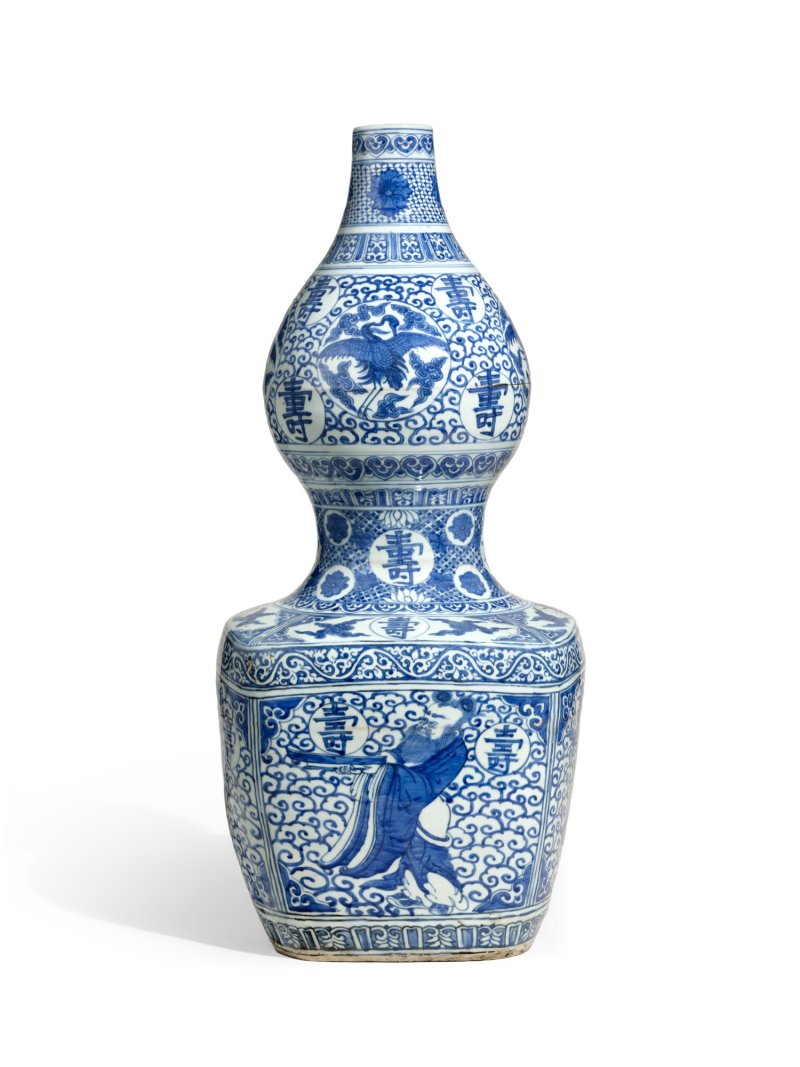

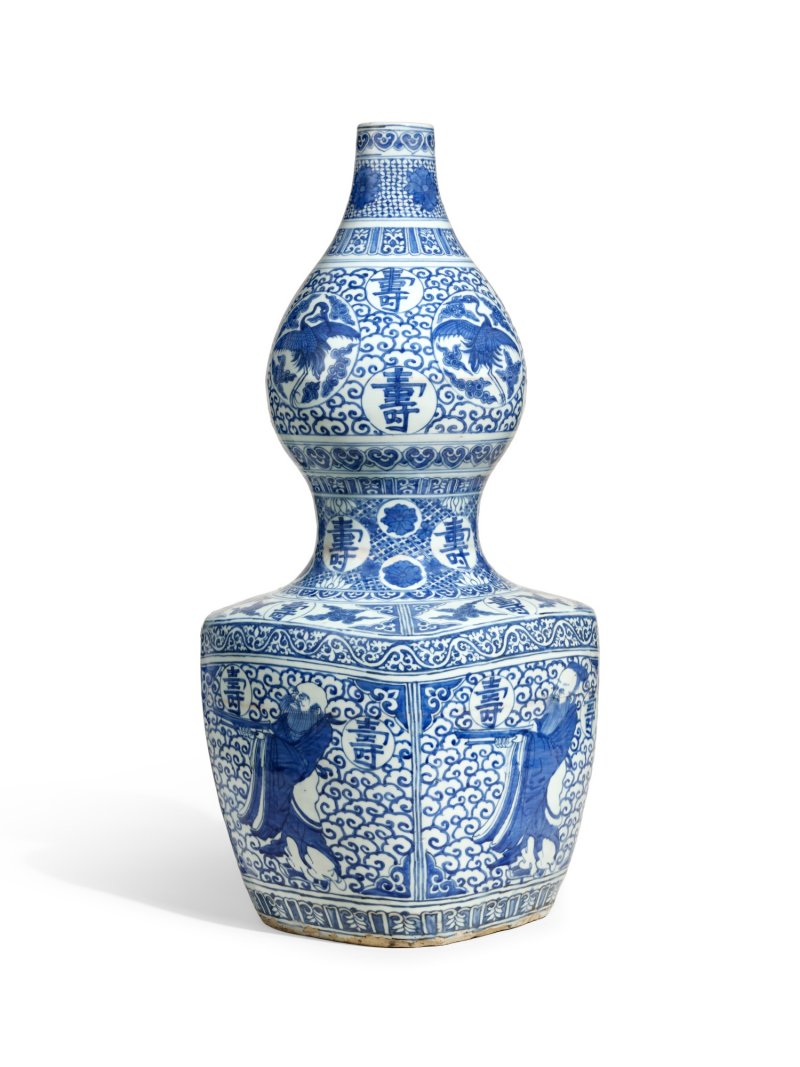
Lot 2170 A large blue and white 'longevity' double gourd vase, Ming dynasty, Jiajing–Wanli period | 明嘉靖至萬曆 青花壽翁雲鶴紋天圓地方葫蘆瓶
落槌价
****
成交价
****
拍品信息
拍品名称
A large blue and white 'longevity' double gourd vase, Ming dynasty, Jiajing–Wanli period | 明嘉靖至萬曆 青花壽翁雲鶴紋天圓地方葫蘆瓶
起拍价
HKD 200,000
估值区间
200,000 - 400,000 HKD
尺寸
未知
品相
Very good overall condition, with original firing imperfections typical of the period, including firing lines along the luting lines, some at the bulb, waist, shoulder of the square body, and near the base. Minor glaze pull (largest approx. 1.4 cm), and a small kiln bump (approx. 1 cm) above the foot scroll.
整體品相良好。見正常窰燒瑕疵,包括窰線,部分見於接胎處(如上腹腰、束腰處、下腹肩部,及近底處)。偶見小釉縮(最大約1.4公分),足部蓮瓣紋上見一小窰凸(約1公分)。
If a condition report is provided to assist you with assessing the condition of the lot, it is for guidance purposes only. Such condition report may not refer to all faults, restoration, alterations, or adaptations because Sotheby's is not a professional conservator or restorer but rather a condition report is a statement of subjective, qualified opinion genuinely held by Sotheby's. For these reasons, any such condition report is not an alternative to taking your own professional advice regarding the condition of the lot. Prospective buyers should also refer to the Guide for Buyers at Auction which includes important notices concerning the type of property in this sale.
整體品相良好。見正常窰燒瑕疵,包括窰線,部分見於接胎處(如上腹腰、束腰處、下腹肩部,及近底處)。偶見小釉縮(最大約1.4公分),足部蓮瓣紋上見一小窰凸(約1公分)。
If a condition report is provided to assist you with assessing the condition of the lot, it is for guidance purposes only. Such condition report may not refer to all faults, restoration, alterations, or adaptations because Sotheby's is not a professional conservator or restorer but rather a condition report is a statement of subjective, qualified opinion genuinely held by Sotheby's. For these reasons, any such condition report is not an alternative to taking your own professional advice regarding the condition of the lot. Prospective buyers should also refer to the Guide for Buyers at Auction which includes important notices concerning the type of property in this sale.
更多信息
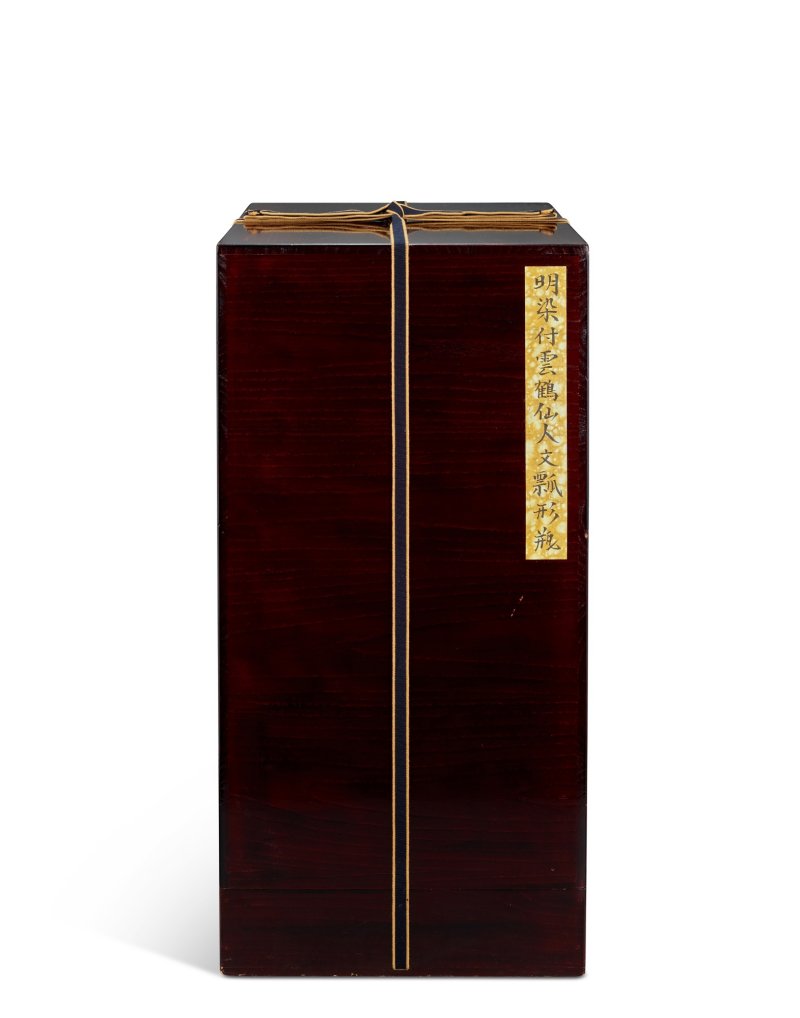
Japanese wood box
66 cm
来源:Kochukyo Co., Ltd, Tokyo.
图录
说明:來源
壺中居,東京
The gourd-shaped form and motifs, including immortals, cranes, and shou roundels, reflect the broader Daoist and longevity interests that shaped imperial porcelain production from the Jiajing into the Wanli period. Jingdezhen potters revived early fifteenth-century shapes like the double gourd, not merely as functional vessels, but as potent symbols of the cosmos and eternal fortune.
In Daoist tradition, the gourd (hulu 葫蘆) was viewed as a “miniature universe” or “heaven and earth in one flask,” its phonetic resonance with fulu 福祿 (“fortune and prosperity”) spurring its popularity during the Jiajing and Wanli reigns, when gourd vases flourished in diverse forms, from square, faceted, lobed, hexagonal, and round-over-square forms, such as the present vase, as imagined dwellings for immortals and elixirs of life. Jiangxi sheng dazhi [Great Gazetteer of Jiangxi Province] also notes that gourd-shaped porcelains were commissioned at Jingdezhen on a large scale.
See a similar example, attributed to the Wanli period and decorated with applique Shoulao figures on the upper bulb, sold at Christie’s London, 10th June 1991, lot 189, and again on 9th November 2010, lot 294. Other related large round-over-square gourd vases with Shoulao and longevity motifs include one attributed to the Jiajing period, published in Ming Blue and White: Jiajing-Chongzhen Including Dated Examples, S. Marchant & Son, London, 2004, cat. no. 8, and sold in our New York rooms, 21st September 2005, lot 71. A further example, attributed to the Ming dynasty, is now in the Taipei Palace Museum, acc. no. guci-6487. Another Wanli-period vase, with a neck that appears to have been reduced, is illustrated in Oriental Ceramics: The World’s Great Collections, vol. 3: Museum Pusat, Jakarta, Tokyo, 1982, no. 227.
66 cm
来源:Kochukyo Co., Ltd, Tokyo.
图录
说明:來源
壺中居,東京
The gourd-shaped form and motifs, including immortals, cranes, and shou roundels, reflect the broader Daoist and longevity interests that shaped imperial porcelain production from the Jiajing into the Wanli period. Jingdezhen potters revived early fifteenth-century shapes like the double gourd, not merely as functional vessels, but as potent symbols of the cosmos and eternal fortune.
In Daoist tradition, the gourd (hulu 葫蘆) was viewed as a “miniature universe” or “heaven and earth in one flask,” its phonetic resonance with fulu 福祿 (“fortune and prosperity”) spurring its popularity during the Jiajing and Wanli reigns, when gourd vases flourished in diverse forms, from square, faceted, lobed, hexagonal, and round-over-square forms, such as the present vase, as imagined dwellings for immortals and elixirs of life. Jiangxi sheng dazhi [Great Gazetteer of Jiangxi Province] also notes that gourd-shaped porcelains were commissioned at Jingdezhen on a large scale.
See a similar example, attributed to the Wanli period and decorated with applique Shoulao figures on the upper bulb, sold at Christie’s London, 10th June 1991, lot 189, and again on 9th November 2010, lot 294. Other related large round-over-square gourd vases with Shoulao and longevity motifs include one attributed to the Jiajing period, published in Ming Blue and White: Jiajing-Chongzhen Including Dated Examples, S. Marchant & Son, London, 2004, cat. no. 8, and sold in our New York rooms, 21st September 2005, lot 71. A further example, attributed to the Ming dynasty, is now in the Taipei Palace Museum, acc. no. guci-6487. Another Wanli-period vase, with a neck that appears to have been reduced, is illustrated in Oriental Ceramics: The World’s Great Collections, vol. 3: Museum Pusat, Jakarta, Tokyo, 1982, no. 227.
常见问题
拍品的品相状况如何?
Very good overall condition, with original firing imperfections typical of the period, including firing lines along the luting lines, some at the bulb, waist, shoulder of the square body, and near the base. Minor glaze pull (largest approx. 1.4 cm), and a small kiln bump (approx. 1 cm) above the foot scroll.
整體品相良好。見正常窰燒瑕疵,包括窰線,部分見於接胎處(如上腹腰、束腰處、下腹肩部,及近底處)。偶見小釉縮(最大約1.4公分),足部蓮瓣紋上見一小窰凸(約1公分)。
If a condition report is provided to assist you with assessing the condition of the lot, it is for guidance purposes only. Such condition report may not refer to all faults, restoration, alterations, or adaptations because Sotheby's is not a professional conservator or restorer but rather a condition report is a statement of subjective, qualified opinion genuinely held by Sotheby's. For these reasons, any such condition report is not an alternative to taking your own professional advice regarding the condition of the lot. Prospective buyers should also refer to the Guide for Buyers at Auction which includes important notices concerning the type of property in this sale.
整體品相良好。見正常窰燒瑕疵,包括窰線,部分見於接胎處(如上腹腰、束腰處、下腹肩部,及近底處)。偶見小釉縮(最大約1.4公分),足部蓮瓣紋上見一小窰凸(約1公分)。
If a condition report is provided to assist you with assessing the condition of the lot, it is for guidance purposes only. Such condition report may not refer to all faults, restoration, alterations, or adaptations because Sotheby's is not a professional conservator or restorer but rather a condition report is a statement of subjective, qualified opinion genuinely held by Sotheby's. For these reasons, any such condition report is not an alternative to taking your own professional advice regarding the condition of the lot. Prospective buyers should also refer to the Guide for Buyers at Auction which includes important notices concerning the type of property in this sale.
这件拍品的流传来源是什么?
Kochukyo Co., Ltd, Tokyo.
图录
图录