
拍品信息
拍品名称
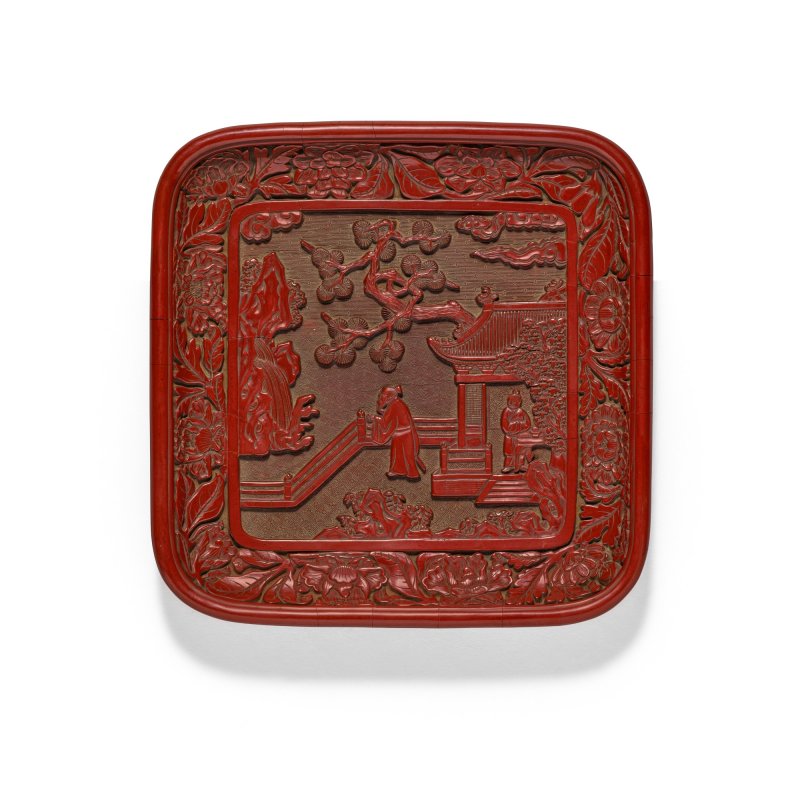
明十五世紀 剔紅松庭觀瀑圖委角方盤
起拍价
GBP 20,000
估值区间
20,000 - 40,000 GBP
尺寸
未知
品相
如欲了解本拍品狀況的更多資訊,請聯絡 chinese.london@sothebys.com
更多信息
Japanese wood box (3)
Length 17.8 cm, 7 in.
来源:英國私人收藏(傳)
图录
说明:Fashioned from numerous thin layers of cinnabar lacquer, this dish is notable for the crispness and depth of its carving. Scenes of scholars in idyllic landscape settings were generally inspired by woodblock printed books or contemporary paintings, and began to be reproduced in lacquer in the Yuan dynasty (1279-1368). Depictions of scholars gazing at waterfalls were a popular painting subject, and the composition on the present example bears resemblance to a hanging scroll by Zhong Li (active ca. 1480-1500), from the collection of P.Y. and Kinmay W. Tang, in the Metropolitan Museum of Art, New York, acc. no. 1991.438.4.
Compare a dish decorated with this motif, but the carving somewhat less refined, sold in these rooms, 19th December 1980, lot 252, and again at Christie’s London, 16th November 1998, lot 16; one with a scholar in a terrace, in the Palace Museum, Beijing, illustrated in 200 Objects You Should Know. Carved Laquer Ware, Beijing, 2008, pl. 58; another carved with a scholar in a pavilion, sold in our New York rooms, 19th March 2007, lot 413; and a larger example, sold in these rooms, 8th November 2006, lot 2.
For an earlier rendition of this design, see an octagonal dish attributed to the Yuan dynasty, in the Palace Museum, Beijing, illustrated in 200 Objects You Should Know, op. cit., pl. 1.
Indeed, lacquer dishes of the present square form with rounded corners, are more often found in the Yuan dynasty, usually carved with overall flower or flower-and-bird designs, see Sō Gen no bi. Denrai no shikki to chūshin ni/The Colors and Forms of Song and Yuan China. Featuring Lacquerwares, Ceramics, and Metalwares
, Nezu Institute of Fine Arts, Tokyo, 2004, no. 95; Jan Wirgin, ‘Some Chinese Carved Lacquer of the Yüan and Ming Periods’, Bulletin of the Museum of Far Eastern Antiquities, no. 44, Stockholm, 1972, pl. 1; or N.S. Brommelle and Perry Smith, eds, Urushi. Proceedings of the Urushi Study Group, June 10-27, 1985, Tokyo, Santa Monica, 1988, p. 101, figs 3-6.
常见问题
这件明十五世紀 剔紅松庭觀瀑圖委角方盤的成交价是多少?
落槌价为 预展中。 成交价为 预展中。
拍品的品相状况如何?
如欲了解本拍品狀況的更多資訊,請聯絡 chinese.london@sothebys.com
这件拍品的流传来源是什么?
英國私人收藏(傳)
图录
图录