
拍品信息
拍品名称
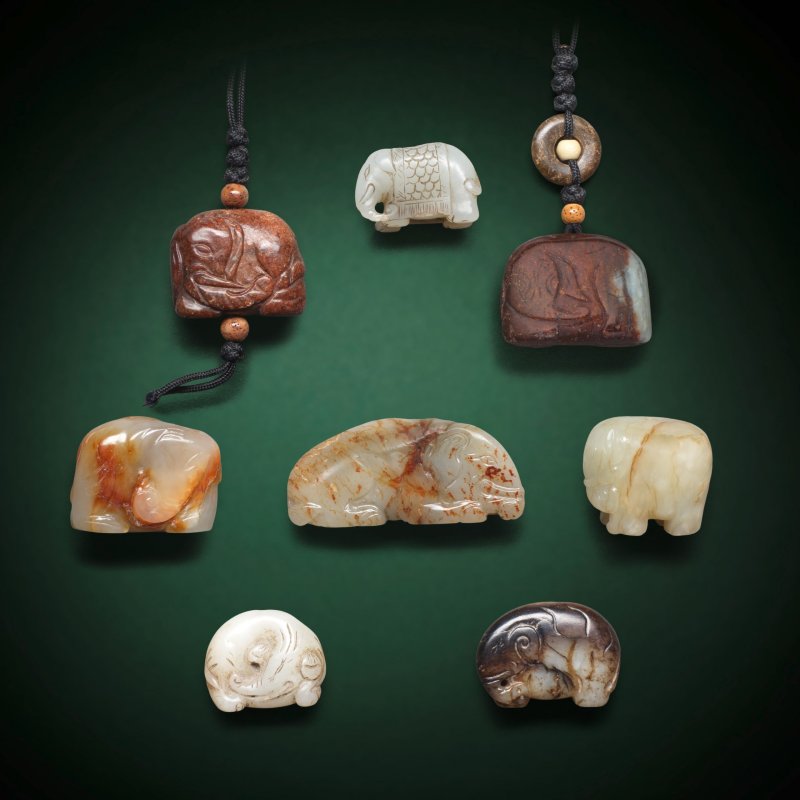
明及其后 玉象 一組八件 | EIGHT SMALL JADE 'ELEPHANT' CARVINGS
年代
Ming Dynasty and later
起拍价
GBP 3,000
估值区间
GBP 3000 - 5000
尺寸
未知
品相
未知
更多信息
Ming Dynasty and later
Comprising: the largest pebble carved as a recumbent elephant, the legs tucked neatly beneath the large body, the stone of greenish-grey tone with russet-red inclusions, 5.5cm (2 1/8in) wide; another pebble of pale green and russet tone carved with the head turned sharply to its right, with almond-shaped eyes, a taiji symbol on its back, 3.5cm (1 3/8in) wide; one rounded pebble of pale grey tone with brownish-black patches, carved with a rotund body and incised wrinkles, 3.5cm (1 3/8in) wide; one pendant smoothly carved as an elephant looking sharply to its left, the stone of reddish-brown tone with pale grey patch, 3.5cm (1 3/8in) wide; another pendant of terracotta tone similarly carved, 3.1cm (1 1/4in) wide; one pebble of pale green tone with russet striations, carved as a standing elephant with rounded body and head facing forward with lotus-leaf ears, 3cm (1 1/4in) wide; the flattened pebble carved as an elephant with scaly caparison with a taiji symbol on its back, the stone of pale green tone, 2.8cm (1 1/8in) wide; the final pebble of rounded form carved as an elephant with its head turned sharply to its right, the stone of pale grey tone, 2.7cm (1 1/8in) wide. (8).
Footnotes
明及其后 玉象 一組八件
The elephant (xiang 象) occupies an important place in Chinese auspicious imagery, symbolising peace, strength, and benevolent rule. Owing to its associations in visual rebuses, elephant-shaped jade pendants were prized as auspicious ornaments expressing wishes for harmony, prosperity, and enduring good fortune.
Compare with a cream and brown jade 'elephant' pendant, 17th century, which was sold at Bonhams Knightsbridge, 14 May 2018, lot 425. See also a yellow and russet jade 'elephant' pendant, 17th century, which was sold at Sotheby's Hong Kong, 26 May 2014, lot 844. Compare also with a celadon jade 'elephant' pendant, Ming dynasty, which was sold at Sotheby's Hong Kong, 31 May 2023, lot 3033.
Comprising: the largest pebble carved as a recumbent elephant, the legs tucked neatly beneath the large body, the stone of greenish-grey tone with russet-red inclusions, 5.5cm (2 1/8in) wide; another pebble of pale green and russet tone carved with the head turned sharply to its right, with almond-shaped eyes, a taiji symbol on its back, 3.5cm (1 3/8in) wide; one rounded pebble of pale grey tone with brownish-black patches, carved with a rotund body and incised wrinkles, 3.5cm (1 3/8in) wide; one pendant smoothly carved as an elephant looking sharply to its left, the stone of reddish-brown tone with pale grey patch, 3.5cm (1 3/8in) wide; another pendant of terracotta tone similarly carved, 3.1cm (1 1/4in) wide; one pebble of pale green tone with russet striations, carved as a standing elephant with rounded body and head facing forward with lotus-leaf ears, 3cm (1 1/4in) wide; the flattened pebble carved as an elephant with scaly caparison with a taiji symbol on its back, the stone of pale green tone, 2.8cm (1 1/8in) wide; the final pebble of rounded form carved as an elephant with its head turned sharply to its right, the stone of pale grey tone, 2.7cm (1 1/8in) wide. (8).
Footnotes
明及其后 玉象 一組八件
The elephant (xiang 象) occupies an important place in Chinese auspicious imagery, symbolising peace, strength, and benevolent rule. Owing to its associations in visual rebuses, elephant-shaped jade pendants were prized as auspicious ornaments expressing wishes for harmony, prosperity, and enduring good fortune.
Compare with a cream and brown jade 'elephant' pendant, 17th century, which was sold at Bonhams Knightsbridge, 14 May 2018, lot 425. See also a yellow and russet jade 'elephant' pendant, 17th century, which was sold at Sotheby's Hong Kong, 26 May 2014, lot 844. Compare also with a celadon jade 'elephant' pendant, Ming dynasty, which was sold at Sotheby's Hong Kong, 31 May 2023, lot 3033.
常见问题
这件明及其后 玉象 一組八件 | EIGHT SMALL JADE 'ELEPHANT' CARVINGS的成交价是多少?
落槌价为 预展中。 成交价为 预展中。


