
拍品信息
拍品名称
十七/十八世紀 灰玉雕高士圖山子 | A MASSIVE GREYISH-GREEN AND RUSSET JADE 'SCHOLAR PRACTISING CALLIGRAPHY ON A LEAF' BOULDER
年代
17th/18th century
起拍价
GBP 10,000
估值区间
GBP 10000 - 20000
尺寸
未知
品相
未知
更多信息
17th/18th century
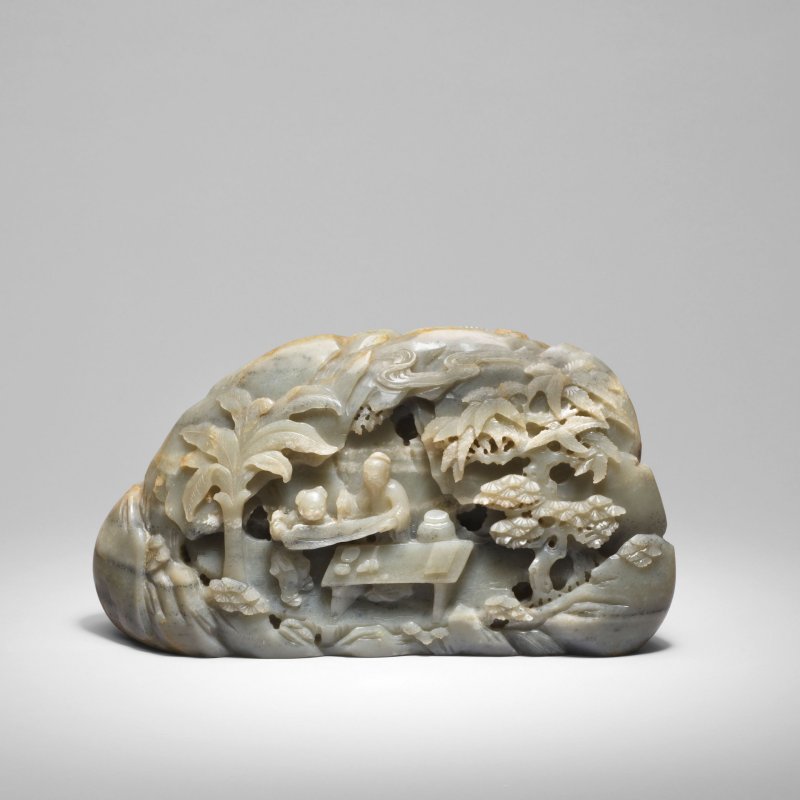
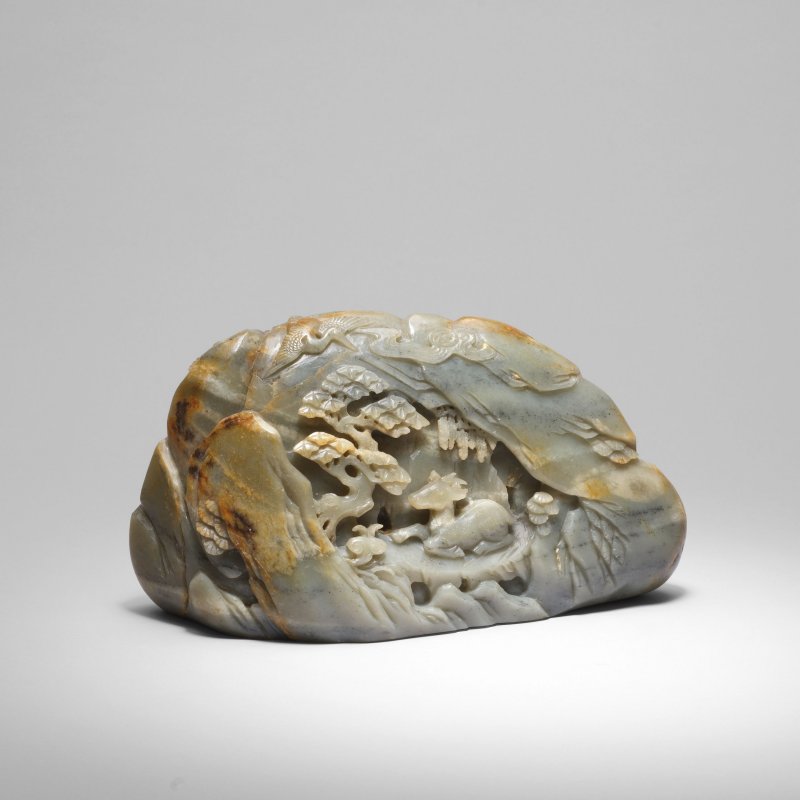
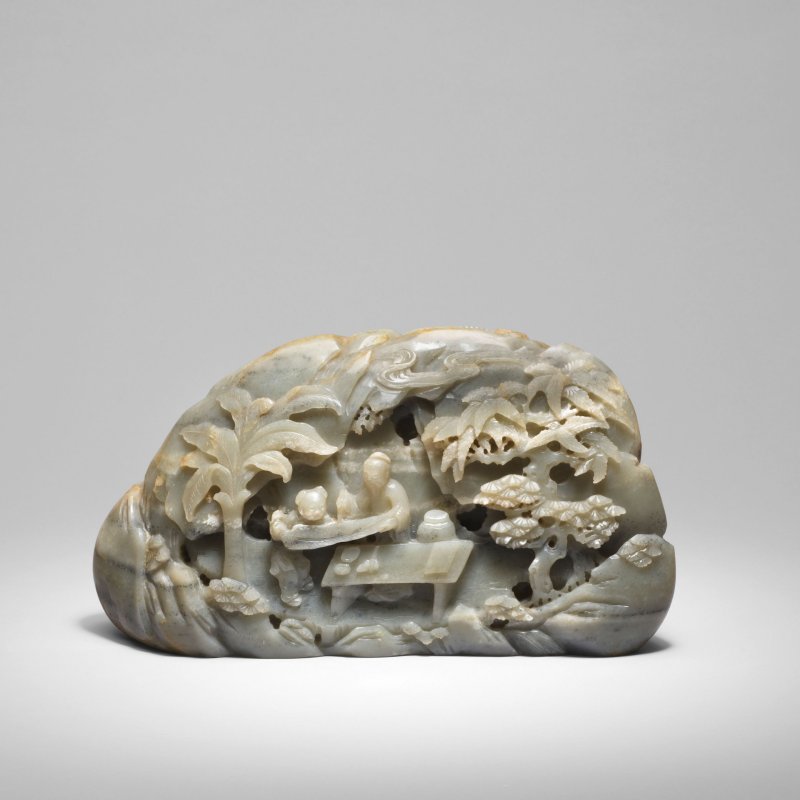
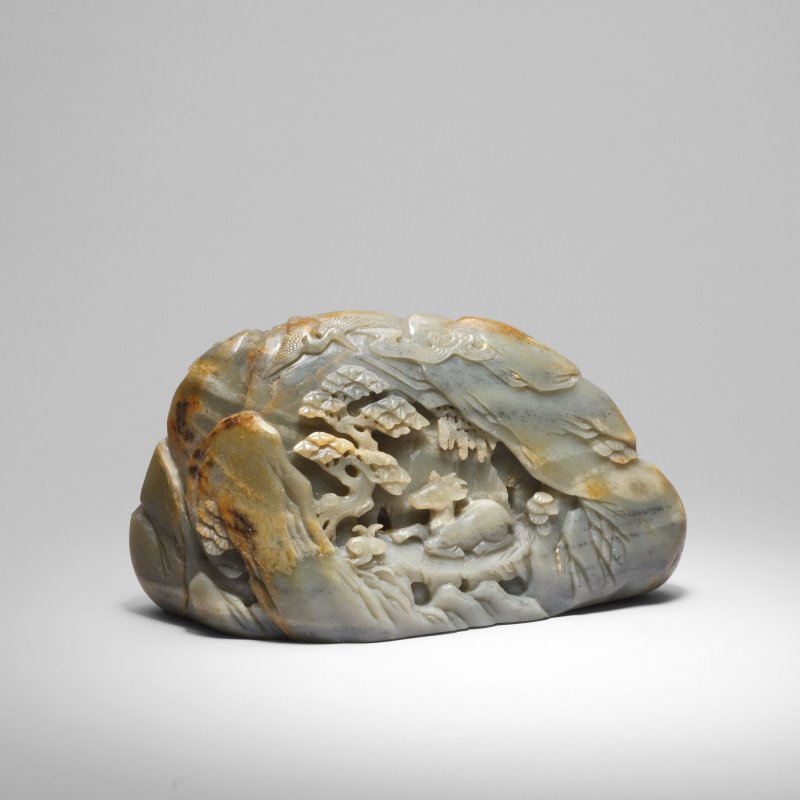
The large boulder deftly carved in high relief on one side with a scholar standing before his desk with book, inkstone and brushes, writing on a large plantain leaf held out by a boy-attendant, all within a rocky grove with plantain, and other trees, the reverse with a deer resting beside a tree and lingzhi fungus, a crane flying above through wispy clouds, the stone of greyish-green tone with russet patches, hongmu stand. 32.5cm (12 3/4in) wide. (2).
Footnotes
十七/十八世紀 灰玉雕高士圖山子
Provenance: William Clayton Ltd., London
R.G. Hewins, Northamptonshire
來源:倫敦古董商William Clayton Ltd.
R.G. Hewins,英國北安普敦郡
The present powerful carving depicts a scholar standing beside a large plantain leaf, upon which he practises calligraphy. Such imagery belongs to the rich visual language of the Chinese literati tradition, where the cultivation of brushwork was regarded not merely as an artistic exercise, but as a form of moral and spiritual self-cultivation. The scene may also allude to the celebrated Tang dynasty monk-calligrapher Huaisu (737–799), who, according to tradition, planted banana trees around his temple and used their leaves as a writing surface when he could not afford sufficient paper for practice.
Plantain leaves ( 芭蕉) held layered associations in Chinese painting, poetry and Buddhist thought. Their broad surfaces resemble sheets of paper, and historical sources suggest that impoverished scholars occasionally used the leaves as temporary writing surfaces when paper was scarce. As a result, the motif came to symbolise scholarly diligence, humility, and perseverance in study. Even the Qianlong Emperor, who certainly did not lack access to fine paper, when a prince, had himself depicted as a scholar practicing calligraphy on a plantain leaf to show his humble diligence; see , c.1730, in the Palace Museum, Beijing, illustrated by E.Rawski and J.Rawson, , London, 2005, p.277, no.187.
Beyond this practical association, the plantain possessed profound poetic and philosophical resonance. In Chinese literature, the sound of rain falling upon banana leaves became a celebrated image of solitude, introspection and the passing of time. The leaves themselves, which unfurl gradually before tearing easily in wind and rain, suggested both the unfolding of wisdom and the fragility of worldly ambition.
The motif also carried Buddhist connotations. In Buddhist texts, the banana plant was frequently employed as a metaphor for impermanence and emptiness, since its trunk possesses no solid core but consists only of layered sheaths. Within this context, the image of a scholar writing upon a plantain leaf may be understood as a meditation upon the transient nature of fame, examination success and human endeavour itself.
The reverse is carved with a deer gazing upward at a flying crane, a rebus associated with longevity, high rank and harmonious retirement from official life. The pairing recalls decorative motifs seen on Kangxi period blue and white porcelain. The close stylistic and iconographic parallels with these late 17th and early 18th century decorative arts provide a persuasive point of comparison for dating the present carving. See for example, a blue and white crane, pine and deer, phoenix-tail vase, Kangxi, illustrated in , Beijing, 2005, pp.476-477, no.307.
Compare with a related large pale greyish-green and russet jade mountain, 17th/18th century, with scholars, which was sold at Christie's New York, 14 September 2012, lot 1019.
The large boulder deftly carved in high relief on one side with a scholar standing before his desk with book, inkstone and brushes, writing on a large plantain leaf held out by a boy-attendant, all within a rocky grove with plantain, and other trees, the reverse with a deer resting beside a tree and lingzhi fungus, a crane flying above through wispy clouds, the stone of greyish-green tone with russet patches, hongmu stand. 32.5cm (12 3/4in) wide. (2).
Footnotes
十七/十八世紀 灰玉雕高士圖山子
Provenance: William Clayton Ltd., London
R.G. Hewins, Northamptonshire
來源:倫敦古董商William Clayton Ltd.
R.G. Hewins,英國北安普敦郡
The present powerful carving depicts a scholar standing beside a large plantain leaf, upon which he practises calligraphy. Such imagery belongs to the rich visual language of the Chinese literati tradition, where the cultivation of brushwork was regarded not merely as an artistic exercise, but as a form of moral and spiritual self-cultivation. The scene may also allude to the celebrated Tang dynasty monk-calligrapher Huaisu (737–799), who, according to tradition, planted banana trees around his temple and used their leaves as a writing surface when he could not afford sufficient paper for practice.
Plantain leaves ( 芭蕉) held layered associations in Chinese painting, poetry and Buddhist thought. Their broad surfaces resemble sheets of paper, and historical sources suggest that impoverished scholars occasionally used the leaves as temporary writing surfaces when paper was scarce. As a result, the motif came to symbolise scholarly diligence, humility, and perseverance in study. Even the Qianlong Emperor, who certainly did not lack access to fine paper, when a prince, had himself depicted as a scholar practicing calligraphy on a plantain leaf to show his humble diligence; see , c.1730, in the Palace Museum, Beijing, illustrated by E.Rawski and J.Rawson, , London, 2005, p.277, no.187.
Beyond this practical association, the plantain possessed profound poetic and philosophical resonance. In Chinese literature, the sound of rain falling upon banana leaves became a celebrated image of solitude, introspection and the passing of time. The leaves themselves, which unfurl gradually before tearing easily in wind and rain, suggested both the unfolding of wisdom and the fragility of worldly ambition.
The motif also carried Buddhist connotations. In Buddhist texts, the banana plant was frequently employed as a metaphor for impermanence and emptiness, since its trunk possesses no solid core but consists only of layered sheaths. Within this context, the image of a scholar writing upon a plantain leaf may be understood as a meditation upon the transient nature of fame, examination success and human endeavour itself.
The reverse is carved with a deer gazing upward at a flying crane, a rebus associated with longevity, high rank and harmonious retirement from official life. The pairing recalls decorative motifs seen on Kangxi period blue and white porcelain. The close stylistic and iconographic parallels with these late 17th and early 18th century decorative arts provide a persuasive point of comparison for dating the present carving. See for example, a blue and white crane, pine and deer, phoenix-tail vase, Kangxi, illustrated in , Beijing, 2005, pp.476-477, no.307.
Compare with a related large pale greyish-green and russet jade mountain, 17th/18th century, with scholars, which was sold at Christie's New York, 14 September 2012, lot 1019.
常见问题
这件十七/十八世紀 灰玉雕高士圖山子 | A MASSIVE GREYISH-GREEN AND RUSSET JADE 'SCHOLAR PRACTISING CALLIGRAPHY ON A LEAF' BOULDER的成交价是多少?
落槌价为 预展中。 成交价为 预展中。


