
拍品信息
拍品名称
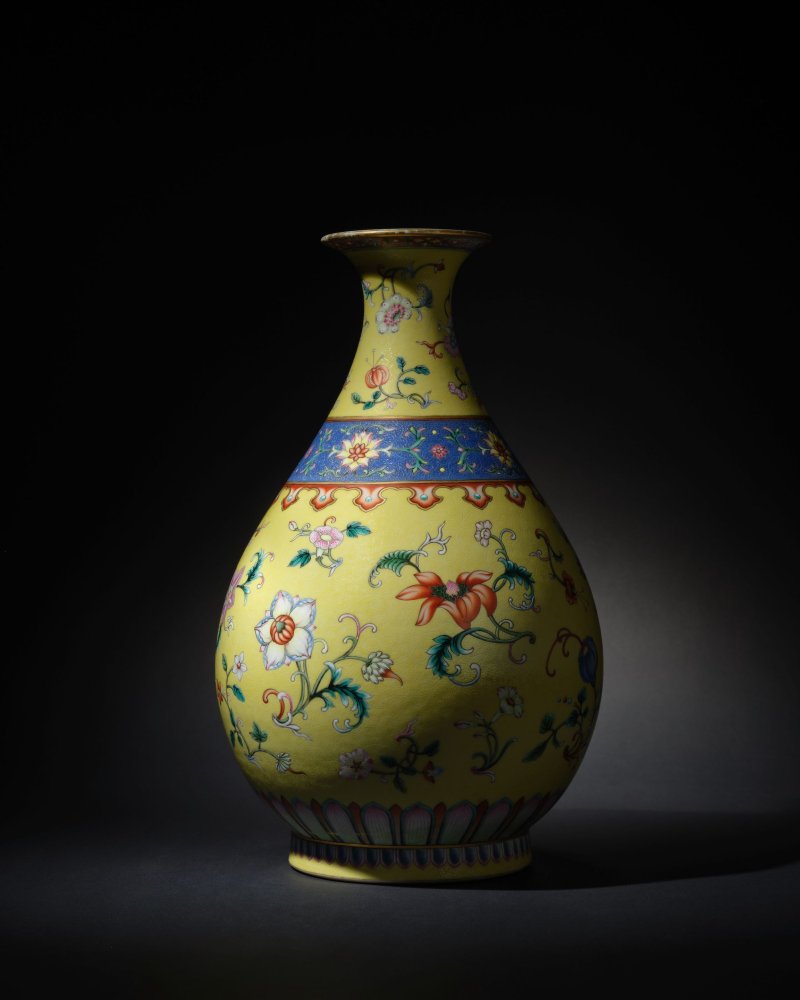
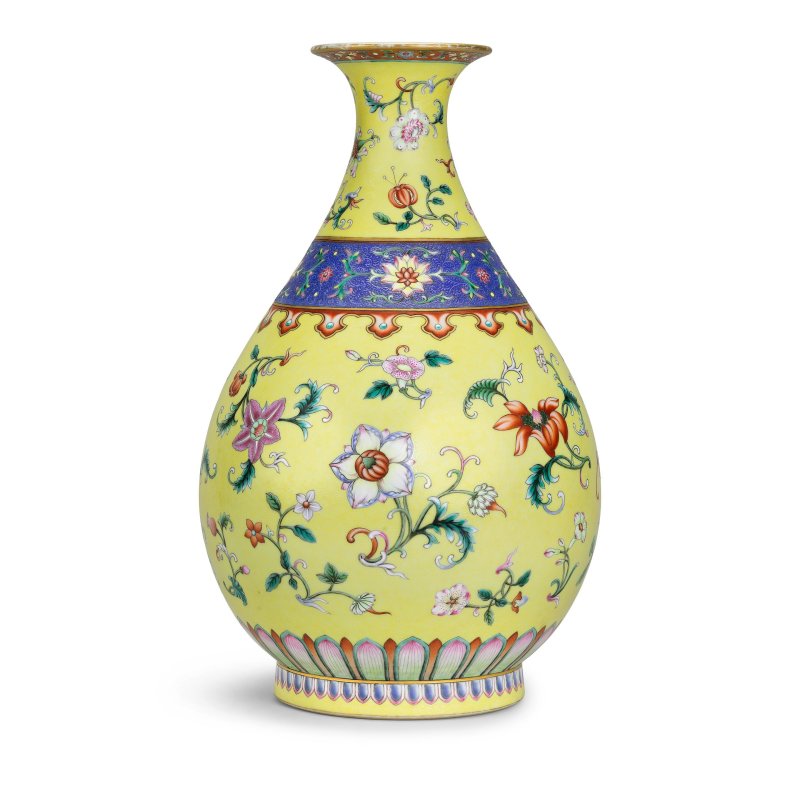
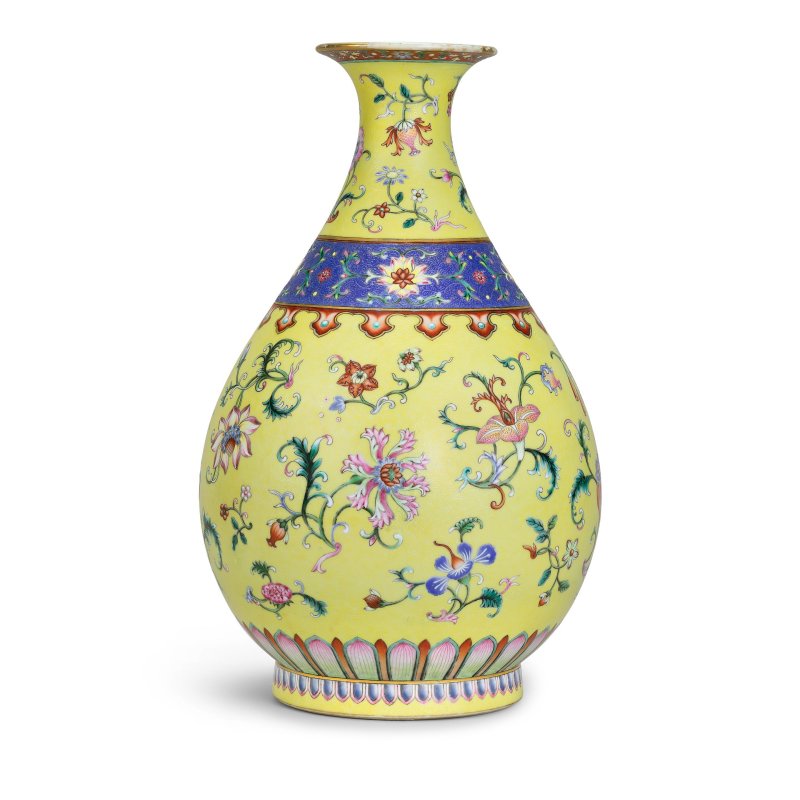
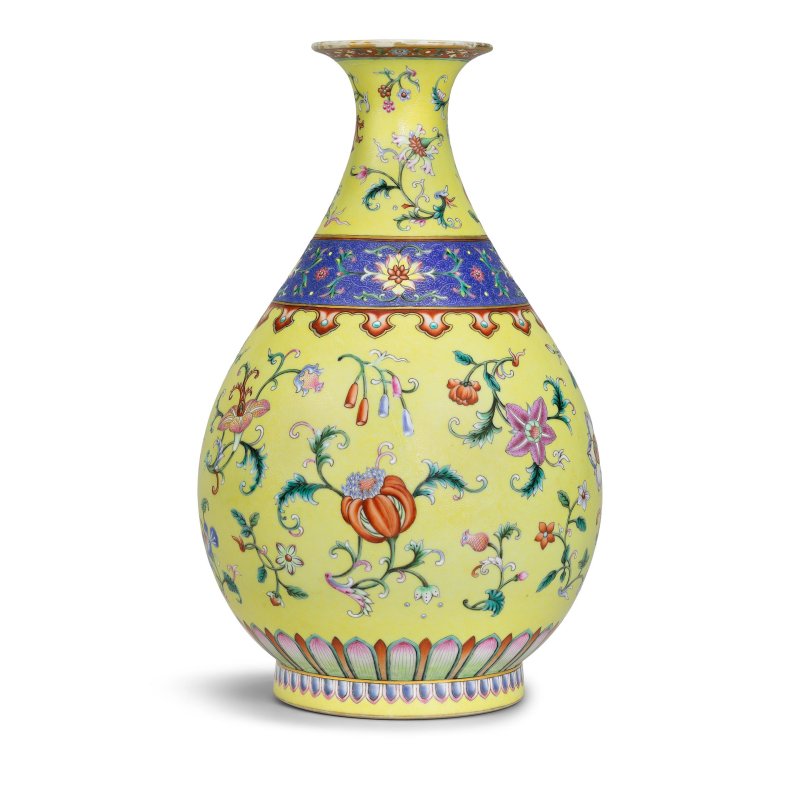
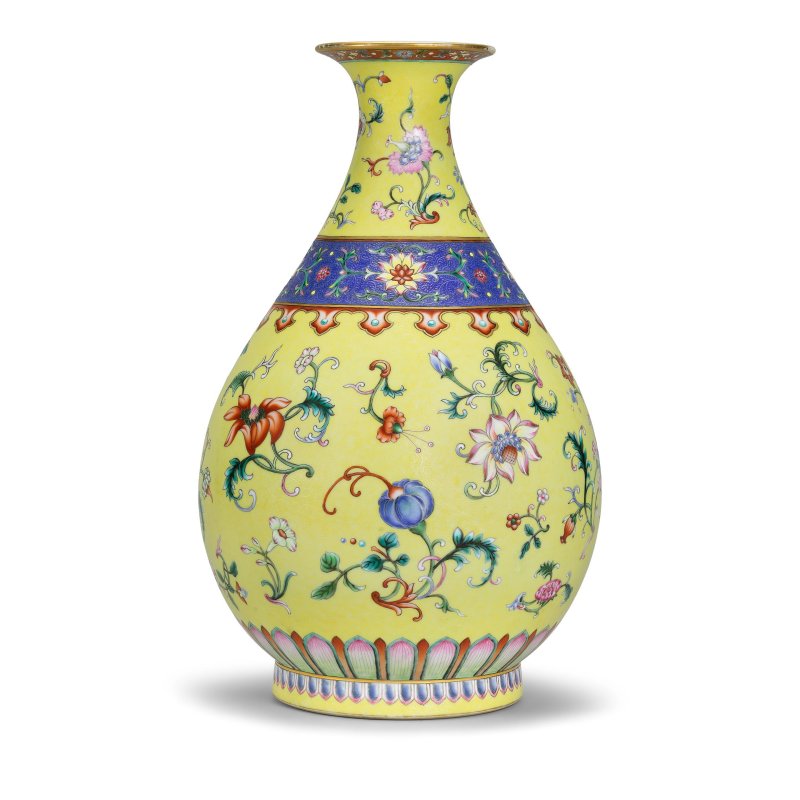
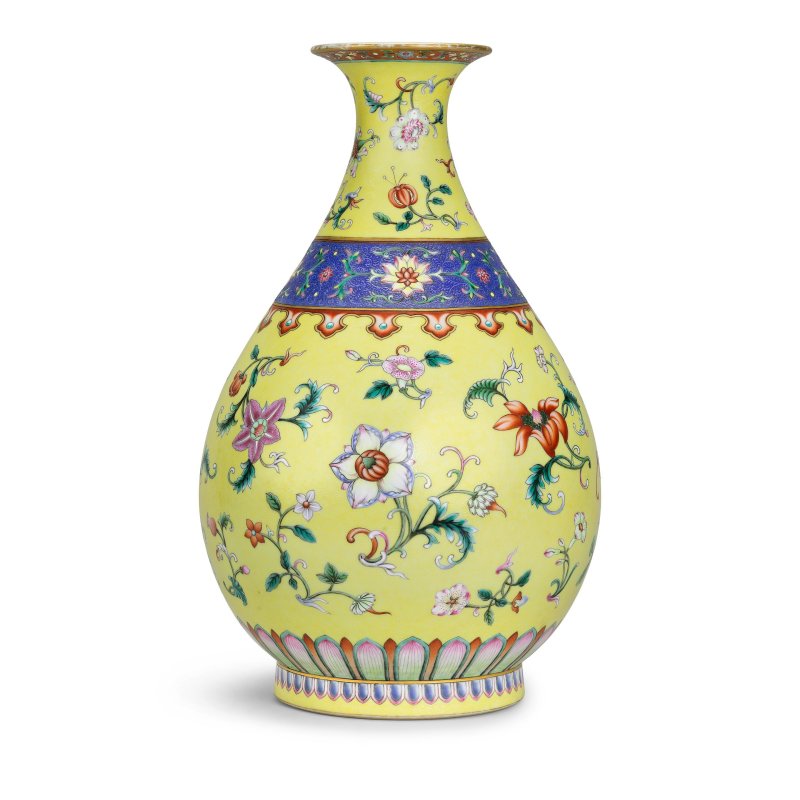
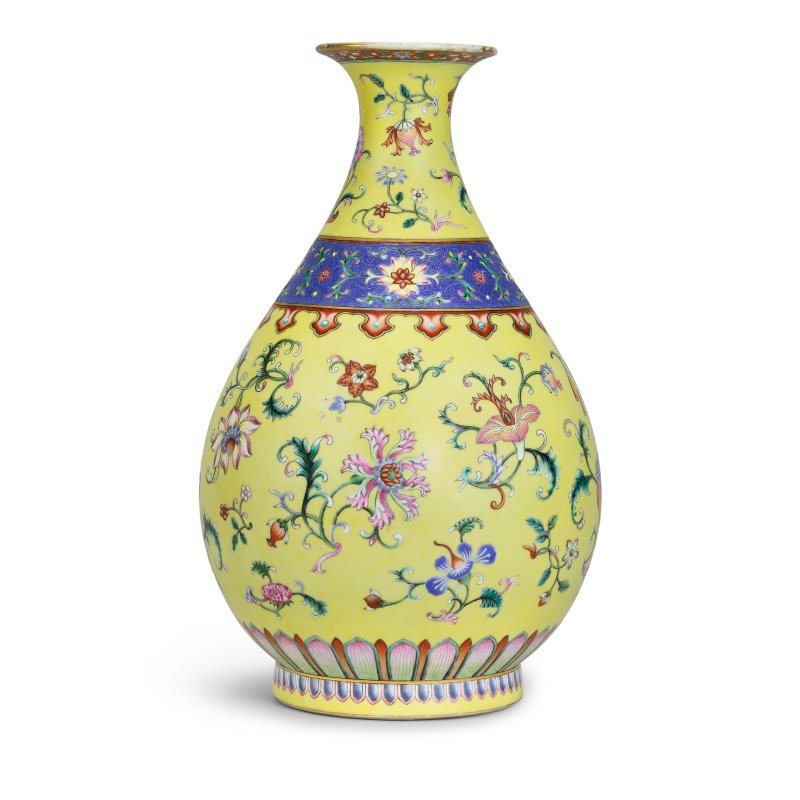
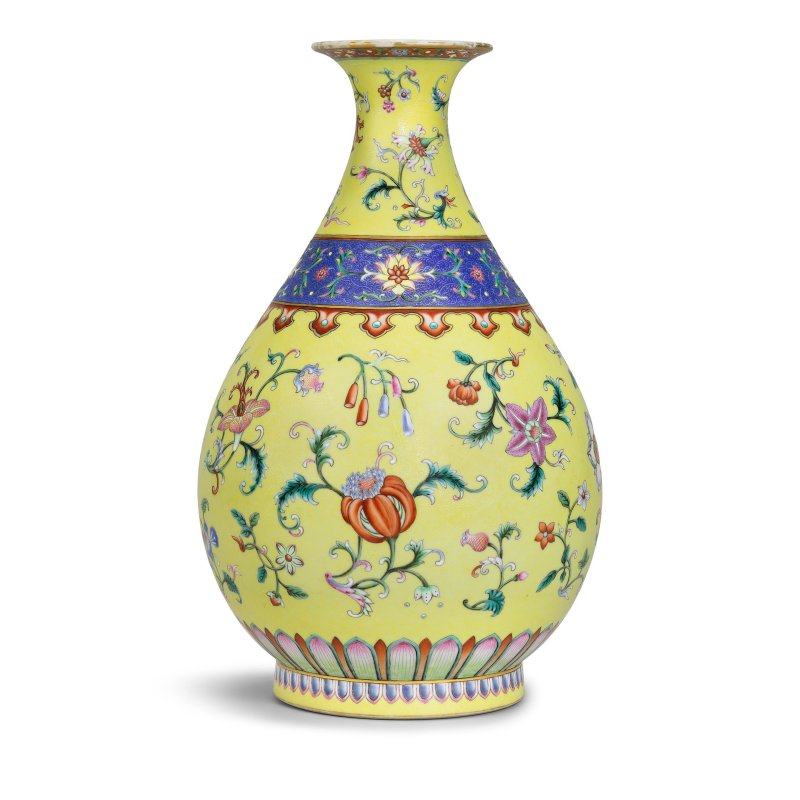
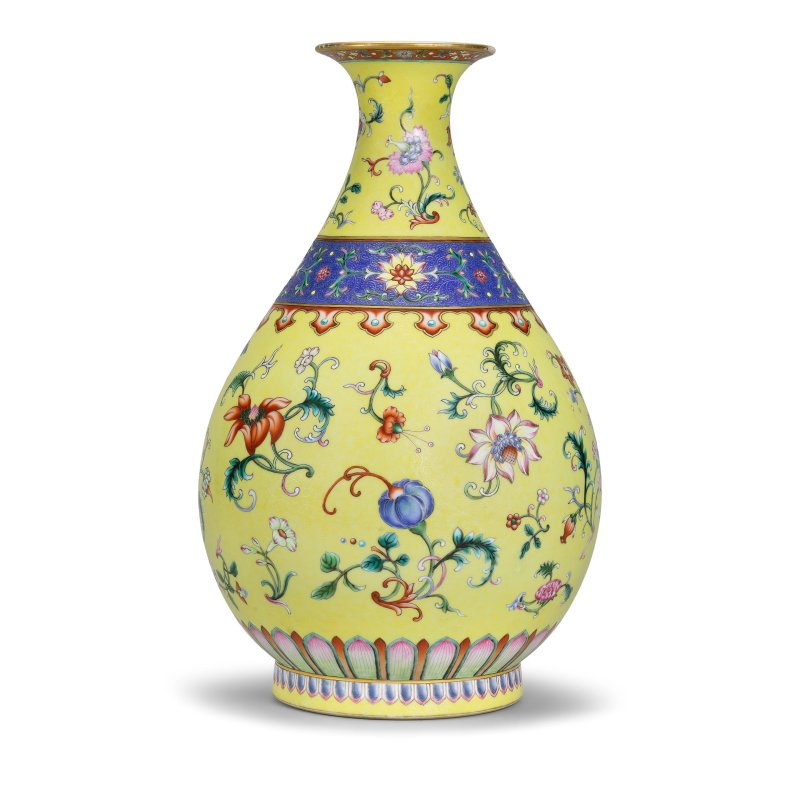
清乾隆 御製黃地洋彩軋道錦地折枝洋花玉壺春瓶 | A MAGNIFICENT AND FINELY ENAMELLED IMPERIAL YELLOW-GROUND SGRAFFIATO YANGCAI 'FLORAL' VASE, YUHUCHUNPING
年代
Qianlong four-character mark and of the period
起拍价
HKD 4,000,000
估值区间
HKD 4000000 - 6000000
尺寸
未知
品相
未知
更多信息
Qianlong four-character mark and of the period
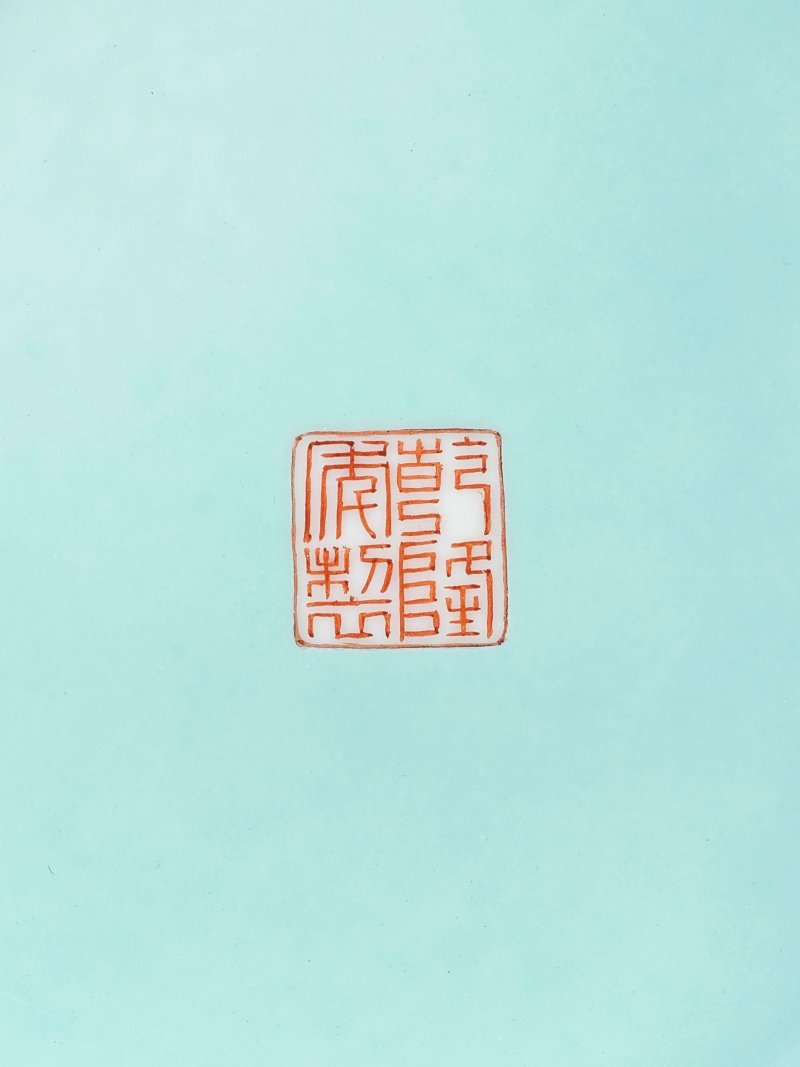
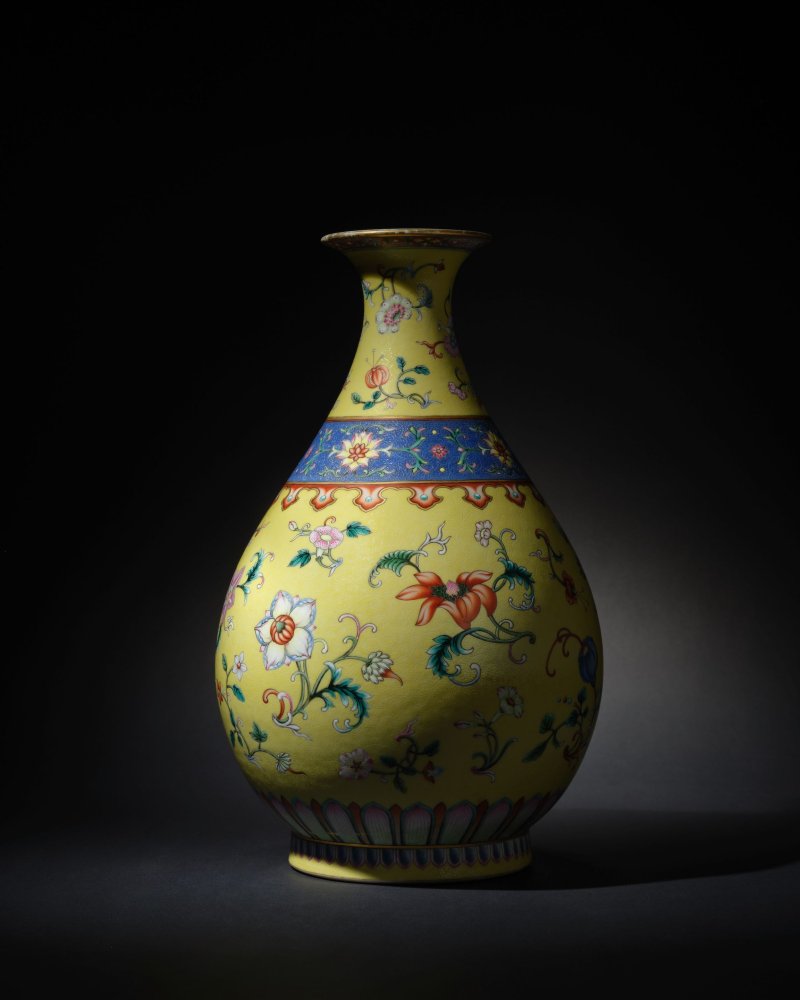
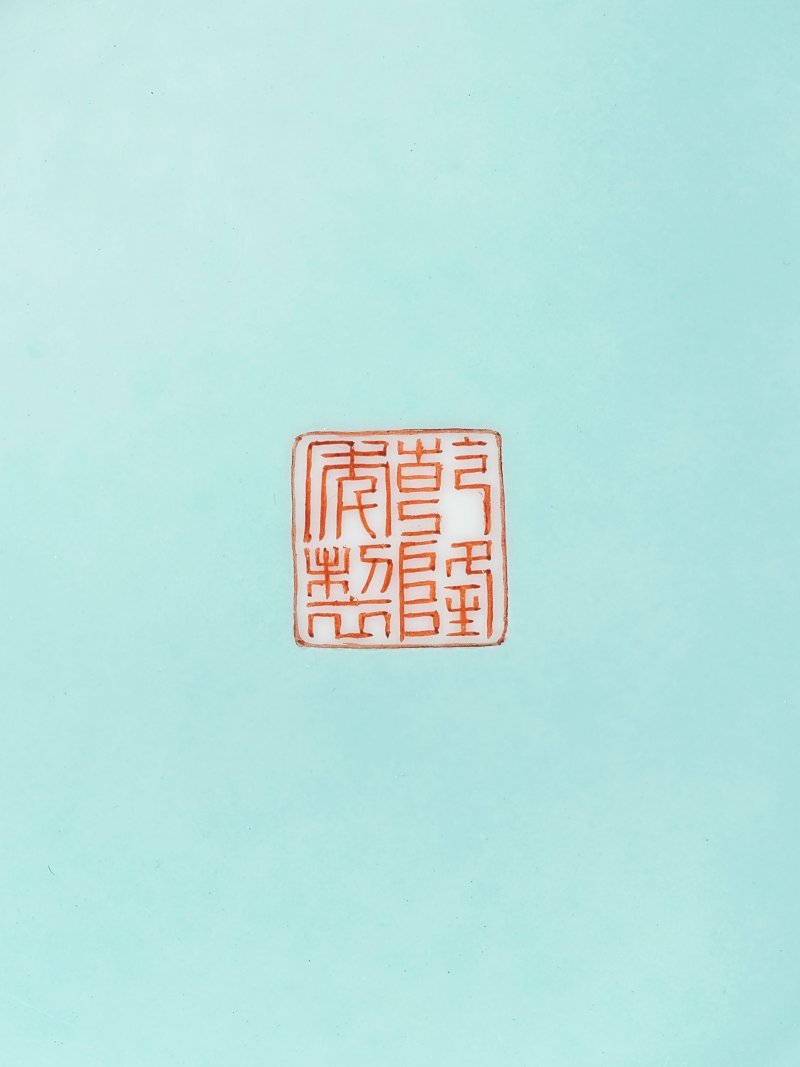
Elegantly potted with a full pear-shaped body tapering to a flared neck and gilded rim, supported on a short footrim, the exterior masterfully decorated against a vibrant yellow enamel ground accentuated by engraved sgraffiato design, with opulent floral sprays, featuring various luxuriant blossoms including stylised lotus, anemone, lily, passiflora, pomegranate, honeysuckle, iris, narcissus, rose, aster, peach blossom and morning glory, the shoulder encircled by a vivid blue-ground band with lotus blossoms borne on meandering stems, flanked by ruyi-head and gilt borders, the lower body framed by a band of upright overlapping pink and green lotus petals above a small band of stylised lotus petals picked out in blue and outlined in pink, the interiors and base with a pale turquoise glaze, the base with a four-character seal mark within a square cartouche reserved in white.
30.4cm (12in) high.
Footnotes
清乾隆 御製黃地洋彩軋道錦地折枝洋花玉壺春瓶
礬紅「乾隆年製」篆書款
Provenance:
James Adams Ballard (1855-1908), acquired in China in the late 19th century
Alfred Hunter Ballard D.S.C., R.N.R. (1896-1950), and thence by descent within the family
Christie's London, 10 November 2015, lot 305
James Adams Ballard(1855至1908年) 收藏,於十九世紀末得自中國
Alfred Hunter Ballard D.S.C., R.N.R.(1896至1950年) 收藏,此後家族傳承
倫敦佳士得,2015年11月10日,拍品編號305
James Adams Ballard (1855-1908) was a prominent British resident of late nineteenth-century Shanghai and an early Western collector of Chinese art. Born in Sandhurst, Kent, Ballard relocated to Shanghai, where he joined Russell & Company, the leading American trading house in Qing-dynasty China. Following the liquidation of the firm in 1891, he transitioned into the insurance industry, establishing the partnership Messrs. Ballard & Hunter alongside Alfred Carroll Hunter. During his years in Shanghai, Ballard took an active role in civic and commercial life, serving on the directorate of the Shanghai Mercury and Evening Post and co-founding the Shanghai Free Christian Church. He remained a respected member of the community until his death in 1908 at fifty-three.
The collection was inherited by his second son, Lieutenant Commander Alfred Hunter Ballard, D.S.C., R.N.R. (1896–1950). Born in Shanghai, he was named in honour of his father's close business associate, Alfred Carroll Hunter. The younger Ballard served in the British Armed Forces through both World Wars. During the Second World War, as a Temporary Lieutenant in the Royal Naval Reserve, he was awarded the Distinguished Service Cross (D.S.C.) and Bar for exceptional gallantry, skill, and devotion to duty.
According to the , on the 8th day of the 2nd month of the 16th year of the Qianlong reign, corresponding to 1751, a selection of porcelain vessels was dispatched directly from the Jingdezhen Imperial kilns. Amongst the enumerated items, the register explicitly records the delivery of a pair of . Imperial decrees from this period dictate that such premier creations were subjected to the Qianlong Emperor's personal inspection before being designated for specific palace halls, most notably the Qianqinggong, where they were meticulously inventoried in Court ledgers.
The exceptional similarity of the present bottle vase to the specific parameters set forth in the 1751 archival record underscores its extraordinary historic importance. It is compelling to note that a closely related yellow-ground was sold at Sotheby's Hong Kong, 8 October 2014, lot 3639. Given the virtually identical execution, palette, and proportions shared between these two masterpieces, it is highly probable that the 2014 example and the present vessel constitute the original pair presented to the Qianlong Emperor in 1751.
This extraordinary vase represents the pinnacle of technical innovation and artistic mastery achieved at the Imperial kilns in Jingdezhen under the guidance of the legendary supervisor Tang Ying (1682–1756). Highly prized by the Qianlong Emperor, porcelains were housed within his private quarters in the ('Palace of Heavenly Purity') and the European-style palaces of the . The decoration showcases the celebrated ('adding flowers to brocade') technique, where intricate scrollwork is incised into the delicate yellow enamel before being painted with vibrant floral motifs. The idiom derives from a poem by Northern Song literatus Huang Tingjian (1045–1105), ('An Ode to the Liaoliao Buddhist Monastery'), carrying the auspicious meaning of 'making what is good even better'. While the classical profile — modified here with a broader foot and slightly rounder belly — and literary motifs embody traditional Chinese taste, the painterly palette, light-and-shadow shading, and gilt borders reflect profound Western artistic influences mediated through Jesuit artists and Beijing Court enamels.
Compare a pair of ruby-ground vases, Qianlong seal marks and of the period, decorated to the body with similar floral sprigs to the present vase, from the Qing Court Collection and in the Palace Museum, Taipei, exhibited in , Taipei, 2008, cat.no.43.
詹姆斯.亞當斯.巴拉德(James Adams Ballard,1855–1908年) 為十九世紀末居於上海之著名英籍旅滬人士及早期西方中國藝術收藏家。巴拉德氏出生於英國肯特郡桑德赫斯特,後赴上海發展,任職於晚清時期聲名最顯赫之美資洋行——旗昌洋行(Russell & Company)。1891年旗昌洋行停業後,彼轉投保險業,並與阿爾弗雷德.卡羅爾.亨特(Alfred Carroll Hunter)合夥創立 Ballard & Hunter 保險行。居滬期間,巴拉德氏活躍於商界與社會事務,曾任《大美晚報》(Shanghai Mercury and Evening Post)董事,並為上海新恩堂(Shanghai Free Christian Church)創始人之一,於1908年逝世(享年五十三歲)前始終為上海外僑社群之領袖人物。
本品後由其次子阿爾弗雷德.亨特.巴拉德皇家海軍後備隊少校,獲頒傑出服務十字勳章加勳扣(Lt. Cdr. Alfred Hunter Ballard, D.S.C. and Bar, R.N.R.,1896–1950年) 繼承。阿爾弗雷德出生於上海,其名即取自其父之摯友兼商業夥伴亨特氏。彼後來成為英軍勳績卓著之軍官,先後服役於第一次及第二次世界大戰。於二戰期間擔任皇家海軍後備隊中尉,因作戰英勇卓越,兩度榮獲傑出服務十字勳章(D.S.C. and Bar)。此批珍藏於家族內部世代相傳逾一世紀,傳承脈絡清晰遞嬗,為典型源自十九世紀末且首次重現於市場之英國家族私人珍藏。
本品御製黃地洋彩軋道錦地折枝洋花玉壺春瓶,堪稱乾隆朝景德鎮御窯督陶官唐英(1682–1756年)督造下,結合極致工藝與創新美學之巔峰巨作。洋彩瓷器深得乾隆皇帝珍視,多數特為乾清宮及圓明園歐式宮殿等御前私密空間所設。器身裝飾採用聲名遠播之「錦上添花」(又稱軋道洋彩)技法,即先於柔和之檸檬黃釉地上剔刻細密綿長之鳳尾卷草錦地,再以洋彩精繪流暢纏枝花卉。此一語彙源自北宋著名文學家黃庭堅(1045–1105年)《潦潦庵頌》詩句,蘊含「錦上添花、福壽雙全」之吉慶寓意。本品雖承襲宋代經典玉壺春瓶之造型(唯比例上略將圈足加寬、腹部微抱以求創新),但其洋彩設色、葉瓣之西洋明暗渲染立體繪法,以及口足之描金工藝,均深刻映照出當時宮廷西洋傳教士畫家與北京畫琺瑯作坊對清宮御瓷美學之深遠影響。
據《清宮瓷器檔案》記載,乾隆十六年(1751年)二月初八日,一批由景德鎮御窯督造完成並押運進京之御瓷精品裏明確記載包含「洋彩錦上花玉壺春瓶一對」。依乾隆朝宮廷典制,此類極品洋彩御瓷在進呈後,必先經乾隆皇帝親自裁定鑑賞,隨後方奉旨分發至乾隆帝極為重視之宮殿(如乾清宮等處)陳設。
本品之造型、釉色與裝飾工藝,均與乾隆十六年清檔之記載吻合,極具權威之考據價值。值得注意的是,香港蘇富比曾於2014年10月8日售出一件極為相似之乾隆黃地洋彩錦上添花玉壺春瓶(拍品編號 3639)。兩者於造型比例、紋飾構圖、軋道工藝及洋彩設色上均如出一轍,極可能即為乾隆十六年清檔記載中同時進呈宮廷之對瓶,歷史意義殊為重大。
可比較一對清宮舊藏乾隆洋彩紅地錦上添花膽瓶,器身裝飾與本品相似之花卉紋樣,現藏台北故宮博物院,展於《華麗彩瓷:乾隆洋彩》,台北,2008年,圖版43。
Elegantly potted with a full pear-shaped body tapering to a flared neck and gilded rim, supported on a short footrim, the exterior masterfully decorated against a vibrant yellow enamel ground accentuated by engraved sgraffiato design, with opulent floral sprays, featuring various luxuriant blossoms including stylised lotus, anemone, lily, passiflora, pomegranate, honeysuckle, iris, narcissus, rose, aster, peach blossom and morning glory, the shoulder encircled by a vivid blue-ground band with lotus blossoms borne on meandering stems, flanked by ruyi-head and gilt borders, the lower body framed by a band of upright overlapping pink and green lotus petals above a small band of stylised lotus petals picked out in blue and outlined in pink, the interiors and base with a pale turquoise glaze, the base with a four-character seal mark within a square cartouche reserved in white.
30.4cm (12in) high.
Footnotes
清乾隆 御製黃地洋彩軋道錦地折枝洋花玉壺春瓶
礬紅「乾隆年製」篆書款
Provenance:
James Adams Ballard (1855-1908), acquired in China in the late 19th century
Alfred Hunter Ballard D.S.C., R.N.R. (1896-1950), and thence by descent within the family
Christie's London, 10 November 2015, lot 305
James Adams Ballard(1855至1908年) 收藏,於十九世紀末得自中國
Alfred Hunter Ballard D.S.C., R.N.R.(1896至1950年) 收藏,此後家族傳承
倫敦佳士得,2015年11月10日,拍品編號305
James Adams Ballard (1855-1908) was a prominent British resident of late nineteenth-century Shanghai and an early Western collector of Chinese art. Born in Sandhurst, Kent, Ballard relocated to Shanghai, where he joined Russell & Company, the leading American trading house in Qing-dynasty China. Following the liquidation of the firm in 1891, he transitioned into the insurance industry, establishing the partnership Messrs. Ballard & Hunter alongside Alfred Carroll Hunter. During his years in Shanghai, Ballard took an active role in civic and commercial life, serving on the directorate of the Shanghai Mercury and Evening Post and co-founding the Shanghai Free Christian Church. He remained a respected member of the community until his death in 1908 at fifty-three.
The collection was inherited by his second son, Lieutenant Commander Alfred Hunter Ballard, D.S.C., R.N.R. (1896–1950). Born in Shanghai, he was named in honour of his father's close business associate, Alfred Carroll Hunter. The younger Ballard served in the British Armed Forces through both World Wars. During the Second World War, as a Temporary Lieutenant in the Royal Naval Reserve, he was awarded the Distinguished Service Cross (D.S.C.) and Bar for exceptional gallantry, skill, and devotion to duty.
According to the , on the 8th day of the 2nd month of the 16th year of the Qianlong reign, corresponding to 1751, a selection of porcelain vessels was dispatched directly from the Jingdezhen Imperial kilns. Amongst the enumerated items, the register explicitly records the delivery of a pair of . Imperial decrees from this period dictate that such premier creations were subjected to the Qianlong Emperor's personal inspection before being designated for specific palace halls, most notably the Qianqinggong, where they were meticulously inventoried in Court ledgers.
The exceptional similarity of the present bottle vase to the specific parameters set forth in the 1751 archival record underscores its extraordinary historic importance. It is compelling to note that a closely related yellow-ground was sold at Sotheby's Hong Kong, 8 October 2014, lot 3639. Given the virtually identical execution, palette, and proportions shared between these two masterpieces, it is highly probable that the 2014 example and the present vessel constitute the original pair presented to the Qianlong Emperor in 1751.
This extraordinary vase represents the pinnacle of technical innovation and artistic mastery achieved at the Imperial kilns in Jingdezhen under the guidance of the legendary supervisor Tang Ying (1682–1756). Highly prized by the Qianlong Emperor, porcelains were housed within his private quarters in the ('Palace of Heavenly Purity') and the European-style palaces of the . The decoration showcases the celebrated ('adding flowers to brocade') technique, where intricate scrollwork is incised into the delicate yellow enamel before being painted with vibrant floral motifs. The idiom derives from a poem by Northern Song literatus Huang Tingjian (1045–1105), ('An Ode to the Liaoliao Buddhist Monastery'), carrying the auspicious meaning of 'making what is good even better'. While the classical profile — modified here with a broader foot and slightly rounder belly — and literary motifs embody traditional Chinese taste, the painterly palette, light-and-shadow shading, and gilt borders reflect profound Western artistic influences mediated through Jesuit artists and Beijing Court enamels.
Compare a pair of ruby-ground vases, Qianlong seal marks and of the period, decorated to the body with similar floral sprigs to the present vase, from the Qing Court Collection and in the Palace Museum, Taipei, exhibited in , Taipei, 2008, cat.no.43.
詹姆斯.亞當斯.巴拉德(James Adams Ballard,1855–1908年) 為十九世紀末居於上海之著名英籍旅滬人士及早期西方中國藝術收藏家。巴拉德氏出生於英國肯特郡桑德赫斯特,後赴上海發展,任職於晚清時期聲名最顯赫之美資洋行——旗昌洋行(Russell & Company)。1891年旗昌洋行停業後,彼轉投保險業,並與阿爾弗雷德.卡羅爾.亨特(Alfred Carroll Hunter)合夥創立 Ballard & Hunter 保險行。居滬期間,巴拉德氏活躍於商界與社會事務,曾任《大美晚報》(Shanghai Mercury and Evening Post)董事,並為上海新恩堂(Shanghai Free Christian Church)創始人之一,於1908年逝世(享年五十三歲)前始終為上海外僑社群之領袖人物。
本品後由其次子阿爾弗雷德.亨特.巴拉德皇家海軍後備隊少校,獲頒傑出服務十字勳章加勳扣(Lt. Cdr. Alfred Hunter Ballard, D.S.C. and Bar, R.N.R.,1896–1950年) 繼承。阿爾弗雷德出生於上海,其名即取自其父之摯友兼商業夥伴亨特氏。彼後來成為英軍勳績卓著之軍官,先後服役於第一次及第二次世界大戰。於二戰期間擔任皇家海軍後備隊中尉,因作戰英勇卓越,兩度榮獲傑出服務十字勳章(D.S.C. and Bar)。此批珍藏於家族內部世代相傳逾一世紀,傳承脈絡清晰遞嬗,為典型源自十九世紀末且首次重現於市場之英國家族私人珍藏。
本品御製黃地洋彩軋道錦地折枝洋花玉壺春瓶,堪稱乾隆朝景德鎮御窯督陶官唐英(1682–1756年)督造下,結合極致工藝與創新美學之巔峰巨作。洋彩瓷器深得乾隆皇帝珍視,多數特為乾清宮及圓明園歐式宮殿等御前私密空間所設。器身裝飾採用聲名遠播之「錦上添花」(又稱軋道洋彩)技法,即先於柔和之檸檬黃釉地上剔刻細密綿長之鳳尾卷草錦地,再以洋彩精繪流暢纏枝花卉。此一語彙源自北宋著名文學家黃庭堅(1045–1105年)《潦潦庵頌》詩句,蘊含「錦上添花、福壽雙全」之吉慶寓意。本品雖承襲宋代經典玉壺春瓶之造型(唯比例上略將圈足加寬、腹部微抱以求創新),但其洋彩設色、葉瓣之西洋明暗渲染立體繪法,以及口足之描金工藝,均深刻映照出當時宮廷西洋傳教士畫家與北京畫琺瑯作坊對清宮御瓷美學之深遠影響。
據《清宮瓷器檔案》記載,乾隆十六年(1751年)二月初八日,一批由景德鎮御窯督造完成並押運進京之御瓷精品裏明確記載包含「洋彩錦上花玉壺春瓶一對」。依乾隆朝宮廷典制,此類極品洋彩御瓷在進呈後,必先經乾隆皇帝親自裁定鑑賞,隨後方奉旨分發至乾隆帝極為重視之宮殿(如乾清宮等處)陳設。
本品之造型、釉色與裝飾工藝,均與乾隆十六年清檔之記載吻合,極具權威之考據價值。值得注意的是,香港蘇富比曾於2014年10月8日售出一件極為相似之乾隆黃地洋彩錦上添花玉壺春瓶(拍品編號 3639)。兩者於造型比例、紋飾構圖、軋道工藝及洋彩設色上均如出一轍,極可能即為乾隆十六年清檔記載中同時進呈宮廷之對瓶,歷史意義殊為重大。
可比較一對清宮舊藏乾隆洋彩紅地錦上添花膽瓶,器身裝飾與本品相似之花卉紋樣,現藏台北故宮博物院,展於《華麗彩瓷:乾隆洋彩》,台北,2008年,圖版43。
常见问题
这件清乾隆 御製黃地洋彩軋道錦地折枝洋花玉壺春瓶 | A MAGNIFICENT AND FINELY ENAMELLED IMPERIAL YELLOW-GROUND SGRAFFIATO YANGCAI 'FLORAL' VASE, YUHUCHUNPING的成交价是多少?
落槌价为 预展中。 成交价为 预展中。